

Question 101
You are planning a proof of concept (POC) that will use an Azure IoT hub.
You have two self-signed client authentication certificates named Cert1 and Cert2. Cert1 has a basic constraint that contains Subject Type=CA. Cert2 has a basic constraint that contains Subject Type=End Entity.
You need to identify which certificates to use.
What should you identify? To answer, select the appropriate options in the answer area.
NOTE: Each correct selection is worth one point.

You have two self-signed client authentication certificates named Cert1 and Cert2. Cert1 has a basic constraint that contains Subject Type=CA. Cert2 has a basic constraint that contains Subject Type=End Entity.
You need to identify which certificates to use.
What should you identify? To answer, select the appropriate options in the answer area.
NOTE: Each correct selection is worth one point.


Question 102
Note: This question is part of a series of questions that present the same scenario. Each question in the series contains a unique solution that might meet the stated goals. Some question sets might have more than one correct solution, while others might not have a correct solution.
After you answer a question in this section, you will NOT be able to return to it. As a result, these questions will not appear in the review screen.
You are developing a custom Azure IoT Edge module.
The module needs to identify the device ID of the local device.
Solution: You configure the module to read the IOTEDGE_DEVICEID environment variable.
Does this meet the goal?
After you answer a question in this section, you will NOT be able to return to it. As a result, these questions will not appear in the review screen.
You are developing a custom Azure IoT Edge module.
The module needs to identify the device ID of the local device.
Solution: You configure the module to read the IOTEDGE_DEVICEID environment variable.
Does this meet the goal?
Question 103
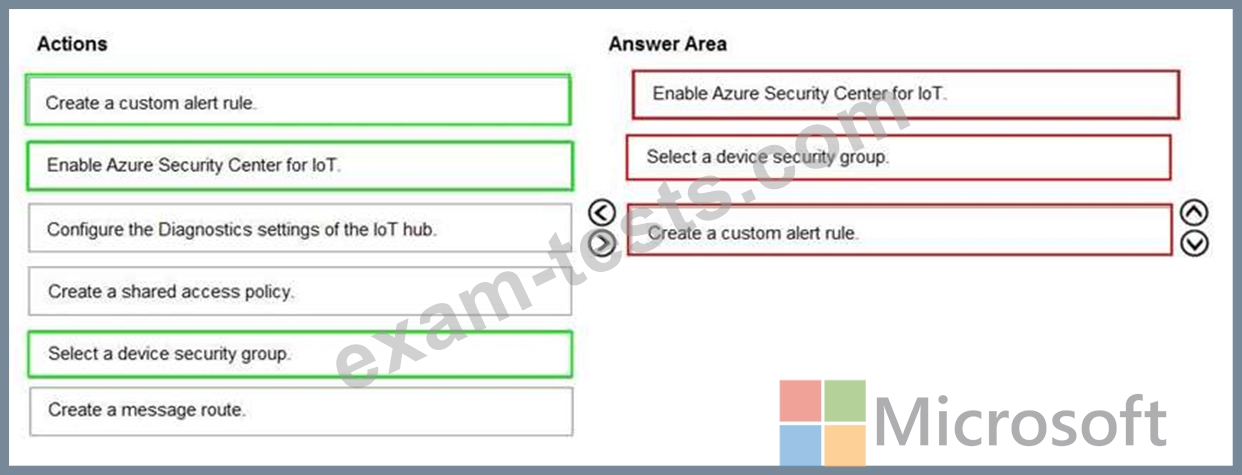
You have 100 devices that connect to an Azure IoT hub.
You need to be notified about failed local logins to a subnet of the devices.
Which three actions should you perform in sequence? To answer, move the appropriate actions from the list of actions to the answer area and arrange them in the correct order.
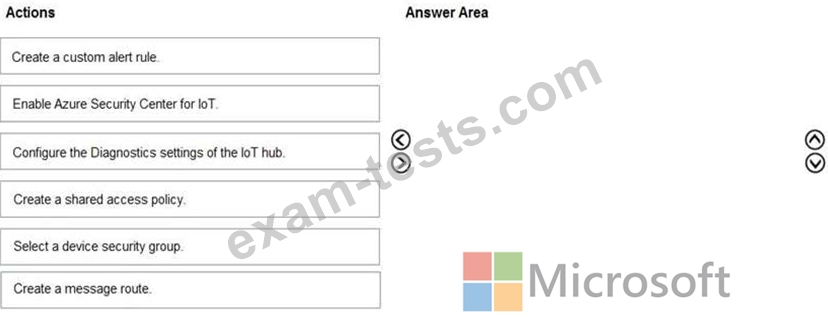
You need to be notified about failed local logins to a subnet of the devices.
Which three actions should you perform in sequence? To answer, move the appropriate actions from the list of actions to the answer area and arrange them in the correct order.
Question 104
You have three Azure IoT hubs named Hub1, Hub2, and Hub3, a Device Provisioning Service instance, and an IoT device named Device1.
Each IoT hub is deployed to a separate Azure region. Device enrollment uses the Lowest latency allocation policy.
The Device Provisioning Service uses the Lowest latency allocation policy. Device1 is auto-provisioned to Hub1 by using the Device Provisioning Service. Device1 regularly moves between regions.
You need to ensure that Device1 always connects to the IoT hub that has the lowest latency. What should you do?
Each IoT hub is deployed to a separate Azure region. Device enrollment uses the Lowest latency allocation policy.
The Device Provisioning Service uses the Lowest latency allocation policy. Device1 is auto-provisioned to Hub1 by using the Device Provisioning Service. Device1 regularly moves between regions.
You need to ensure that Device1 always connects to the IoT hub that has the lowest latency. What should you do?
Question 105
You have an Azure IoT hub and three Azure IoT Edge devices. The device twin code for each device is shown in the following table.

A standard automatic deployment is already applied.
You have three layered deployments. The deployment code for each deployment is shown in the following table.

For each of the following statements, select Yes if the statement is true. Otherwise select No. NOTE: Each correct selection is worth one point.

A standard automatic deployment is already applied.
You have three layered deployments. The deployment code for each deployment is shown in the following table.
For each of the following statements, select Yes if the statement is true. Otherwise select No. NOTE: Each correct selection is worth one point.
