

Question 11
You are securing access to the resources in an Azure subscription.
A new company policy states that all the Azure virtual machines in the subscription must use managed disks.
You need to prevent users from creating virtual machines that use unmanaged disks.
What should you use?
A new company policy states that all the Azure virtual machines in the subscription must use managed disks.
You need to prevent users from creating virtual machines that use unmanaged disks.
What should you use?
Question 12
You have an Azure Active Directory (Azure AD) tenant that contains the users shown in the following table.

The tenant contains the named locations shown in the following table.

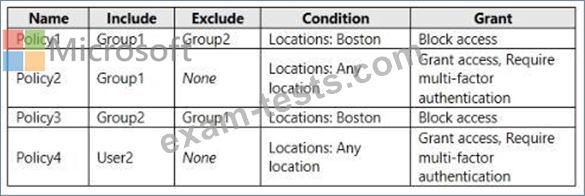
You create the conditional access policies for a cloud app named App1 as shown in the following table.
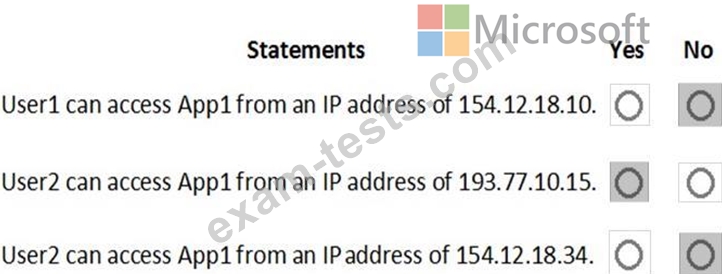
For each of the following statements, select Yes if the statement is true. Otherwise, select No.
NOTE: Each correct selection is worth one point.

The tenant contains the named locations shown in the following table.
You create the conditional access policies for a cloud app named App1 as shown in the following table.
For each of the following statements, select Yes if the statement is true. Otherwise, select No.
NOTE: Each correct selection is worth one point.
Question 13
You have an Azure subscription that contains an Azure SQL database named sql1.
You plan to audit sql1.
You need to configure the audit log destination. The solution must meet the following requirements:
Support querying events by using the Kusto query language.
Minimize administrative effort.
What should you configure?
You plan to audit sql1.
You need to configure the audit log destination. The solution must meet the following requirements:
Support querying events by using the Kusto query language.
Minimize administrative effort.
What should you configure?
Question 14
Note: This question is part of a series of questions that present the same scenario. Each question in the series contains a unique solution that might meet the stated goals. Some question sets might have more than one correct solution, while others might not have a correct solution.
After you answer a question in this section, you will NOT be able to return to it. As a result, these questions will not appear in the review screen.
You have an Azure subscription named Sub1.
You have an Azure Storage account named Sa1 in a resource group named RG1.
Users and applications access the blob service and the file service in Sa1 by using several shared access signatures (SASs) and stored access policies.
You discover that unauthorized users accessed both the file service and the blob service.
You need to revoke all access to Sa1.
Solution: You create a lock on Sa1.
Does this meet the goal?
Question 15
You have the Azure key vaults shown in the following table.

KV1 stores a secret named Secret1 and a key for a managed storage account named Key1.
You back up Secret1 and Key1.
To which key vaults can you restore each backup? To answer, select the appropriate options in the answer area.
NOTE: Each correct selection is worth one point.

KV1 stores a secret named Secret1 and a key for a managed storage account named Key1.
You back up Secret1 and Key1.
To which key vaults can you restore each backup? To answer, select the appropriate options in the answer area.
NOTE: Each correct selection is worth one point.
