Question 86
You have an Azure virtual network named Vnet1 that has one subnet. Vnet1 is in the West Europe Azure region.
You deploy an Azure App Service app named App1 to the West Europe region.
You need to provide App1 with access to the resources in Vnet1. The solution must minimize costs.
What should you do first?
You deploy an Azure App Service app named App1 to the West Europe region.
You need to provide App1 with access to the resources in Vnet1. The solution must minimize costs.
What should you do first?
Question 87
You have an Azure subscription that contains the virtual machines shown in the following table.
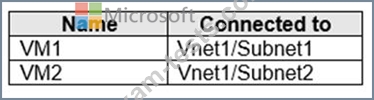
Subnet1 and Subnet2 are associated to a network security group (NSG) named NSG1 that has the following outbound rule:
Priority: 100
Port: Any
Protocol: Any
Source: Any
Destination: Storage
Action: Deny
You create a private endpoint that has the following settings:
Name: Private1
Resource type: Microsoft.Storage/storageAccounts
Resource: storage1
Target sub-resource: blob
Virtual network: Vnet1
Subnet: Subnet1
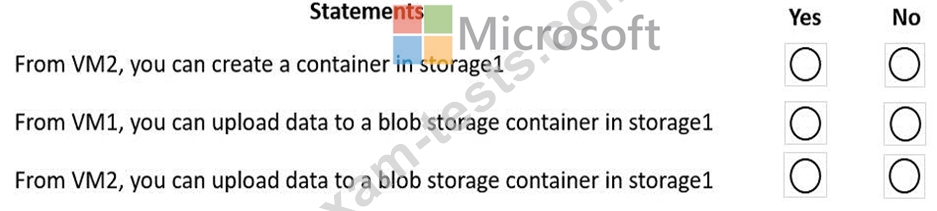
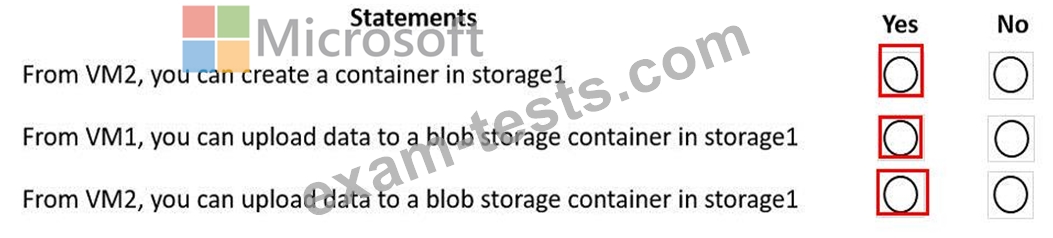
For each of the following statements, select Yes of the statement is true. Otherwise, select No.
NOTE: Each correct selection is worth one point.
Subnet1 and Subnet2 are associated to a network security group (NSG) named NSG1 that has the following outbound rule:
Priority: 100
Port: Any
Protocol: Any
Source: Any
Destination: Storage
Action: Deny
You create a private endpoint that has the following settings:
Name: Private1
Resource type: Microsoft.Storage/storageAccounts
Resource: storage1
Target sub-resource: blob
Virtual network: Vnet1
Subnet: Subnet1
For each of the following statements, select Yes of the statement is true. Otherwise, select No.
NOTE: Each correct selection is worth one point.
Question 88
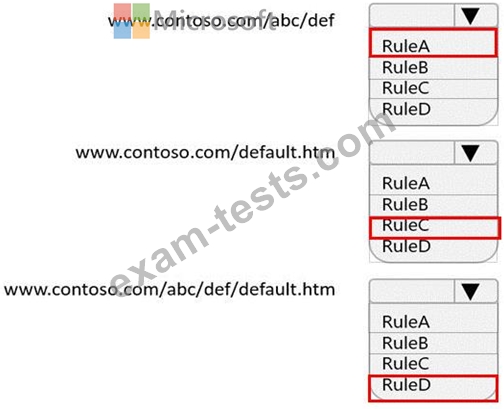
You have an Azure Front Door instance that provides access to a web app. The web app uses a hostname of www.contoso.com.
You have the routing rules shown in the following table.

Which rule will apply to each incoming request? To answer, select the appropriate options in the answer area.
NOTE: Each correct selection is worth one point

You have the routing rules shown in the following table.
Which rule will apply to each incoming request? To answer, select the appropriate options in the answer area.
NOTE: Each correct selection is worth one point
Question 89
Azure virtual networks in the East US Azure region as shown in the following table.

The virtual networks are peered to one another. Each virtual network contains four subnets.
You plan to deploy a virtual machine named VM1 that will inspect and route traffic between all the subnets on both the virtual networks.
What is the minimum number of IP addresses that you must assign to VM1?
The virtual networks are peered to one another. Each virtual network contains four subnets.
You plan to deploy a virtual machine named VM1 that will inspect and route traffic between all the subnets on both the virtual networks.
What is the minimum number of IP addresses that you must assign to VM1?
Question 90
You have two Azure virtual networks named Vnet1 and Vnet2 in an Azure region that has three availability zones.
You deploy 12 virtual machines to each virtual network, deploying four virtual machines per zone. The virtual machines in Vnet1 host an app named App1. The virtual machines in Vnet2 host an app named App2.
You plan to use Azure Virtual Network NAT to implement outbound connectivity for App1 and App2.
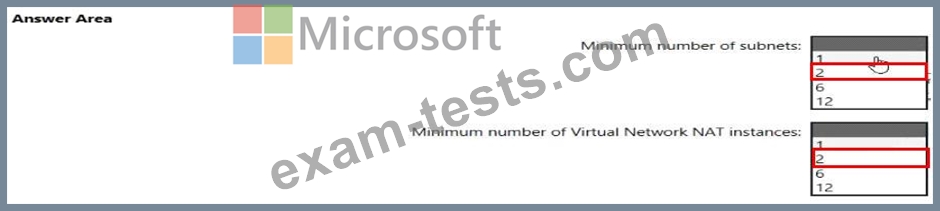
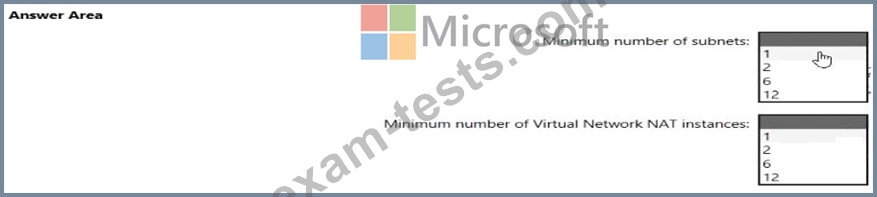
You need to identify the minimum number of subnets and Virtual Network NAT instances required to meet the following requirements:
* A failure of two zones must NOT affect the availability of either App1 or App2.
* A failure of two zones must NOT affect the outbound connectivity of either App1 or App2.
What should you identify? To answer, select the appropriate options in the answer are
a.
NOTE: Each correct selection is worth one point.
You deploy 12 virtual machines to each virtual network, deploying four virtual machines per zone. The virtual machines in Vnet1 host an app named App1. The virtual machines in Vnet2 host an app named App2.
You plan to use Azure Virtual Network NAT to implement outbound connectivity for App1 and App2.
You need to identify the minimum number of subnets and Virtual Network NAT instances required to meet the following requirements:
* A failure of two zones must NOT affect the availability of either App1 or App2.
* A failure of two zones must NOT affect the outbound connectivity of either App1 or App2.
What should you identify? To answer, select the appropriate options in the answer are
a.
NOTE: Each correct selection is worth one point.