

Question 21
You have the hybrid network shown in the Network Diagram exhibit.

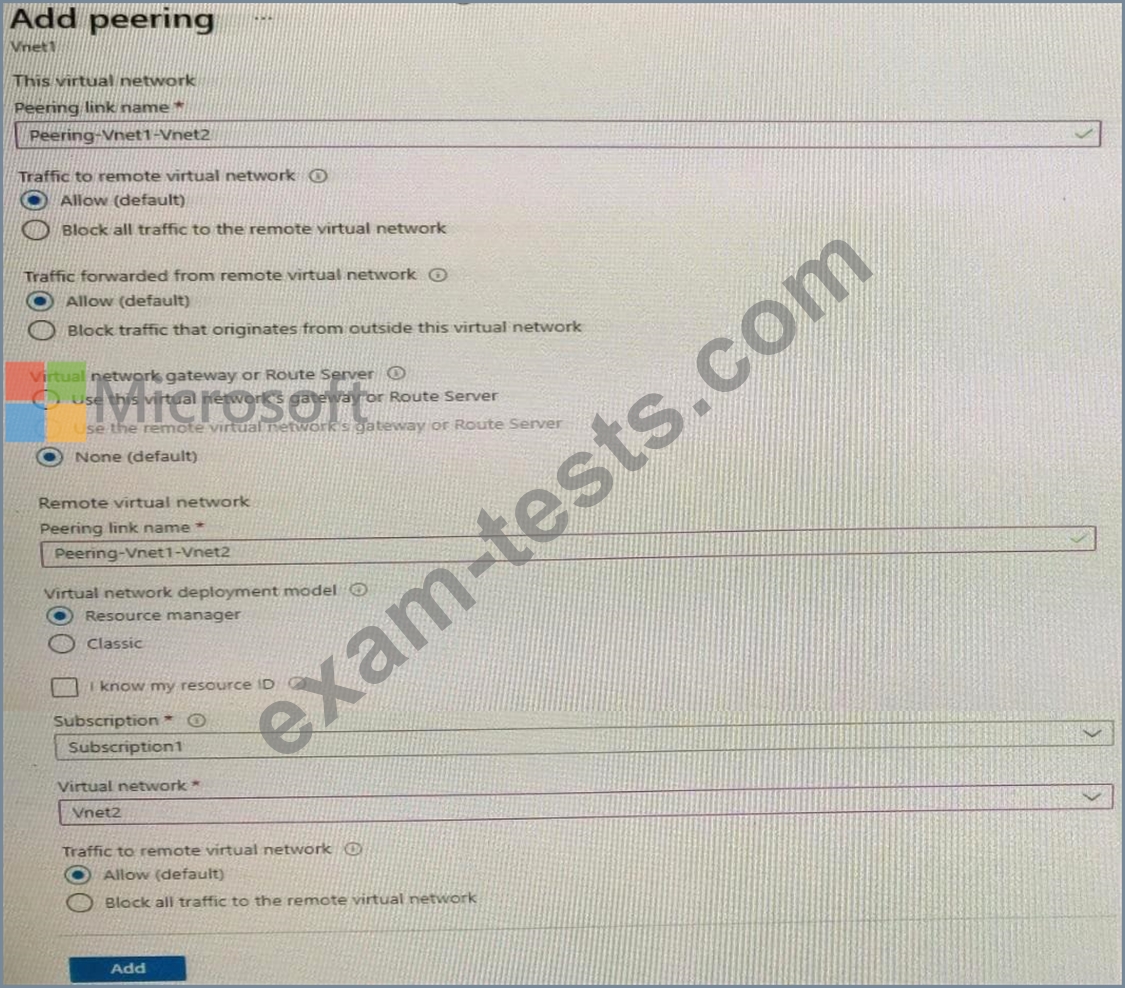
You have a peering connection between Vnet1 and Vnet2 as shown in the Peering-Vnet1-Vnet2 exhibit.
You have a peering connection between Vnet1 and Vnet3 as shown in the Peering -Vnet1-Vnet3 exhibit.

For each of the following statements, select Yes if the statement is true. Otherwise, select No.
NOTE: Each correct selection is worth one point.

You have a peering connection between Vnet1 and Vnet2 as shown in the Peering-Vnet1-Vnet2 exhibit.
You have a peering connection between Vnet1 and Vnet3 as shown in the Peering -Vnet1-Vnet3 exhibit.
For each of the following statements, select Yes if the statement is true. Otherwise, select No.
NOTE: Each correct selection is worth one point.


Question 22
Your company has an Azure virtual network named Vnet1 that uses an IP address space of 192.168.0.0/20.
Vnet1 contains a subnet named Subnet1 that uses an IP address space of 192.168.0.0/24.
You create an IPv6 address range to Vnet1 by using a CIDR suffix of /48.
You need to enable the virtual machines on Subnet1 to communicate with each other by using IPv6 addresses assigned by the company. The solution must minimize the number of additional IPv4 addresses.
What should you do? To answer, select the appropriate options in the answer area.
NOTE: Each correct selection is worth one point.


Question 23
You have the Azure virtual networks shown in the following table.

You have the Azure resources shown in the following table.

You need to check latency between the resources by using connection monitors in Azure Network Watcher.
What is the minimum number of connection monitors that you must create?
You have the Azure resources shown in the following table.
You need to check latency between the resources by using connection monitors in Azure Network Watcher.
What is the minimum number of connection monitors that you must create?
Question 24
You have an Azure application gateway for a web app named App1. The application gateway allows end-to-end encryption.
You configure the listener for HTTPS by uploading an enterprise signed certificate.
You need to ensure that the application gateway can provide end-to-end encryption for App1. What should you do?
You configure the listener for HTTPS by uploading an enterprise signed certificate.
You need to ensure that the application gateway can provide end-to-end encryption for App1. What should you do?
Question 25
You need to configure a security policy. As a process, first you find the name for the resource group containing Front Door profile with the help of Get-AzResourceGroup. Now, which of the following cmdlet would you use to configure a security policy in the identified resource group?