

Question 1
You are developing a new application and are looking for a Jenkins installation to build and deploy your source code. You want to automate the installation as quickly and easily as possible.
What should you do?
What should you do?
Question 2
You are building a pipeline to process time-series dat
a. Which Google Cloud Platform services should you put in boxes 1,2,3, and 4?
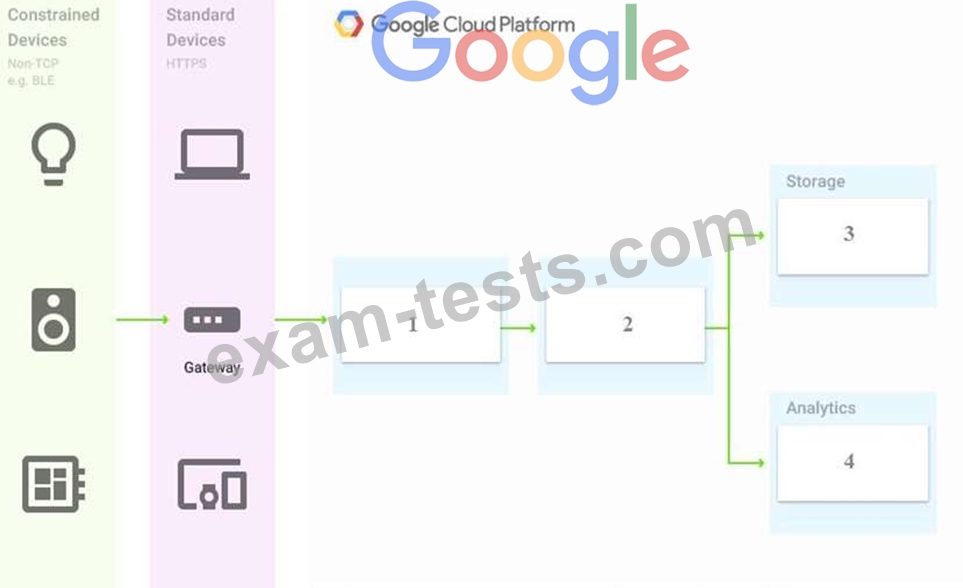
a. Which Google Cloud Platform services should you put in boxes 1,2,3, and 4?
Question 3
You want to run a single caching HTTP reverse proxy on GCP for a latency-sensitive website. This specific reverse proxy consumes almost no CPU.
You want to have a 30-GB in-memory cache, and need an additional 2 GB of memory for the rest of the processes. You want to minimize cost. How should you run this reverse proxy?
You want to have a 30-GB in-memory cache, and need an additional 2 GB of memory for the rest of the processes. You want to minimize cost. How should you run this reverse proxy?
Question 4
A cloud engineer wants to create a VM named whiz-server-1 with four CPUs. Which of the following commands would he use to create the VM whiz-server-1?
Question 5
You are building an application that processes data files uploaded from thousands of suppliers. Your primary goals for the application are data security and the expiration of aged data. You need to design the application to:
* Restrict access so that suppliers can access only their own data.
* Give suppliers write access to data only for 30 minutes.
* Delete data that is over 45 days old.
You have a very short development cycle, and you need to make sure that the application requires minimal maintenance. Which two strategies should you use? (Choose two.)
* Restrict access so that suppliers can access only their own data.
* Give suppliers write access to data only for 30 minutes.
* Delete data that is over 45 days old.
You have a very short development cycle, and you need to make sure that the application requires minimal maintenance. Which two strategies should you use? (Choose two.)