

Question 66
Which of the following would be the most appropriate solution for preventing privacy violations related to information exposure through an error message?
Question 67
SCENARIO
Tom looked forward to starting his new position with a U.S -based automobile leasing company (New Company), now operating in 32 states. New Company was recently formed through the merger of two prominent players, one from the eastern region (East Company) and one from the western region (West Company). Tom, a Certified Information Privacy Technologist (CIPT), is New Company's first Information Privacy and Security Officer. He met today with Dick from East Company, and Harry, from West Company. Dick and Harry are veteran senior information privacy and security professionals at their respective companies, and continue to lead the east and west divisions of New Company. The purpose of the meeting was to conduct a SWOT (strengths/weaknesses/opportunities/threats) analysis for New Company. Their SWOT analysis conclusions are summarized below.
Dick was enthusiastic about an opportunity for the New Company to reduce costs and increase computing power and flexibility through cloud services. East Company had been contemplating moving to the cloud, but West Company already had a vendor that was providing it with software-as-a-service (SaaS). Dick was looking forward to extending this service to the eastern region. Harry noted that this was a threat as well, because West Company had to rely on the third party to protect its data.
Tom mentioned that neither of the legacy companies had sufficient data storage space to meet the projected growth of New Company, which he saw as a weakness. Tom stated that one of the team's first projects would be to construct a consolidated New Company data warehouse. Tom would personally lead this project and would be held accountable if information was modified during transmission to or during storage in the new data warehouse.
Tom, Dick and Harry agreed that employee network access could be considered both a strength and a weakness. East Company and West Company had strong performance records in this regard; both had robust network access controls that were working as designed. However, during a projected year-long transition period, New Company employees would need to be able to connect to a New Company network while retaining access to the East Company and West Company networks.
Which statement is correct about addressing New Company stakeholders' expectations for privacy?
Tom looked forward to starting his new position with a U.S -based automobile leasing company (New Company), now operating in 32 states. New Company was recently formed through the merger of two prominent players, one from the eastern region (East Company) and one from the western region (West Company). Tom, a Certified Information Privacy Technologist (CIPT), is New Company's first Information Privacy and Security Officer. He met today with Dick from East Company, and Harry, from West Company. Dick and Harry are veteran senior information privacy and security professionals at their respective companies, and continue to lead the east and west divisions of New Company. The purpose of the meeting was to conduct a SWOT (strengths/weaknesses/opportunities/threats) analysis for New Company. Their SWOT analysis conclusions are summarized below.
Dick was enthusiastic about an opportunity for the New Company to reduce costs and increase computing power and flexibility through cloud services. East Company had been contemplating moving to the cloud, but West Company already had a vendor that was providing it with software-as-a-service (SaaS). Dick was looking forward to extending this service to the eastern region. Harry noted that this was a threat as well, because West Company had to rely on the third party to protect its data.
Tom mentioned that neither of the legacy companies had sufficient data storage space to meet the projected growth of New Company, which he saw as a weakness. Tom stated that one of the team's first projects would be to construct a consolidated New Company data warehouse. Tom would personally lead this project and would be held accountable if information was modified during transmission to or during storage in the new data warehouse.
Tom, Dick and Harry agreed that employee network access could be considered both a strength and a weakness. East Company and West Company had strong performance records in this regard; both had robust network access controls that were working as designed. However, during a projected year-long transition period, New Company employees would need to be able to connect to a New Company network while retaining access to the East Company and West Company networks.
Which statement is correct about addressing New Company stakeholders' expectations for privacy?
Question 68
Which of the following is considered a client-side IT risk?
Question 69
SCENARIO
Clean-Q is a company that offers house-hold and office cleaning services. The company receives requests from consumers via their website and telephone, to book cleaning services. Based on the type and size of service, Clean-Q then contracts individuals that are registered on its resource database - currently managed in-house by Clean-Q IT Support. Because of Clean-Q's business model, resources are contracted as needed instead of permanently employed.
The table below indicates some of the personal information Clean-Q requires as part of its business operations:
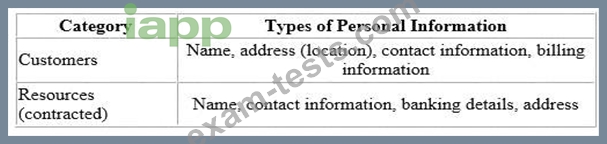
Clean-Q has an internal employee base of about 30 people. A recent privacy compliance exercise has been conducted to align employee data management and human resource functions with applicable data protection regulation. Therefore, the Clean-Q permanent employee base is not included as part of this scenario.
With an increase in construction work and housing developments, Clean-Q has had an influx of requests for cleaning services. The demand has overwhelmed Clean-Q's traditional supply and demand system that has caused some overlapping bookings.
Ina business strategy session held by senior management recently, Clear-Q invited vendors to present potential solutions to their current operational issues. These vendors included Application developers and Cloud-Q's solution providers, presenting their proposed solutions and platforms.
The Managing Director opted to initiate the process to integrate Clean-Q's operations with a cloud solution (LeadOps) that will provide the following solution one single online platform: A web interface that Clean-Q accesses for the purposes of resource and customer management. This would entail uploading resource and customer information.
* A customer facing web interface that enables customers to register, manage and submit cleaning service requests online.
* A resource facing web interface that enables resources to apply and manage their assigned jobs.
* An online payment facility for customers to pay for services.
Considering that LeadOps will host/process personal information on behalf of Clean-Q remotely, what is an appropriate next step for Clean-Q senior management to assess LeadOps' appropriateness?
Clean-Q is a company that offers house-hold and office cleaning services. The company receives requests from consumers via their website and telephone, to book cleaning services. Based on the type and size of service, Clean-Q then contracts individuals that are registered on its resource database - currently managed in-house by Clean-Q IT Support. Because of Clean-Q's business model, resources are contracted as needed instead of permanently employed.
The table below indicates some of the personal information Clean-Q requires as part of its business operations:
Clean-Q has an internal employee base of about 30 people. A recent privacy compliance exercise has been conducted to align employee data management and human resource functions with applicable data protection regulation. Therefore, the Clean-Q permanent employee base is not included as part of this scenario.
With an increase in construction work and housing developments, Clean-Q has had an influx of requests for cleaning services. The demand has overwhelmed Clean-Q's traditional supply and demand system that has caused some overlapping bookings.
Ina business strategy session held by senior management recently, Clear-Q invited vendors to present potential solutions to their current operational issues. These vendors included Application developers and Cloud-Q's solution providers, presenting their proposed solutions and platforms.
The Managing Director opted to initiate the process to integrate Clean-Q's operations with a cloud solution (LeadOps) that will provide the following solution one single online platform: A web interface that Clean-Q accesses for the purposes of resource and customer management. This would entail uploading resource and customer information.
* A customer facing web interface that enables customers to register, manage and submit cleaning service requests online.
* A resource facing web interface that enables resources to apply and manage their assigned jobs.
* An online payment facility for customers to pay for services.
Considering that LeadOps will host/process personal information on behalf of Clean-Q remotely, what is an appropriate next step for Clean-Q senior management to assess LeadOps' appropriateness?
Question 70
SCENARIO - Please use the following to answer the next question:
Looking back at your first two years as the Director of Personal Information Protection and Compliance for the Berry Country Regional Medical Center in Thorn Bay, Ontario, Canada, you see a parade of accomplishments, from developing state-of-the-art simulation based training for employees on privacy protection to establishing an interactive medical records system that is accessible by patients as well as by the medical personnel. Now, however, a question you have put off looms large: how do we manage all the data-not only records produced recently, but those still on hand from years ago? A data flow diagram generated last year shows multiple servers, databases, and work stations, many of which hold files that have not yet been incorporated into the new records system. While most of this data is encrypted, its persistence may pose security and compliance concerns. The situation is further complicated by several long-term studies being conducted by the medical staff using patient information. Having recently reviewed the major Canadian privacy regulations, you want to make certain that the medical center is observing them.
SCENARIO - Please use the following to answer the next question:
Looking back at your first two years as the Director of Personal Information Protection and Compliance for the Berry Country Regional Medical Center in Thorn Bay, Ontario, Canada, you see a parade of accomplishments, from developing state-of-the-art simulation based training for employees on privacy protection to establishing an interactive medical records system that is accessible by patients as well as by the medical personnel. Now, however, a question you have put off looms large: how do we manage all the data-not only records produced recently, but those still on hand from years ago? A data flow diagram generated last year shows multiple servers, databases, and work stations, many of which hold files that have not yet been incorporated into the new records system. While most of this data is encrypted, its persistence may pose security and compliance concerns. The situation is further complicated by several long-term studies being conducted by the medical staff using patient information. Having recently reviewed the major Canadian privacy regulations, you want to make certain that the medical center is observing them.
You also recall a recent visit to the Records Storage Section, often termed :The Dungeon" in the basement of the old hospital next to the modern facility, where you noticed a multitude of paper records. Some of these were in crates marked by years, medical condition or alphabetically by patient name, while others were in undifferentiated bundles on shelves and on the floor. The back shelves of the section housed data tapes and old hard drives that were often unlabeled but appeared to be years old. On your way out of the dungeon, you noticed just ahead of you a small man in a lab coat who you did not recognize. He carried a batch of folders under his arm, apparently records he had removed from storage.
Which regulation most likely applies to the data stored by Berry Country Regional Medical Center?
Looking back at your first two years as the Director of Personal Information Protection and Compliance for the Berry Country Regional Medical Center in Thorn Bay, Ontario, Canada, you see a parade of accomplishments, from developing state-of-the-art simulation based training for employees on privacy protection to establishing an interactive medical records system that is accessible by patients as well as by the medical personnel. Now, however, a question you have put off looms large: how do we manage all the data-not only records produced recently, but those still on hand from years ago? A data flow diagram generated last year shows multiple servers, databases, and work stations, many of which hold files that have not yet been incorporated into the new records system. While most of this data is encrypted, its persistence may pose security and compliance concerns. The situation is further complicated by several long-term studies being conducted by the medical staff using patient information. Having recently reviewed the major Canadian privacy regulations, you want to make certain that the medical center is observing them.
SCENARIO - Please use the following to answer the next question:
Looking back at your first two years as the Director of Personal Information Protection and Compliance for the Berry Country Regional Medical Center in Thorn Bay, Ontario, Canada, you see a parade of accomplishments, from developing state-of-the-art simulation based training for employees on privacy protection to establishing an interactive medical records system that is accessible by patients as well as by the medical personnel. Now, however, a question you have put off looms large: how do we manage all the data-not only records produced recently, but those still on hand from years ago? A data flow diagram generated last year shows multiple servers, databases, and work stations, many of which hold files that have not yet been incorporated into the new records system. While most of this data is encrypted, its persistence may pose security and compliance concerns. The situation is further complicated by several long-term studies being conducted by the medical staff using patient information. Having recently reviewed the major Canadian privacy regulations, you want to make certain that the medical center is observing them.
You also recall a recent visit to the Records Storage Section, often termed :The Dungeon" in the basement of the old hospital next to the modern facility, where you noticed a multitude of paper records. Some of these were in crates marked by years, medical condition or alphabetically by patient name, while others were in undifferentiated bundles on shelves and on the floor. The back shelves of the section housed data tapes and old hard drives that were often unlabeled but appeared to be years old. On your way out of the dungeon, you noticed just ahead of you a small man in a lab coat who you did not recognize. He carried a batch of folders under his arm, apparently records he had removed from storage.
Which regulation most likely applies to the data stored by Berry Country Regional Medical Center?