

Question 76
A credit card with the last few numbers visible is an example of what?
Question 77
SCENARIO
Carol was a U.S.-based glassmaker who sold her work at art festivals. She kept things simple by only accepting cash and personal checks.
As business grew, Carol couldn't keep up with demand, and traveling to festivals became burdensome. Carol opened a small boutique and hired Sam to run it while she worked in the studio. Sam was a natural salesperson, and business doubled. Carol told Sam, "I don't know what you are doing, but keep doing it!" But months later, the gift shop was in chaos. Carol realized that Sam needed help so she hired Jane, who had business expertise and could handle the back-office tasks. Sam would continue to focus on sales. Carol gave Jane a few weeks to get acquainted with the artisan craft business, and then scheduled a meeting for the three of them to discuss Jane's first impressions.
At the meeting, Carol could not wait to hear Jane's thoughts, but she was unprepared for what Jane had to say.
"Carol, I know that he doesn't realize it, but some of Sam's efforts to increase sales have put you in a vulnerable position. You are not protecting customers' personal information like you should." Sam said, "I am protecting our information. I keep it in the safe with our bank deposit. It's only a list of customers' names, addresses and phone numbers that I get from their checks before I deposit them. I contact them when you finish a piece that I think they would like. That's the only information I have! The only other thing I do is post photos and information about your work on the photo sharing site that I use with family and friends. I provide my email address and people send me their information if they want to see more of your work. Posting online really helps sales, Carol. In fact, the only complaint I hear is about having to come into the shop to make a purchase." Carol replied, "Jane, that doesn't sound so bad. Could you just fix things and help us to post even more online?"
'I can," said Jane. "But it's not quite that simple. I need to set up a new program to make sure that we follow the best practices in data management. And I am concerned for our customers. They should be able to manage how we use their personal information. We also should develop a social media strategy." Sam and Jane worked hard during the following year. One of the decisions they made was to contract with an outside vendor to manage online sales. At the end of the year, Carol shared some exciting news. "Sam and Jane, you have done such a great job that one of the biggest names in the glass business wants to buy us out!
And Jane, they want to talk to you about merging all of our customer and vendor information with theirs beforehand." When initially collecting personal information from customers, what should Jane be guided by?
Carol was a U.S.-based glassmaker who sold her work at art festivals. She kept things simple by only accepting cash and personal checks.
As business grew, Carol couldn't keep up with demand, and traveling to festivals became burdensome. Carol opened a small boutique and hired Sam to run it while she worked in the studio. Sam was a natural salesperson, and business doubled. Carol told Sam, "I don't know what you are doing, but keep doing it!" But months later, the gift shop was in chaos. Carol realized that Sam needed help so she hired Jane, who had business expertise and could handle the back-office tasks. Sam would continue to focus on sales. Carol gave Jane a few weeks to get acquainted with the artisan craft business, and then scheduled a meeting for the three of them to discuss Jane's first impressions.
At the meeting, Carol could not wait to hear Jane's thoughts, but she was unprepared for what Jane had to say.
"Carol, I know that he doesn't realize it, but some of Sam's efforts to increase sales have put you in a vulnerable position. You are not protecting customers' personal information like you should." Sam said, "I am protecting our information. I keep it in the safe with our bank deposit. It's only a list of customers' names, addresses and phone numbers that I get from their checks before I deposit them. I contact them when you finish a piece that I think they would like. That's the only information I have! The only other thing I do is post photos and information about your work on the photo sharing site that I use with family and friends. I provide my email address and people send me their information if they want to see more of your work. Posting online really helps sales, Carol. In fact, the only complaint I hear is about having to come into the shop to make a purchase." Carol replied, "Jane, that doesn't sound so bad. Could you just fix things and help us to post even more online?"
'I can," said Jane. "But it's not quite that simple. I need to set up a new program to make sure that we follow the best practices in data management. And I am concerned for our customers. They should be able to manage how we use their personal information. We also should develop a social media strategy." Sam and Jane worked hard during the following year. One of the decisions they made was to contract with an outside vendor to manage online sales. At the end of the year, Carol shared some exciting news. "Sam and Jane, you have done such a great job that one of the biggest names in the glass business wants to buy us out!
And Jane, they want to talk to you about merging all of our customer and vendor information with theirs beforehand." When initially collecting personal information from customers, what should Jane be guided by?
Question 78
SCENARIO - Please use the following to answer the next question:
Clean-Q is a company that offers house-hold and office cleaning services. The company receives requests from consumers via their website and telephor, to book cleaning services. Based on the type and size of service, Clean-Q then contracts individuals that are registered on its resource database - currently managed in-house by Clean-Q IT Support. Because of Clean-Q:s business.
model, resources are contracted as needed instead of permanently employed.
The table below indicates some of the personal information Clean-Q requires as part of its business operations:

Clean-Q has an internal employee base of about 30 people. A recent privacy compliance exercise has been conducted to align employee data management and human resource functions with applicable data protection regulation.
Therefore, the Clean-Q permanent employee base is not included as part of this scenario.
With an increase in construction work and housing developments, Clean-Q has had an influx of requests for cleaning services. The demand has overwhelmed Clean-Q:s traditional supply and demand system that has caused some overlapping bookings.
In a business statrategy session held by senior management recently, Clearning invited vendors to present potential solutions to their current operational issues. These vendors includes included Application development and Cloud solution providers, presenting their proposed solution and platforms.
The Managing Direct opted to initiate the process to integrate Clean-Q's operations with a cloud solution (LeadOps) that will provide the following solution one single online platform. A web interface that Clean-Q accesses for the purposes of resource and customer management. This would entail uploading resource and customer information.
A customer facing web interface that enables customers to register, manage and submit cleaning service requests online.
A resource facing web interface that enables resources to apply and manage their assigned jobs.
An online payment facility for customer to pay for services.
What is a key consideration for assessing external service providers like LeadOps, which will conduct personal information processing operations on Clean-Q:s behalf?
Clean-Q is a company that offers house-hold and office cleaning services. The company receives requests from consumers via their website and telephor, to book cleaning services. Based on the type and size of service, Clean-Q then contracts individuals that are registered on its resource database - currently managed in-house by Clean-Q IT Support. Because of Clean-Q:s business.
model, resources are contracted as needed instead of permanently employed.
The table below indicates some of the personal information Clean-Q requires as part of its business operations:
Clean-Q has an internal employee base of about 30 people. A recent privacy compliance exercise has been conducted to align employee data management and human resource functions with applicable data protection regulation.
Therefore, the Clean-Q permanent employee base is not included as part of this scenario.
With an increase in construction work and housing developments, Clean-Q has had an influx of requests for cleaning services. The demand has overwhelmed Clean-Q:s traditional supply and demand system that has caused some overlapping bookings.
In a business statrategy session held by senior management recently, Clearning invited vendors to present potential solutions to their current operational issues. These vendors includes included Application development and Cloud solution providers, presenting their proposed solution and platforms.
The Managing Direct opted to initiate the process to integrate Clean-Q's operations with a cloud solution (LeadOps) that will provide the following solution one single online platform. A web interface that Clean-Q accesses for the purposes of resource and customer management. This would entail uploading resource and customer information.
A customer facing web interface that enables customers to register, manage and submit cleaning service requests online.
A resource facing web interface that enables resources to apply and manage their assigned jobs.
An online payment facility for customer to pay for services.
What is a key consideration for assessing external service providers like LeadOps, which will conduct personal information processing operations on Clean-Q:s behalf?
Question 79
SCENARIO
Please use the following to answer the next question:
Jordan just joined a fitness-tracker start-up based in California, USA, as its first Information Privacy and Security Officer. The company is quickly growing its business but does not sell any of the fitness trackers itself. Instead, it relies on a distribution network of third-party retailers in all major countries. Despite not having any stores, the company has a 78% market share in the EU. It has a website presenting the company and products, and a member section where customers can access their information. Only the email address and physical address need to be provided as part of the registration process in order to customize the site to the user's region and country. There is also a newsletter sent every month to all members featuring fitness tips, nutrition advice, product spotlights from partner companies based on user behavior and preferences.
Jordan says the General Data Protection Regulation (GDPR) does not apply to the company. He says the company is not established in the EU, nor does it have a processor in the region. Furthermore, it does not do any "offering goods or services" in the EU since it does not do any marketing there, nor sell to consumers directly. Jordan argues that it is the customers who chose to buy the products on their own initiative and there is no "offering" from the company.
The fitness trackers incorporate advanced features such as sleep tracking, GPS tracking, heart rate monitoring. wireless syncing, calorie-counting and step-tracking. The watch must be paired with either a smartphone or a computer in order to collect data on sleep levels, heart rates, etc. All information from the device must be sent to the company's servers in order to be processed, and then the results are sent to the smartphone or computer. Jordan argues that there is no personal information involved since the company does not collect banking or social security information.
Why is Jordan's claim that the company does not collect personal information as identified by the GDPR inaccurate?
Please use the following to answer the next question:
Jordan just joined a fitness-tracker start-up based in California, USA, as its first Information Privacy and Security Officer. The company is quickly growing its business but does not sell any of the fitness trackers itself. Instead, it relies on a distribution network of third-party retailers in all major countries. Despite not having any stores, the company has a 78% market share in the EU. It has a website presenting the company and products, and a member section where customers can access their information. Only the email address and physical address need to be provided as part of the registration process in order to customize the site to the user's region and country. There is also a newsletter sent every month to all members featuring fitness tips, nutrition advice, product spotlights from partner companies based on user behavior and preferences.
Jordan says the General Data Protection Regulation (GDPR) does not apply to the company. He says the company is not established in the EU, nor does it have a processor in the region. Furthermore, it does not do any "offering goods or services" in the EU since it does not do any marketing there, nor sell to consumers directly. Jordan argues that it is the customers who chose to buy the products on their own initiative and there is no "offering" from the company.
The fitness trackers incorporate advanced features such as sleep tracking, GPS tracking, heart rate monitoring. wireless syncing, calorie-counting and step-tracking. The watch must be paired with either a smartphone or a computer in order to collect data on sleep levels, heart rates, etc. All information from the device must be sent to the company's servers in order to be processed, and then the results are sent to the smartphone or computer. Jordan argues that there is no personal information involved since the company does not collect banking or social security information.
Why is Jordan's claim that the company does not collect personal information as identified by the GDPR inaccurate?
Question 80
SCENARIO
Clean-Q is a company that offers house-hold and office cleaning services. The company receives requests from consumers via their website and telephone, to book cleaning services. Based on the type and size of service, Clean-Q then contracts individuals that are registered on its resource database - currently managed in-house by Clean-Q IT Support. Because of Clean-Q's business model, resources are contracted as needed instead of permanently employed.
The table below indicates some of the personal information Clean-Q requires as part of its business operations:
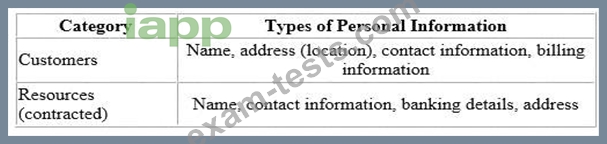
Clean-Q has an internal employee base of about 30 people. A recent privacy compliance exercise has been conducted to align employee data management and human resource functions with applicable data protection regulation. Therefore, the Clean-Q permanent employee base is not included as part of this scenario.
With an increase in construction work and housing developments, Clean-Q has had an influx of requests for cleaning services. The demand has overwhelmed Clean-Q's traditional supply and demand system that has caused some overlapping bookings.
Ina business strategy session held by senior management recently, Clear-Q invited vendors to present potential solutions to their current operational issues. These vendors included Application developers and Cloud-Q's solution providers, presenting their proposed solutions and platforms.
The Managing Director opted to initiate the process to integrate Clean-Q's operations with a cloud solution (LeadOps) that will provide the following solution one single online platform: A web interface that Clean-Q accesses for the purposes of resource and customer management. This would entail uploading resource and customer information.
* A customer facing web interface that enables customers to register, manage and submit cleaning service requests online.
* A resource facing web interface that enables resources to apply and manage their assigned jobs.
* An online payment facility for customers to pay for services.
If Clean-Q were to utilize LeadOps' services, what is a contract clause that may be included in the agreement entered into with LeadOps?
Clean-Q is a company that offers house-hold and office cleaning services. The company receives requests from consumers via their website and telephone, to book cleaning services. Based on the type and size of service, Clean-Q then contracts individuals that are registered on its resource database - currently managed in-house by Clean-Q IT Support. Because of Clean-Q's business model, resources are contracted as needed instead of permanently employed.
The table below indicates some of the personal information Clean-Q requires as part of its business operations:
Clean-Q has an internal employee base of about 30 people. A recent privacy compliance exercise has been conducted to align employee data management and human resource functions with applicable data protection regulation. Therefore, the Clean-Q permanent employee base is not included as part of this scenario.
With an increase in construction work and housing developments, Clean-Q has had an influx of requests for cleaning services. The demand has overwhelmed Clean-Q's traditional supply and demand system that has caused some overlapping bookings.
Ina business strategy session held by senior management recently, Clear-Q invited vendors to present potential solutions to their current operational issues. These vendors included Application developers and Cloud-Q's solution providers, presenting their proposed solutions and platforms.
The Managing Director opted to initiate the process to integrate Clean-Q's operations with a cloud solution (LeadOps) that will provide the following solution one single online platform: A web interface that Clean-Q accesses for the purposes of resource and customer management. This would entail uploading resource and customer information.
* A customer facing web interface that enables customers to register, manage and submit cleaning service requests online.
* A resource facing web interface that enables resources to apply and manage their assigned jobs.
* An online payment facility for customers to pay for services.
If Clean-Q were to utilize LeadOps' services, what is a contract clause that may be included in the agreement entered into with LeadOps?