
- Home
- ISACA Certification
- CISA Exam
- ISACA.CISA.v2026-09-24.q827 Practice Test

Question 321
Which of the following testing method examines internal structure or working of an application?
Correct Answer: A
Explanation/Reference:
White-box testing (also known as clear box testing, glass box testing, transparent box testing, and structural testing) is a method of testing software that tests internal structures or workings of an application, as opposed to its functionality (i.e. black-box testing). In white-box testing an internal perspective of the system, as well as programming skills, are used to design test cases. The tester chooses inputs to exercise paths through the code and determine the appropriate outputs. This is analogous to testing nodes in a circuit, e.g. in-circuit testing (ICT).
White-box testing can be applied at the unit, integration and system levels of the software testing process.
Although traditional testers tended to think of white-box testing as being done at the unit level, it is used for integration and system testing more frequently today. It can test paths within a unit, paths between units during integration, and between subsystems during a system-level test. Though this method of test design can uncover many errors or problems, it has the potential to miss unimplemented parts of the specification or missing requirements.
For your exam you should know the information below:
Alpha and Beta Testing - An alpha version is early version is an early version of the application system submitted to the internal user for testing. The alpha version may not contain all the features planned for the final version. Typically, software goes to two stages testing before it consider finished. The first stage is called alpha testing is often performed only by the user within the organization developing the software.
The second stage is called beta testing, a form of user acceptance testing, generally involves a limited number of external users. Beta testing is the last stage of testing, and normally involves real world exposure, sending the beta version of the product to independent beta test sites or offering it free to interested user.
Pilot Testing -A preliminary test that focuses on specific and predefined aspect of a system. It is not meant to replace other testing methods, but rather to provide a limited evaluation of the system. Proof of concept are early pilot tests - usually over interim platform and with only basic functionalities.
White box testing - Assess the effectiveness of a software program logic. Specifically, test data are used in determining procedural accuracy or conditions of a program's specific logic path. However, testing all possible logical path in large information system is not feasible and would be cost prohibitive, and therefore is used on selective basis only.
Black Box Testing - An integrity based form of testing associated with testing components of an information system's "functional" operating effectiveness without regards to any specific internal program structure. Applicable to integration and user acceptance testing.
Function/validation testing - It is similar to system testing but it is often used to test the functionality of the system against the detailed requirements to ensure that the software that has been built is traceable to customer requirements.
Regression Testing -The process of rerunning a portion of a test scenario or test plan to ensure that changes or corrections have not introduced new errors. The data used in regression testing should be same as original data.
Parallel Testing - This is the process of feeding test data into two systems - the modified system and an alternative system and comparing the result.
Sociability Testing -The purpose of these tests is to confirm that new or modified system can operate in its target environment without adversely impacting existing system. This should cover not only platform that will perform primary application processing and interface with other system but, in a client server and web development, changes to the desktop environment. Multiple application may run on the user's desktop, potentially simultaneously, so it is important to test the impact of installing new dynamic link libraries (DLLs), making operating system registry or configuration file modification, and possibly extra memory utilization.
The following answers are incorrect:
Parallel Testing - This is the process of feeding test data into two systems - the modified system and an alternative system and comparing the result.
Regression Testing -The process of rerunning a portion of a test scenario or test plan to ensure that changes or corrections have not introduced new errors. The data used in regression testing should be same as original data.
Pilot Testing -A preliminary test that focuses on specific and predefined aspect of a system. It is not meant to replace other testing methods, but rather to provide a limited evaluation of the system. Proof of concept are early pilot tests - usually over interim platform and with only basic functionalities The following reference(s) were/was used to create this question:
CISA review manual 2014 Page number 167
Official ISC2 guide to CISSP CBK 3rd Edition Page number 176
White-box testing (also known as clear box testing, glass box testing, transparent box testing, and structural testing) is a method of testing software that tests internal structures or workings of an application, as opposed to its functionality (i.e. black-box testing). In white-box testing an internal perspective of the system, as well as programming skills, are used to design test cases. The tester chooses inputs to exercise paths through the code and determine the appropriate outputs. This is analogous to testing nodes in a circuit, e.g. in-circuit testing (ICT).
White-box testing can be applied at the unit, integration and system levels of the software testing process.
Although traditional testers tended to think of white-box testing as being done at the unit level, it is used for integration and system testing more frequently today. It can test paths within a unit, paths between units during integration, and between subsystems during a system-level test. Though this method of test design can uncover many errors or problems, it has the potential to miss unimplemented parts of the specification or missing requirements.
For your exam you should know the information below:
Alpha and Beta Testing - An alpha version is early version is an early version of the application system submitted to the internal user for testing. The alpha version may not contain all the features planned for the final version. Typically, software goes to two stages testing before it consider finished. The first stage is called alpha testing is often performed only by the user within the organization developing the software.
The second stage is called beta testing, a form of user acceptance testing, generally involves a limited number of external users. Beta testing is the last stage of testing, and normally involves real world exposure, sending the beta version of the product to independent beta test sites or offering it free to interested user.
Pilot Testing -A preliminary test that focuses on specific and predefined aspect of a system. It is not meant to replace other testing methods, but rather to provide a limited evaluation of the system. Proof of concept are early pilot tests - usually over interim platform and with only basic functionalities.
White box testing - Assess the effectiveness of a software program logic. Specifically, test data are used in determining procedural accuracy or conditions of a program's specific logic path. However, testing all possible logical path in large information system is not feasible and would be cost prohibitive, and therefore is used on selective basis only.
Black Box Testing - An integrity based form of testing associated with testing components of an information system's "functional" operating effectiveness without regards to any specific internal program structure. Applicable to integration and user acceptance testing.
Function/validation testing - It is similar to system testing but it is often used to test the functionality of the system against the detailed requirements to ensure that the software that has been built is traceable to customer requirements.
Regression Testing -The process of rerunning a portion of a test scenario or test plan to ensure that changes or corrections have not introduced new errors. The data used in regression testing should be same as original data.
Parallel Testing - This is the process of feeding test data into two systems - the modified system and an alternative system and comparing the result.
Sociability Testing -The purpose of these tests is to confirm that new or modified system can operate in its target environment without adversely impacting existing system. This should cover not only platform that will perform primary application processing and interface with other system but, in a client server and web development, changes to the desktop environment. Multiple application may run on the user's desktop, potentially simultaneously, so it is important to test the impact of installing new dynamic link libraries (DLLs), making operating system registry or configuration file modification, and possibly extra memory utilization.
The following answers are incorrect:
Parallel Testing - This is the process of feeding test data into two systems - the modified system and an alternative system and comparing the result.
Regression Testing -The process of rerunning a portion of a test scenario or test plan to ensure that changes or corrections have not introduced new errors. The data used in regression testing should be same as original data.
Pilot Testing -A preliminary test that focuses on specific and predefined aspect of a system. It is not meant to replace other testing methods, but rather to provide a limited evaluation of the system. Proof of concept are early pilot tests - usually over interim platform and with only basic functionalities The following reference(s) were/was used to create this question:
CISA review manual 2014 Page number 167
Official ISC2 guide to CISSP CBK 3rd Edition Page number 176
Question 322
Which of the following technique is used for speeding up network traffic flow and making it easier to manage?
Correct Answer: C
Explanation/Reference:
Multiprotocol Label Switching (MPLS) is a standards-approved technology for speeding up network traffic flow and making it easier to manage. MPLS involves setting up a specific path for a given sequence of packets, identified by a label put in each packet, thus saving the time needed for a router to look up the address to the next node to forward the packet to. MPLS is called multiprotocol because it works with the Internet Protocol (IP), Asynchronous Transport Mode (ATM), and frame relay network protocols. With reference to the standard model for a network (the Open Systems Interconnection, or OSI model), MPLS allows most packets to be forwarded at the Layer 2 (switching) level rather than at the Layer 3 (routing) level. In addition to moving traffic faster overall, MPLS makes it easy to manage a network for quality of service (QoS). For these reasons, the technique is expected to be readily adopted as networks begin to carry more and different mixtures of traffic.
For your exam you should know below information about WAN Technologies:
Point-to-point protocol
PPP (Point-to-Point Protocol) is a protocol for communication between two computers using a serial interface, typically a personal computer connected by phone line to a server. For example, your Internet server provider may provide you with a PPP connection so that the provider's server can respond to your requests, pass them on to the Internet, and forward your requested Internet responses back to you. PPP uses the Internet protocol (IP) (and is designed to handle others). It is sometimes considered a member of the TCP/IP suite of protocols. Relative to the Open Systems Interconnection (OSI) reference model, PPP provides layer 2 (data-link layer) service. Essentially, it packages your computer's TCP/IP packets and forwards them to the server where they can actually be put on the Internet.
PPP is a full-duplex protocol that can be used on various physical media, including twisted pair or fiber optic lines or satellite transmission. It uses a variation of High Speed Data Link Control (HDLC) for packet encapsulation.
PPP is usually preferred over the earlier de facto standard Serial Line Internet Protocol (SLIP) because it can handle synchronous as well as asynchronous communication. PPP can share a line with other users and it has error detection that SLIP lacks. Where a choice is possible, PPP is preferred.
Point-to-point protocol
X.25
X.25 is an ITU-T standard protocol suite for packet switched wide area network (WAN) communication.
X.25 is a packet switching technology which uses carrier switch to provide connectivity for many different networks.
Subscribers are charged based on amount of bandwidth they use. Data are divided into 128 bytes and encapsulated in High Level Data Link Control (HDLC).
X.25 works at network and data link layer of an OSI model.
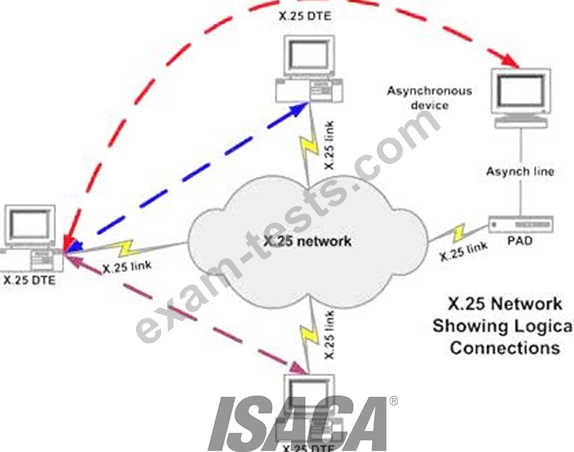
X.25
Frame Relay
Works on a packet switching
Operates at data link layer of an OSI model
Companies that pay more to ensure that a higher level of bandwidth will always be available, pay a committed information rate or CIR
Two main types of equipment's are used in Frame Relay
1. Data Terminal Equipment (DTE) - Usually a customer owned device that provides a connectivity between company's own network and the frame relay's network.
2. Data Circuit Terminal Equipment (DCE) - Service provider device that does the actual data transmission and switching in the frame relay cloud.
The Frame relay cloud is the collection of DCE that provides that provides switching and data communication functionality. Frame relay is any to any service.
Frame Relay
Integrated Service Digital Network
Enables data, voice and other types of traffic to travel over a medium in a digital manner previously used only for analog voice transmission.
Same copper telephone wire is used.
Provide digital point-to-point circuit switching medium.
ISDN
Asynchronous Transfer Mode (ATM)
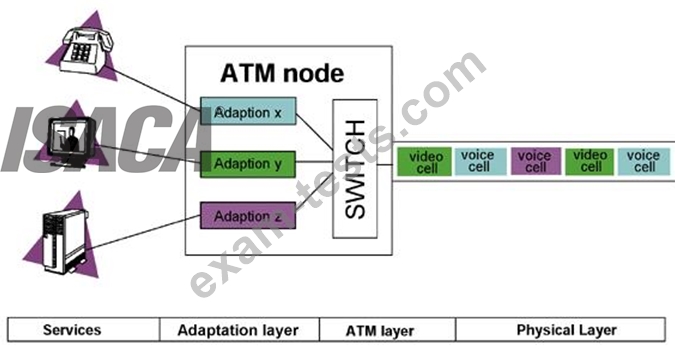
Uses Cell switching method
High speed network technology used for LAN, MAN and WAN
Like a frame relay it is connection oriented technology which creates and uses fixed channel Data are segmented into fixed size cell of 53 bytes
Some companies have replaces FDDI back-end with ATM
Asynchronous Transfer Mode
Multiprotocol Label Switching (MPLS)
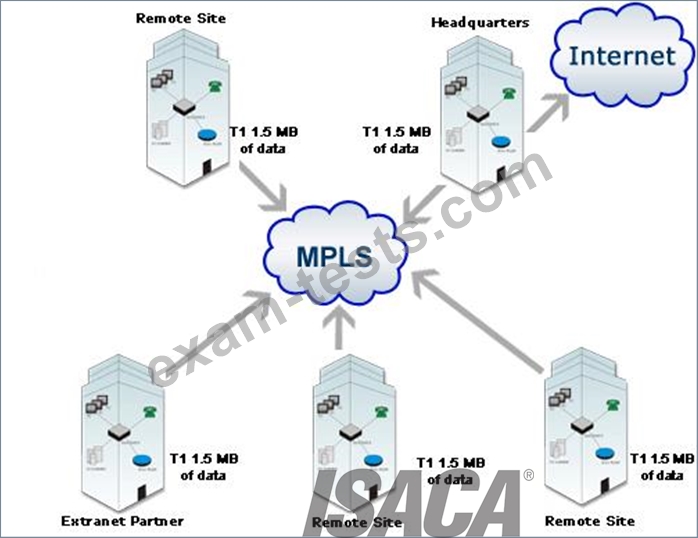
Multiprotocol Label Switching (MPLS) is a standards-approved technology for speeding up network traffic flow and making it easier to manage. MPLS involves setting up a specific path for a given sequence of packets, identified by a label put in each packet, thus saving the time needed for a router to look up the address to the next node to forward the packet to. MPLS is called multiprotocol because it works with the Internet Protocol (IP), Asynchronous Transport Mode (ATM), and frame relay network protocols. With reference to the standard model for a network (the Open Systems Interconnection, or OSI model), MPLS allows most packets to be forwarded at the Layer 2 (switching) level rather than at the Layer 3 (routing) level. In addition to moving traffic faster overall, MPLS makes it easy to manage a network for quality of service (QoS). For these reasons, the technique is expected to be readily adopted as networks begin to carry more and different mixtures of traffic.
MPLS
The following answers are incorrect:
X.25 - X.25 is an ITU-T standard protocol suite for packet switched wide area network (WAN) communication.X.25 is a packet switching technology which uses carrier switch to provide connectivity for many different networks.
Point-to-point protocol - PPP (Point-to-Point Protocol) is a protocol for communication between two computers using a serial interface, typically a personal computer connected by phone line to a server.
ISDN -Enables data, voice and other types of traffic to travel over a medium in a digital manner previously used only for analog voice transmission.
The following reference(s) were/was used to create this question:
CISA review manual 2014 page number 266
Multiprotocol Label Switching (MPLS) is a standards-approved technology for speeding up network traffic flow and making it easier to manage. MPLS involves setting up a specific path for a given sequence of packets, identified by a label put in each packet, thus saving the time needed for a router to look up the address to the next node to forward the packet to. MPLS is called multiprotocol because it works with the Internet Protocol (IP), Asynchronous Transport Mode (ATM), and frame relay network protocols. With reference to the standard model for a network (the Open Systems Interconnection, or OSI model), MPLS allows most packets to be forwarded at the Layer 2 (switching) level rather than at the Layer 3 (routing) level. In addition to moving traffic faster overall, MPLS makes it easy to manage a network for quality of service (QoS). For these reasons, the technique is expected to be readily adopted as networks begin to carry more and different mixtures of traffic.
For your exam you should know below information about WAN Technologies:
Point-to-point protocol
PPP (Point-to-Point Protocol) is a protocol for communication between two computers using a serial interface, typically a personal computer connected by phone line to a server. For example, your Internet server provider may provide you with a PPP connection so that the provider's server can respond to your requests, pass them on to the Internet, and forward your requested Internet responses back to you. PPP uses the Internet protocol (IP) (and is designed to handle others). It is sometimes considered a member of the TCP/IP suite of protocols. Relative to the Open Systems Interconnection (OSI) reference model, PPP provides layer 2 (data-link layer) service. Essentially, it packages your computer's TCP/IP packets and forwards them to the server where they can actually be put on the Internet.
PPP is a full-duplex protocol that can be used on various physical media, including twisted pair or fiber optic lines or satellite transmission. It uses a variation of High Speed Data Link Control (HDLC) for packet encapsulation.
PPP is usually preferred over the earlier de facto standard Serial Line Internet Protocol (SLIP) because it can handle synchronous as well as asynchronous communication. PPP can share a line with other users and it has error detection that SLIP lacks. Where a choice is possible, PPP is preferred.
Point-to-point protocol
X.25
X.25 is an ITU-T standard protocol suite for packet switched wide area network (WAN) communication.
X.25 is a packet switching technology which uses carrier switch to provide connectivity for many different networks.
Subscribers are charged based on amount of bandwidth they use. Data are divided into 128 bytes and encapsulated in High Level Data Link Control (HDLC).
X.25 works at network and data link layer of an OSI model.
X.25
Frame Relay
Works on a packet switching
Operates at data link layer of an OSI model
Companies that pay more to ensure that a higher level of bandwidth will always be available, pay a committed information rate or CIR
Two main types of equipment's are used in Frame Relay
1. Data Terminal Equipment (DTE) - Usually a customer owned device that provides a connectivity between company's own network and the frame relay's network.
2. Data Circuit Terminal Equipment (DCE) - Service provider device that does the actual data transmission and switching in the frame relay cloud.
The Frame relay cloud is the collection of DCE that provides that provides switching and data communication functionality. Frame relay is any to any service.
Frame Relay
Integrated Service Digital Network
Enables data, voice and other types of traffic to travel over a medium in a digital manner previously used only for analog voice transmission.
Same copper telephone wire is used.
Provide digital point-to-point circuit switching medium.
ISDN
Asynchronous Transfer Mode (ATM)
Uses Cell switching method
High speed network technology used for LAN, MAN and WAN
Like a frame relay it is connection oriented technology which creates and uses fixed channel Data are segmented into fixed size cell of 53 bytes
Some companies have replaces FDDI back-end with ATM
Asynchronous Transfer Mode
Multiprotocol Label Switching (MPLS)
Multiprotocol Label Switching (MPLS) is a standards-approved technology for speeding up network traffic flow and making it easier to manage. MPLS involves setting up a specific path for a given sequence of packets, identified by a label put in each packet, thus saving the time needed for a router to look up the address to the next node to forward the packet to. MPLS is called multiprotocol because it works with the Internet Protocol (IP), Asynchronous Transport Mode (ATM), and frame relay network protocols. With reference to the standard model for a network (the Open Systems Interconnection, or OSI model), MPLS allows most packets to be forwarded at the Layer 2 (switching) level rather than at the Layer 3 (routing) level. In addition to moving traffic faster overall, MPLS makes it easy to manage a network for quality of service (QoS). For these reasons, the technique is expected to be readily adopted as networks begin to carry more and different mixtures of traffic.
MPLS
The following answers are incorrect:
X.25 - X.25 is an ITU-T standard protocol suite for packet switched wide area network (WAN) communication.X.25 is a packet switching technology which uses carrier switch to provide connectivity for many different networks.
Point-to-point protocol - PPP (Point-to-Point Protocol) is a protocol for communication between two computers using a serial interface, typically a personal computer connected by phone line to a server.
ISDN -Enables data, voice and other types of traffic to travel over a medium in a digital manner previously used only for analog voice transmission.
The following reference(s) were/was used to create this question:
CISA review manual 2014 page number 266
Question 323
The PRIMARY purpose of implementing Redundant Array of Inexpensive Disks (RAID) level 1 in a file server is to:
Correct Answer: C
Explanation/Reference:
Explanation:
RAID level 1 provides disk mirroring. Data written to one disk are also written to another disk. Users in the network access data in the first disk; if disk one fails, the second disk takes over. This redundancy ensures the availability of data. RAID level 1 does not improve performance, has no relevance to authentication and does nothing to provide for data confidentiality.
Explanation:
RAID level 1 provides disk mirroring. Data written to one disk are also written to another disk. Users in the network access data in the first disk; if disk one fails, the second disk takes over. This redundancy ensures the availability of data. RAID level 1 does not improve performance, has no relevance to authentication and does nothing to provide for data confidentiality.
Question 324
An IS auditor reviewing an accounts payable system discovers that audit logs are not being reviewed.
When this issue is raised with management the response is that additional controls are not necessary because effective system access controls are in place. The BEST response the auditor can make is to:
When this issue is raised with management the response is that additional controls are not necessary because effective system access controls are in place. The BEST response the auditor can make is to:
Correct Answer: C
Explanation/Reference:
Explanation:
Experience has demonstrated that reliance purely on preventative controls is dangerous. Preventative controls may not prove to be as strong as anticipated or their effectiveness can deteriorate over time.
Evaluating the cost of controls versus the quantum of risk is a valid management concern. However, in a high-risk system a comprehensive control framework is needed, intelligent design should permit additional detective and corrective controls to be established that don't have high ongoing costs, e.g., automated interrogation of logs to highlight suspicious individual transactions or data patterns. Effective access controls are, in themselves, a positive but, for reasons outlined above, may not sufficiently compensate for other control weaknesses. In this situation the IS auditor needs to be proactive. The IS auditor has a fundamental obligation to point out control weaknesses that give rise to unacceptable risks to the organization and work with management to have these corrected. Reviewing background checks on accounts payable staff does not provide evidence that fraud will not occur.
Explanation:
Experience has demonstrated that reliance purely on preventative controls is dangerous. Preventative controls may not prove to be as strong as anticipated or their effectiveness can deteriorate over time.
Evaluating the cost of controls versus the quantum of risk is a valid management concern. However, in a high-risk system a comprehensive control framework is needed, intelligent design should permit additional detective and corrective controls to be established that don't have high ongoing costs, e.g., automated interrogation of logs to highlight suspicious individual transactions or data patterns. Effective access controls are, in themselves, a positive but, for reasons outlined above, may not sufficiently compensate for other control weaknesses. In this situation the IS auditor needs to be proactive. The IS auditor has a fundamental obligation to point out control weaknesses that give rise to unacceptable risks to the organization and work with management to have these corrected. Reviewing background checks on accounts payable staff does not provide evidence that fraud will not occur.
Question 325
IS management has decided to replace the current single-server-based local area network (LAN) with three interconnected servers running different operating systems. Existing applications and data on the old server have been exclusively distributed on the new servers. This will MOST likely result in:
Correct Answer: B
Section: Information System Operations, Maintenance and Support
- Other Version
- 7126ISACA.CISA.v2026-02-11.q999
- 9918ISACA.CISA.v2026-01-26.q999
- 12447ISACA.CISA.v2025-05-24.q773
- 5069ISACA.CISA.v2024-10-22.q310
- 11590ISACA.CISA.v2023-10-02.q715
- 5706ISACA.CISA.v2023-03-29.q119
- 4718ISACA.CISA.v2023-02-09.q181
- 2923ISACA.CISA.v2023-02-06.q107
- 4514ISACA.CISA.v2022-08-28.q129
- 6200ISACA.CISA.v2022-02-25.q148
- 130ISACA.Actualtestpdf.CISA.v2021-11-13.by.sarah.721q.pdf
- 7812ISACA.CISA.v2021-11-11.q194
- 11299ISACA.CISA.v2021-10-08.q198
- 12508ISACA.CISA.v2021-09-28.q199
- 15056ISACA.CISA.v2021-09-11.q201
- Latest Upload
- 118Apple.App-Development-with-Swift-Certified-User.v2026-09-30.q14
- 132Microsoft.AB-210.v2026-09-30.q53
- 149Salesforce.OmniStudio-Consultant.v2026-09-30.q102
- 139InsuranceLicensing.Life-and-Accident-and-Health-or-Sickness-Producer-Combo.v2026-09-30.q93
- 173Salesforce.Data-Architect.v2026-09-29.q136
- 177Huawei.H19-321.v2026-09-29.q100
- 123SAP.C_S4CPB.v2026-09-28.q7
- 134CMAA.Construction-Manager.v2026-09-28.q23
- 154PaloAltoNetworks.XDR-Engineer.v2026-09-28.q50
- 158Anthropic.CCAR-F.v2026-09-27.q53
[×]
Download PDF File
Enter your email address to download ISACA.CISA.v2026-09-24.q827 Practice Test