There is an increasedincidence of type 2 diabetes among patients living near a healthcare organization as compared to the state. Considering social determinants of health, which of the following strategies can be used to address this problem?
Correct Answer: D
Addressing the increased incidence of type 2 diabetes through the lens of social determinants of health involves addressing broader factors that impact health. Collaborating with local farmers'markets to make fresh produce more widely available is a strategy that addresses the social determinants of health by improving access to healthy food options. This approach can help reduce the risk of diabetes by making it easier for community members to make healthy dietary choices, thereby addressing one of the root causes of the increased diabetes incidence. Educate newly diagnosed patients on diabetes disease management (A): While important, this strategy focuses on managing diabetes after it occurs rather than addressing the social determinants that contribute to its onset. Set up a community-based education program about blood glucose monitoring (B): This is also important for management but does not directly address the social determinants that lead to the higher incidence. Review evidence-based diabetes management protocols with primary care providers (C): This improves care quality but does not address the social factors contributing to the disease. References NAHQ Body of Knowledge: Addressing Social Determinants of Health in Quality Improvement NAHQ CPHQ Exam Preparation Materials: Strategies for Managing Social Determinants of Health =========
Question 202
Technology design that prevents a certain action, or requires that another action happen first, is said to have
Correct Answer: D
A forcing function in technology design refers to a mechanism that either prevents a certain action from occurring or requires that another action take place first. This concept is crucial in ensuring safety and adherence to protocols, especially in healthcare settings. * Prevention of Errors: Forcing functions are used to design systems that prevent users from making errors. For example, a medication administration system might require that the correct dosage is entered before allowing the process to continue, thereby preventing overdose. * Sequential Actions: In some cases, forcing functions ensure that a specific sequence of actions is followed. For instance, a system may prevent a surgeon from proceeding with surgery until the patient's identity is confirmed, reducing the risk of wrong-patient surgery. * Design Intent: The primary goal of forcing functions is to design technology that inherently prevents errors, reducing the reliance on human memory and vigilance, which can fail under stress or fatigue. References: (Based on Healthcare Quality NAHQ documents and resources) * NAHQ Study Guide on Patient Safety and Error Prevention. * Quality Management in Health Care, Chapter on Forcing Functions in System Design. =========
Question 203
A healthcare quality professional receives the following Consumer Assessment of Healthcare Providers and Systems (CAHPS) survey results: Which of the following should be the next action by the professional?
Correct Answer: B
The Consumer Assessment of Healthcare Providers and Systems (CAHPS) survey results provide insights into patients' experiences with healthcare services12. In this case, the survey results indicate that there may be issues with how well doctors communicate and the ease of getting necessary care. These are areas where practitioners can directly influence patient experience. Therefore, initiating a practitioner communication initiative on access to care standards (option B) would be an appropriate next step. This initiative could involve training or workshops to improve communication skills and strategies to enhance access to care3. It's also important to continuously monitor CAHPS survey results to track progress and identify new areas for improvement4. The CAHPS survey results indicate that the health plan's score on how well doctors communicate is lower than the Quality Compass Mean. Since communication with healthcare providers is a key aspect of patient experience and can greatly affect patient satisfaction and outcomes, focusing on improving practitioners' communication skills is essential. A practitioner communication initiative could address the gap in communication scores by providing training and resources to enhance how doctors interact with patients. This initiative would likely involve coaching for practitioners on how to effectively listen, explain, and engage with patients to ensure they understand their health conditions and the care provided. References:The National Association for Healthcare Quality (NAHQ) provides resources on improving communication as part of quality improvement in healthcare. Such initiatives are supported by evidence showing that effective communication can lead to better patient satisfaction, adherence to treatment plans, and overall health outcomes. This is also in line with the principles outlined in the NAHQ Healthcare Quality Competency Framework under the domain of Patient Safety and Person-Centered Care, which emphasizes the importance of communication in providing high-quality, safe, and patient-centered care.
Question 204
Within any unit, organization, or system, there will be barriers to spread and adoption (e.g., organizational culture, communication, leadership support). However, failure to transfer knowledge effectively may result in:
Correct Answer: A,D
Question 205
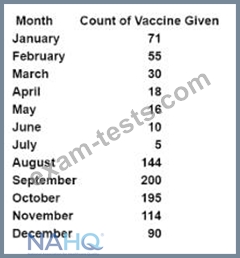
Data for an organization's annual Influenza vaccine administration yields the following results: What is the median for the organization's annual vaccine count?
Correct Answer: B
The median is the value that's exactly in the middle of a dataset when it is ordered12. It's a measure of central tendency that separates the lowest 50% from the highest 50% ofvalues2. The steps for finding the median differ depending on whether you have an odd or an even number of data points123. Based on the data provided in the image, we can calculate the median by arranging the vaccine counts in ascending order and finding the middle value. The counts in ascending order are: 5, 10, 16, 18, 30, 55, 71, 90, 114, 144, 195, and 200. Since there are an even number of data points (12), we take the middle value directly without averaging two middle values. So here it is option B - "55". This is consistent with the principles of median calculation123.