

Question 1
Your company just won a contract to create a new sales application and has committed to a very aggressive delivery timeline. Due to the quick turnaround your primary stakeholder wants to be heavily involved in the design and is very anxious to see the outcome. Because of this, your company has decided to use a spiral development approach. You have a defined test policy and typically use an analytical approach to testing, however, this approach will not work with the development approach.
What test strategy should be utilized? [3]
What test strategy should be utilized? [3]
Question 2
Club 65 to 90 is a holiday club for retired people run by a small company, the IT department consists of 1 Designer, 3 Developers and 1 System Tester Their booking system has been "live" for a number of years and the company has a loyal client base. A variety of automation tools are used for development and testing to improve effectiveness and efficiency.
A new project will introduce a loyalty scheme and both a Business Requirement Specification and a System Design Specification have been produced A Rapid Application Development (RAD) lifecycle model will be used where time is crucial. In the past there have been problems with updates to the existing system, which has affected existing functionality. Testers have not used representative and realistic operational profiles and data, which has led to significant production problems. The following test policy statements have been proposed for the project:
a. Testing must be risk based;
b. A Master Test Plan, confirming to IEEE829, must be produced for each test project; c. Test procedures must be run by a tester who did not write the procedure; d. Regression testing should be carried out on all releases; e. The testers are accountable for all defects found in production; f. Time must be given to designing test environments so that they are representative of the live environment.
Which of the following options identifies the three policy statements that would be MOST beneficial for this project?
A new project will introduce a loyalty scheme and both a Business Requirement Specification and a System Design Specification have been produced A Rapid Application Development (RAD) lifecycle model will be used where time is crucial. In the past there have been problems with updates to the existing system, which has affected existing functionality. Testers have not used representative and realistic operational profiles and data, which has led to significant production problems. The following test policy statements have been proposed for the project:
a. Testing must be risk based;
b. A Master Test Plan, confirming to IEEE829, must be produced for each test project; c. Test procedures must be run by a tester who did not write the procedure; d. Regression testing should be carried out on all releases; e. The testers are accountable for all defects found in production; f. Time must be given to designing test environments so that they are representative of the live environment.
Which of the following options identifies the three policy statements that would be MOST beneficial for this project?
Question 3
You are a new lest manager in an organization You have been asked to assess the defect process to determine if there are any efficiency improvements that could be made that would reduce the cost of quality You have started digging through the defect Information What information would be most helpful for this investigation?
Question 4
You have recently implemented a new defect management process which now includes a defect triage committee whose job is to review all new defects. The process is shown in the following diagram:
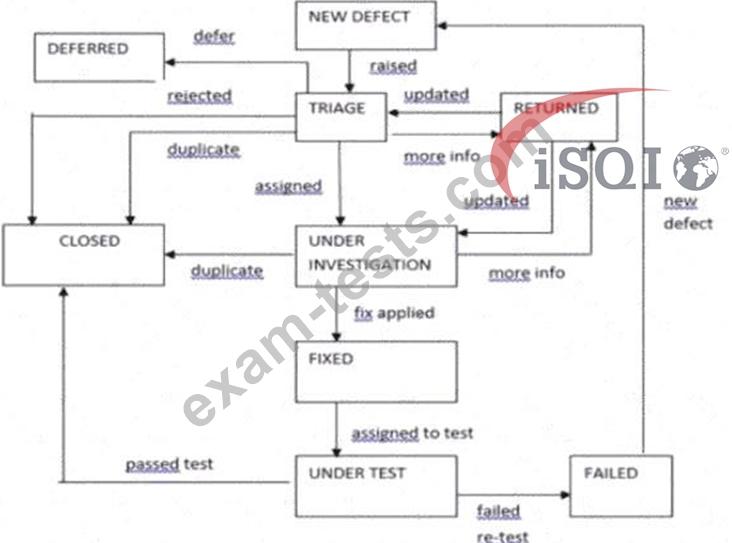
b. The total number of defects rejected as not a problem following investigation by the product author c. The number of defects returned to the defect author, expressed as a percentage of all defects raised d. The total number of defects that failed re-test more than once e. The total number of defects closed by the defect triage committee SELECT ONE OPTION
b. The total number of defects rejected as not a problem following investigation by the product author c. The number of defects returned to the defect author, expressed as a percentage of all defects raised d. The total number of defects that failed re-test more than once e. The total number of defects closed by the defect triage committee SELECT ONE OPTION
Question 5
You are working on a project where the business part of the organization works traditionally with defined requirements, but the development team follows an Agile model Neither team plans to change their approach What is the proper name for this type of project approach''