The critical path refers to which of the following series of tasks in a schedule?
Correct Answer: A
The critical path is thelongest-duration paththrough a project network schedule and represents the sequence of activities withzero (or minimal) float. Because activities on this path have no schedule slack, any delay to a critical-path activity delays theproject completionunless mitigated (e.g., crashing, fast-tracking, resequencing). Standard project scheduling references define the critical path as the chain of tasks that determines theearliest possible finishdate; controlling and monitoring these tasks is essential for schedule management and forecasting. This is why contract administrators and project teams track critical activities and escalate risks affecting them-delivery delays, access constraints, approvals, and rework-because they directly move the completion milestone. Therefore, the critical path refers to tasks thatdictate the finish date of the project, which is optionA.
Question 32
What is the main reason for taking handwritten notes while surveying?
Correct Answer: D
Survey work depends on traceable, reproducible observations. Handwritten field notes (field book entries, sketches, stationing, and benchmark ties) function as theprimary recordof what was measured, under what conditions, and how control was established. Lindeburg describes that elevations of temporary benchmarks are generally found infield notesand local official filings, reflecting that field notes are treated as an enduring record used later for computations, verification, and re-establishment of control. This is why good surveying practice emphasizes complete notes, clear sketches, and unambiguous identification of points-so results can be checked, recalculated, and defended long after the crew leaves site. While survey data supports mapping and may indirectly support disputes, the fundamental purpose of handwritten notes is to create apermanent, auditable recordof survey results and control ties.
Question 33
What is a silt fence used for?
Correct Answer: D
A silt fence is an erosion and sediment control measure intended toretain sedimentcarried by runoff, reducing offsite sedimentation. Lindeburg describes temporary silt fences as measures using posts and filter cloth (e.g., filter fabric) placed on the upstream side toretain suspended silt particles in runoff water. This purpose is to reducesoil movement(sediment transport) caused by erosion processes during construction, especially oalong drainage paths where siltation is expected. The fence does not "stop water" (runoff still passes through while sediment is filtered), is not primarily a site limit marker, and is not an access control barrier for the public. Therefore, the correct statement is that a silt fence is usedto prevent soil from moving through the site due to erosion.
Question 34
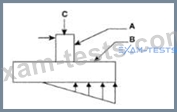
A civil engineering technologist is working on a foundation design and needs to differentiate between different sections of a footing and the point where the vertical pressure is applied. In the diagram, what is represented by letters A, B, and C?
Correct Answer: B
In shallow foundation terminology, thefootingis the widened base element that transfers loads to soil over a larger area to reduce bearing pressure, while apedestalis the short vertical element (often concrete) that supports a column or provides an interface between the column/base plate and the footing. Vertical load from the superstructure is shown as adownward forceapplied at the top of the pedestal/column location, representing thevertical pressure/loadtransmitted into the foundation system. In the diagram, letterBpoints to the large horizontal base element (the footing), letterApoints to the smaller vertical block above it (the pedestal), and letterCmarks the downward applied load. This matches standard foundation component identification used in structural and geotechnical detailing: pedestal above, footing below, and vertical load applied at the top of the pedestal/column line of action.
Question 35
In the middle of the project, the client proposed an additional scope of work that requires a change order to the contract. Which statement applies to the contractor's percentage fee (i.e., mark-up) that should be added to the total amount in the change order?
Correct Answer: C
A change order is a formal amendment to the contract that adjusts scope, price, and/or time under therules already established by the contract documents. The contractor's fee (markup for overhead and profit) is not typically set unilaterally mid-project by either party; instead, the contract commonly defines how change work is priced (lump sum, unit rates, time-and-material) and what allowable markups apply. Industry guidance on change-order costing notes that the markup percentage is oftenincluded up front in the construction contractand applied consistently to change work, ensuring transparency and avoiding disputes during administration. This approach is consistent with standard contract administration practice: pricing of changes is governed by contract terms, and the change order documents implement those terms for a specific modification. Therefore, the contractor's percentage fee to be added to the change order amount isspecified in the contract documents.
Newest Civil-Engineering-Technology Exam PDF Dumps shared by BraindumpsPass.com for Helping Passing Civil-Engineering-Technology Exam! BraindumpsPass.com now offer the updated Civil-Engineering-Technology exam dumps, the BraindumpsPass.com Civil-Engineering-Technology exam questions have been updated and answers have been corrected get the latest BraindumpsPass.com Civil-Engineering-Technology pdf dumps with Exam Engine here: