

Question 166
You are building an Azure Analytics query that will receive input data from Azure IoT Hub and write the results to Azure Blob storage.
You need to calculate the difference in readings per sensor per hour.
How should you complete the query? To answer, select the appropriate options in the answer area.
NOTE: Each correct selection is worth one point.

You need to calculate the difference in readings per sensor per hour.
How should you complete the query? To answer, select the appropriate options in the answer area.
NOTE: Each correct selection is worth one point.

Question 167
You have an Azure Data Lake Storage Gen2 account that contains a JSON file for customers. The file contains two attributes named FirstName and LastName.
You need to copy the data from the JSON file to an Azure Synapse Analytics table by using Azure Databricks. A new column must be created that concatenates the FirstName and LastName values.
You create the following components:
A destination table in Azure Synapse
An Azure Blob storage container
A service principal
Which five actions should you perform in sequence next in is Databricks notebook? To answer, move the appropriate actions from the list of actions to the answer area and arrange them in the correct order.
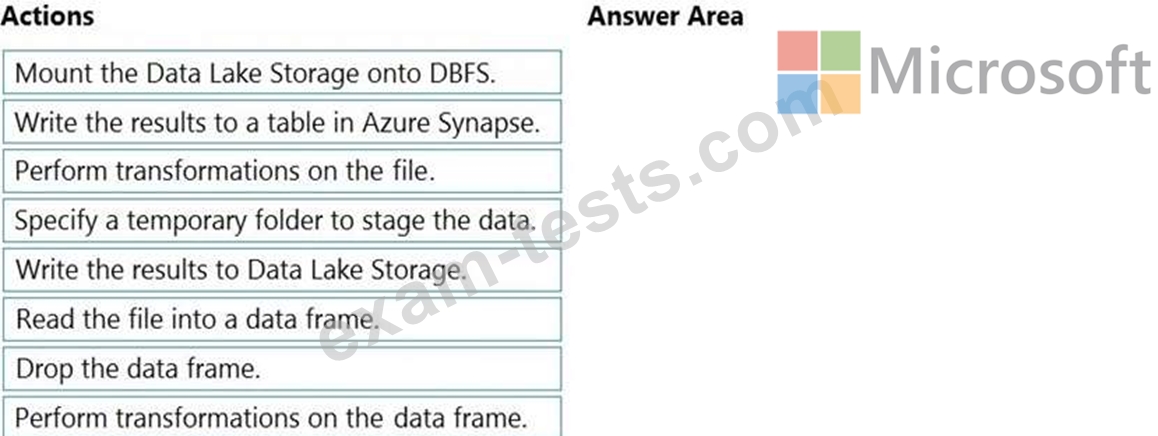
You need to copy the data from the JSON file to an Azure Synapse Analytics table by using Azure Databricks. A new column must be created that concatenates the FirstName and LastName values.
You create the following components:
A destination table in Azure Synapse
An Azure Blob storage container
A service principal
Which five actions should you perform in sequence next in is Databricks notebook? To answer, move the appropriate actions from the list of actions to the answer area and arrange them in the correct order.

Question 168
You are designing an Azure Data Lake Storage Gen2 structure for telemetry data from 25 million devices distributed across seven key geographical regions. Each minute, the devices will send a JSON payload of metrics to Azure Event Hubs.
You need to recommend a folder structure for the dat
a. The solution must meet the following requirements:
Data engineers from each region must be able to build their own pipelines for the data of their respective region only.
The data must be processed at least once every 15 minutes for inclusion in Azure Synapse Analytics serverless SQL pools.
How should you recommend completing the structure? To answer, drag the appropriate values to the correct targets. Each value may be used once, more than once, or not at all. You may need to drag the split bar between panes or scroll to view content.
NOTE: Each correct selection is worth one point.

You need to recommend a folder structure for the dat
a. The solution must meet the following requirements:
Data engineers from each region must be able to build their own pipelines for the data of their respective region only.
The data must be processed at least once every 15 minutes for inclusion in Azure Synapse Analytics serverless SQL pools.
How should you recommend completing the structure? To answer, drag the appropriate values to the correct targets. Each value may be used once, more than once, or not at all. You may need to drag the split bar between panes or scroll to view content.
NOTE: Each correct selection is worth one point.

Question 169
You have the following Azure Stream Analytics query.

For each of the following statements, select Yes if the statement is true. Otherwise, select No.
NOTE: Each correct selection is worth one point.

For each of the following statements, select Yes if the statement is true. Otherwise, select No.
NOTE: Each correct selection is worth one point.

Question 170
You manage an enterprise data warehouse in Azure Synapse Analytics.
Users report slow performance when they run commonly used queries. Users do not report performance changes for infrequently used queries.
You need to monitor resource utilization to determine the source of the performance issues.
Which metric should you monitor?
Users report slow performance when they run commonly used queries. Users do not report performance changes for infrequently used queries.
You need to monitor resource utilization to determine the source of the performance issues.
Which metric should you monitor?