

Question 181
You have an Azure Data Lake Storage account that contains a staging zone.
You need to design a daily process to ingest incremental data from the staging zone, transform the data by executing an R script, and then insert the transformed data into a data warehouse in Azure Synapse Analytics.
Solution: You use an Azure Data Factory schedule trigger to execute a pipeline that executes mapping data Flow, and then inserts the data info the data warehouse.
Does this meet the goal?
You need to design a daily process to ingest incremental data from the staging zone, transform the data by executing an R script, and then insert the transformed data into a data warehouse in Azure Synapse Analytics.
Solution: You use an Azure Data Factory schedule trigger to execute a pipeline that executes mapping data Flow, and then inserts the data info the data warehouse.
Does this meet the goal?
Question 182
You are designing an inventory updates table in an Azure Synapse Analytics dedicated SQL pool. The table will have a clustered columnstore index and will include the following columns:

You identify the following usage patterns:
* Analysts will most commonly analyze transactions for a warehouse.
* Queries will summarize by product category type, date, and/or inventory event type.
You need to recommend a partition strategy for the table to minimize query times.
On which column should you partition the table?
You identify the following usage patterns:
* Analysts will most commonly analyze transactions for a warehouse.
* Queries will summarize by product category type, date, and/or inventory event type.
You need to recommend a partition strategy for the table to minimize query times.
On which column should you partition the table?
Question 183
You have an Azure Data Lake Storage Gen2 account named account1 that stores logs as shown in the following table.

You do not expect that the logs will be accessed during the retention periods.
You need to recommend a solution for account1 that meets the following requirements:
* Automatically deletes the logs at the end of each retention period
* Minimizes storage costs
What should you include in the recommendation? To answer, select the appropriate options in the answer area.
NOTE: Each correct selection is worth one point.

You do not expect that the logs will be accessed during the retention periods.
You need to recommend a solution for account1 that meets the following requirements:
* Automatically deletes the logs at the end of each retention period
* Minimizes storage costs
What should you include in the recommendation? To answer, select the appropriate options in the answer area.
NOTE: Each correct selection is worth one point.


Question 184
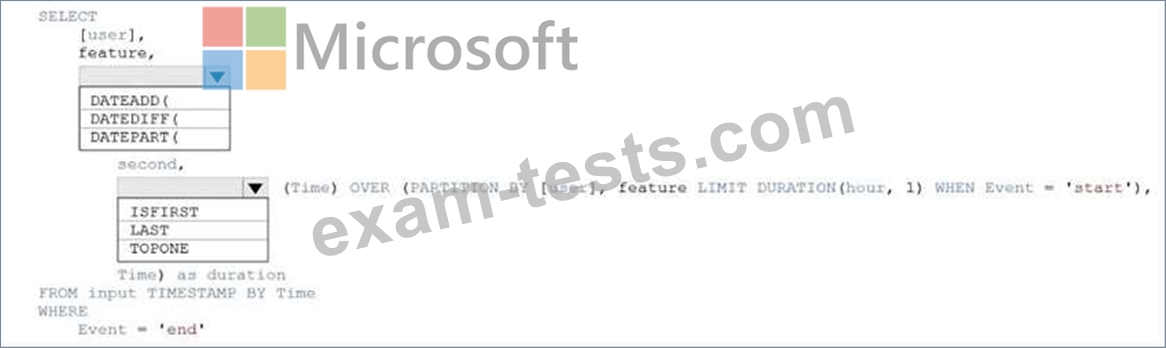
You are building an Azure Stream Analytics job to identify how much time a user spends interacting with a feature on a webpage.
The job receives events based on user actions on the webpage. Each row of data represents an event. Each event has a type of either 'start' or 'end'.
You need to calculate the duration between start and end events.
How should you complete the query? To answer, select the appropriate options in the answer area.
NOTE: Each correct selection is worth one point.
The job receives events based on user actions on the webpage. Each row of data represents an event. Each event has a type of either 'start' or 'end'.
You need to calculate the duration between start and end events.
How should you complete the query? To answer, select the appropriate options in the answer area.
NOTE: Each correct selection is worth one point.

Question 185
You need to integrate the on-premises data sources and Azure Synapse Analytics. The solution must meet the data integration requirements.
Which type of integration runtime should you use?
Which type of integration runtime should you use?