Assuming that the Databricks CLI has been installed and configured correctly, which Databricks CLI command can be used to upload a custom Python Wheel to object storage mounted with the DBFS for use with a production job?
Correct Answer: D
The libraries command group allows you to install, uninstall, and list libraries on Databricks clusters. You can use the libraries install command to install a custom Python Wheel on a cluster by specifying the --whl option and the path to the wheel file. For example, you can use the following command to install a custom Python Wheel named mylib-0.1-py3-none-any.whl on a cluster with the id 1234-567890-abcde123: databricks libraries install --cluster-id 1234-567890-abcde123 --whl dbfs:/mnt/mylib/mylib-0.1-py3-none-any. whl This will upload the custom Python Wheel to the cluster and make it available for use with a production job. You can also use the libraries uninstall command to uninstall a library from a cluster, and the libraries list command to list the libraries installed on a cluster. References: * Libraries CLI (legacy): https://docs.databricks.com/en/archive/dev-tools/cli/libraries-cli.html * Library operations: https://docs.databricks.com/en/dev-tools/cli/commands.html#library-operations * Install or update the Databricks CLI: https://docs.databricks.com/en/dev-tools/cli/install.html
Question 87
Which of the following SQL commands are used to append rows to an existing delta table?
Correct Answer: D
Explanation The answer is INSERT INTO table_name Insert adds rows to an existing table, this is very similar to add rows a traditional Database or Da-tawarehouse.
Question 88
A newly joined team member John Smith in the Marketing team currently has access read access to sales tables but does not have access to update the table, which of the following commands help you accomplish this?
Correct Answer: C
Explanation The answer is GRANT MODIFY ON TABLE table_name TO [email protected] https://docs.microsoft.com/en-us/azure/databricks/security/access-control/table-acls/object-privileges#privileges
Question 89
A user new to Databricks is trying to troubleshoot long execution times for some pipeline logic they are working on. Presently, the user is executing code cell-by-cell, usingdisplay()calls to confirm code is producing the logically correct results as new transformations are added to an operation. To get a measure of average time to execute, the user is running each cell multiple times interactively. Which of the following adjustments will get a more accurate measure of how code is likely to perform in production?
Correct Answer: D
This is the correct answer because it explains which of the following adjustments will get a more accurate measure of how code is likely to perform in production. The adjustment is that calling display() forces a job to trigger, while many transformations will only add to the logical query plan; because of caching, repeated execution of the same logic does not provide meaningful results. When developing code in Databricks notebooks, one should be aware of how Spark handles transformations and actions. Transformations are operations that create a new DataFrame or Dataset from an existing one, such as filter, select, or join. Actions are operations that trigger a computation on a DataFrame or Dataset and return a result to the driver program or write it to storage, such as count, show, or save. Calling display() on a DataFrame or Dataset is also an action that triggers a computation and displays the result in a notebook cell. Spark uses lazy evaluation for transformations, which means that they are not executed until an action is called. Spark also uses caching to store intermediate results in memory or disk for faster access in subsequent actions. Therefore, calling display() forces a job to trigger, while many transformations will only add to the logical query plan; because of caching, repeated execution of the same logic does not provide meaningful results. To get a more accurate measure of how code is likely to perform in production, one should avoid calling display() too often or clear the cache before running each cell. Verified References: [Databricks Certified Data Engineer Professional], under "Spark Core" section; Databricks Documentation, under "Lazy evaluation" section; Databricks Documentation, under "Caching" section.
Question 90
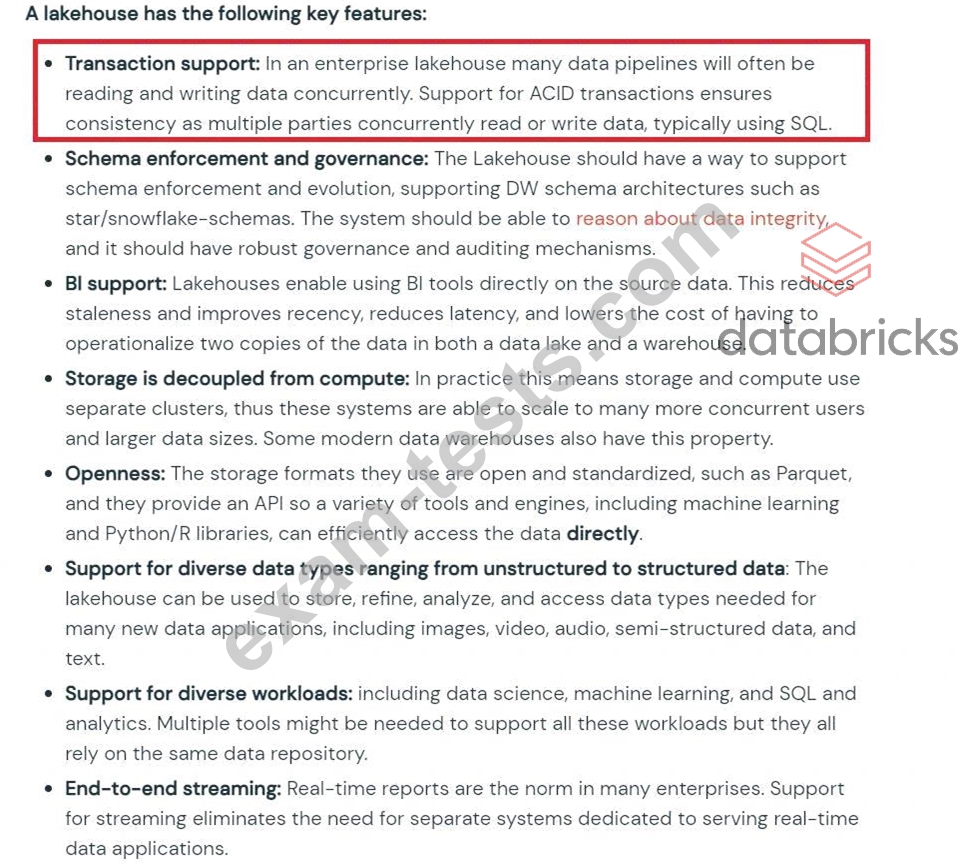
Which of the following statements are true about a lakehouse?
Correct Answer: E
Explanation What Is a Lakehouse? - The Databricks Blog Text Description automatically generated