

Question 66
A Structured Streaming job deployed to production has been resulting in higher than expected cloud storage costs. At present, during normal execution, each micro-batch of data is processed in less than 3 seconds; at least 12 times per minute, a micro-batch is processed that contains 0 records. The streaming write was configured using the default trigger settings. The production job is currently scheduled alongside many other Databricks jobs in a workspace with instance pools provisioned to reduce start-up time for jobs with batch execution. Holding all other variables constant and assuming records need to be processed in less than 10 minutes, which adjustment will meet the requirement?
Question 67
Given the following error traceback (from display(df.select(3*"heartrate"))) which shows AnalysisException: cannot resolve 'heartrateheartrateheartrate', which statement describes the error being raised?
Question 68
To reduce storage and compute costs, the data engineering team has been tasked with curating a series of aggregate tables leveraged by business intelligence dashboards, customer-facing applications, production machine learning models, and ad hoc analytical queries.
The data engineering team has been made aware of new requirements from a customer-facing application, which is the only downstream workload they manage entirely. As a result, an aggregate table used by numerous teams across the organization will need to have a number of fields renamed, and additional fields will also be added.
Which of the solutions addresses the situation while minimally interrupting other teams in the organization without increasing the number of tables that need to be managed?
The data engineering team has been made aware of new requirements from a customer-facing application, which is the only downstream workload they manage entirely. As a result, an aggregate table used by numerous teams across the organization will need to have a number of fields renamed, and additional fields will also be added.
Which of the solutions addresses the situation while minimally interrupting other teams in the organization without increasing the number of tables that need to be managed?
Question 69
You are working on a process to query the table based on batch date, and batch date is an input parameter and expected to change every time the program runs, what is the best way to we can parameterize the query to run without manually changing the batch date?
Question 70
A junior member of the data engineering team is exploring the language interoperability of Databricks notebooks. The intended outcome of the below code is to register a view of all sales that occurred in countries on the continent of Africa that appear in thegeo_lookuptable.
Before executing the code, runningSHOWTABLESon the current database indicates the database contains only two tables:geo_lookupandsales.
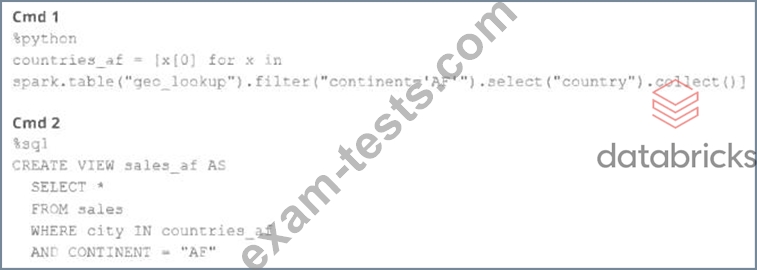
Which statement correctly describes the outcome of executing these command cells in order in an interactive notebook?
Before executing the code, runningSHOWTABLESon the current database indicates the database contains only two tables:geo_lookupandsales.
Which statement correctly describes the outcome of executing these command cells in order in an interactive notebook?