A Delta Lake table representing metadata about content from user has the following schema: user_id LONG, post_text STRING, post_id STRING, longitude FLOAT, latitude FLOAT, post_time TIMESTAMP, date DATE Based on the above schema, which column is a good candidate for partitioning the Delta Table?
Correct Answer: A
Partitioning a Delta Lake table improves query performance by organizing data into partitions based on the values of a column. In the given schema, the date column is a good candidate for partitioning for several reasons: * Time-Based Queries: If queries frequently filter or group by date, partitioning by the date column can significantly improve performance by limiting the amount of data scanned. * Granularity: The date column likely has a granularity that leads to a reasonable number of partitions (not too many and not too few). This balance is important for optimizing both read and write performance. * Data Skew: Other columns like post_id or user_id might lead to uneven partition sizes (data skew), which can negatively impact performance. Partitioning by post_time could also be considered, but typically date is preferred due to its more manageable granularity. : Delta Lake Documentation on Table Partitioning: Optimizing Layout with Partitioning
Question 47
Which of the following technologies can be used to identify key areas of text when parsing Spark Driver log4j output?
Correct Answer: A
Regex, or regular expressions, are a powerful way of matching patterns in text. They can be used to identify key areas of text when parsing Spark Driver log4j output, such as the log level, the timestamp, the thread name, the class name, the method name, and the message. Regex can be applied in various languages and frameworks, such as Scala, Python, Java, Spark SQL, and Databricks notebooks. References: * https://docs.databricks.com/notebooks/notebooks-use.html#use-regular-expressions * https://docs.databricks.com/spark/latest/spark-sql/udf-scala.html#using-regular-expressions-in-udfs * https://docs.databricks.com/spark/latest/sparkr/functions/regexp_extract.html * https://docs.databricks.com/spark/latest/sparkr/functions/regexp_replace.html
Question 48
What is the output of the below function when executed with input parameters 1, 3 : 1.def check_input(x,y): 2. if x < y: 3. x= x+1 4. if x<y: 5. x= x+1 6. if x <y: 7. x = x+1 8. return x check_input(1,3)
Correct Answer: A
Question 49
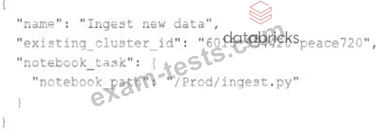
A junior data engineer has configured a workload that posts the following JSON to the Databricks REST API endpoint 2.0/jobs/create. Assuming that all configurations and referenced resources are available, which statement describes the result of executing this workload three times?
Correct Answer: E
This is the correct answer because the JSON posted to the Databricks REST API endpoint 2.0/jobs/create defines a new job with a name, an existing cluster id, and a notebook task. However, it does not specify any schedule or trigger for the job execution. Therefore, three new jobs with the same name and configuration will be created in the workspace, but none of them will be executed until they are manually triggered or scheduled. Verified References: [Databricks Certified Data Engineer Professional], under "Monitoring & Logging" section; [Databricks Documentation], under "Jobs API - Create" section.
Question 50
A new data engineer notices that a critical field was omitted from an application that writes its Kafka source to Delta Lake. This happened even though the critical field was in the Kafka source. That field was further missing from data written to dependent, long-term storage. The retention threshold on the Kafka service is seven days. The pipeline has been in production for three months. Which describes how Delta Lake can help to avoid data loss of this nature in the future?
Correct Answer: E
This is the correct answer because it describes how Delta Lake can help to avoid data loss of this nature in the future. By ingesting all raw data and metadata from Kafka to a bronze Delta table, Delta Lake creates a permanent, replayable history of the data state that can be used for recovery or reprocessing in case of errors or omissions in downstream applications or pipelines. Delta Lake also supports schema evolution, which allows adding new columns to existing tables without affecting existing queries or pipelines. Therefore, if a critical field wasomitted from an application that writes its Kafka source to Delta Lake, it can be easily added later and the data can be reprocessed from the bronze table without losing any information. Verified References: [Databricks Certified Data Engineer Professional], under "Delta Lake" section; Databricks Documentation, under "Delta Lake core features" section.
Newest Databricks-Certified-Professional-Data-Engineer Exam PDF Dumps shared by BraindumpsPass.com for Helping Passing Databricks-Certified-Professional-Data-Engineer Exam! BraindumpsPass.com now offer the updated Databricks-Certified-Professional-Data-Engineer exam dumps, the BraindumpsPass.com Databricks-Certified-Professional-Data-Engineer exam questions have been updated and answers have been corrected get the latest BraindumpsPass.com Databricks-Certified-Professional-Data-Engineer pdf dumps with Exam Engine here: