A data engineering team is configuring access controls in Databricks Unity Catalog. They grant the SELECT privilege on the sales catalog to the analyst_group, expecting that members of this group will automatically have SELECT access to all current and future schemas, tables, and views within the catalog. What describes the privilege inheritance behavior in Unity Catalog?
Correct Answer: B
Comprehensive and Detailed Explanation From Exact Extract of Databricks Data Engineer Documents: In Unity Catalog, privileges are non-cascading-meaning that granting a privilege (like SELECT) on a catalog does not automatically grant the same privilege on contained objects (schemas, tables, or views). Each object type has its own independent access control hierarchy. According to the Databricks access control documentation: "Privileges do not automatically cascade from catalog to schema or table levels." Administrators must explicitly grant privileges on each level if users need access across objects. This design ensures tighter governance and least-privilege enforcement. Therefore, option B correctly describes Unity Catalog's privilege model, while A and D incorrectly imply automatic inheritance.
Question 142
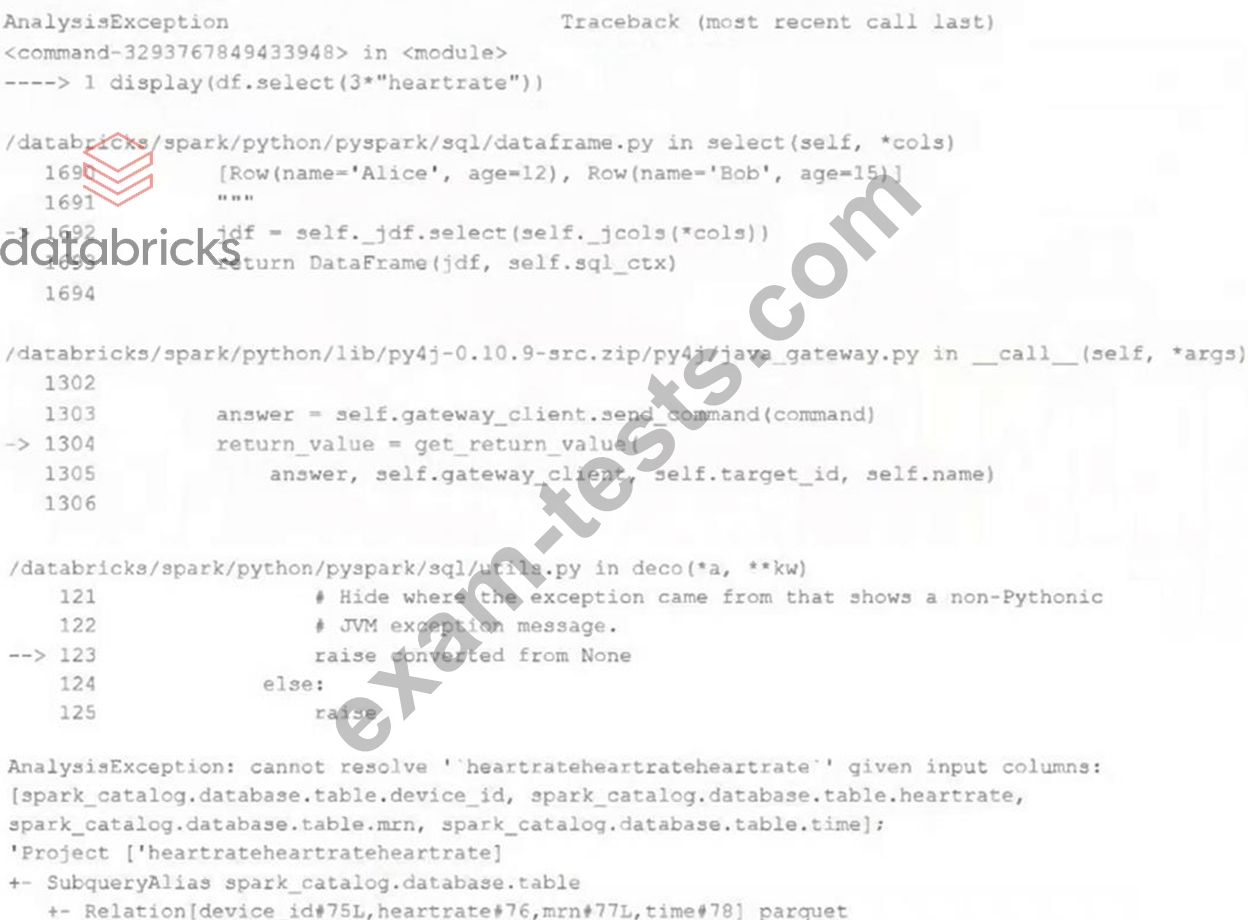
Review the following error traceback: Which statement describes the error being raised?
Correct Answer: E
Explanation The error is a Py4JJavaError, which means that an exception was thrown in Java code called by Python code using Py4J. Py4J is a library that enables Python programs to dynamically access Java objects in a Java Virtual Machine (JVM). PySpark uses Py4J to communicate with Spark's JVM-based engine. The error message shows that the exception was thrown by org.apache.spark.sql.AnalysisException, which means that an error occurred during the analysis phase of Spark SQL query processing. The error message also shows that the cause of the exception was "cannot resolve 'heartrateheartrateheartrate' given input columns". This means that Spark could not find a column named heartrateheartrateheartrate in the input DataFrame or Dataset. The reason for this error is that there is a syntax error in the code that caused this exception. The code is: df.withColumn("heartrate", heartrate * 3) The code tries to create a new column called heartrate by multiplying an existing column called heartrate by 3. However, the code does not correctly identify the heartrate column as a column object, but rather as a plain Python variable. This causes PySpark to concatenate the variable name with itself three times, resulting in heartrateheartrateheartrate, which is not a valid column name. To fix this error, the code should use one of the following ways to identify the heartrate column as a column object: df.withColumn("heartrate", df["heartrate"] * 3) df.withColumn("heartrate", df.heartrate * 3) df.withColumn("heartrate", col("heartrate") * 3) Verified References: [Databricks Certified Data Engineer Professional], under "Spark Core" section; Py4J Documentation, under "What is Py4J?"; Databricks Documentation, under "Query plans - Analysis phase"; Databricks Documentation, under "Accessing columns".
Question 143
Which of the following two options are supported in identifying the arrival of new files, and incre-mental data from Cloud object storage using Auto Loader?
Correct Answer: A
Explanation The answer is A, Directory listing, File notifications Directory listing: Auto Loader identifies new files by listing the input directory. File notification: Auto Loader can automatically set up a notification service and queue service that subscribe to file events from the input directory. Choosing between file notification and directory listing modes | Databricks on AWS
Question 144
A Delta table of weather records is partitioned by date and has the below schema: date DATE, device_id INT, temp FLOAT, latitude FLOAT, longitude FLOAT To find all the records from within the Arctic Circle, you execute a query with the below filter: latitude > 66.3 Which statement describes how the Delta engine identifies which files to load?
Correct Answer: D
Explanation This is the correct answer because Delta Lake uses a transaction log to store metadata about each table, including min and max statistics for each column in each data file. The Delta engine can use this information to quickly identify which files to load based on a filter condition, without scanning the entire table or the file footers. This is called data skipping and it can improve query performance significantly. Verified References: [Databricks Certified Data Engineer Professional], under "Delta Lake" section; [Databricks Documentation], under "Optimizations - Data Skipping" section.
Question 145
Which of the following commands can be used to query a delta table?
Correct Answer: C
Explanation The answer is both options A and B Options C and D are incorrect because there is no command in Spark called execute.sql or delta.sql