

Question 11
The Databricks workspace administrator has configured interactive clusters for each of the data engineering groups. To control costs, clusters are set to terminate after 30 minutes of inactivity. Each user should be able to execute workloads against their assigned clusters at any time of the day.
Assuming users have been added to a workspace but not granted any permissions, which of the following describes the minimal permissions a user would need to start and attach to an already configured cluster.
Assuming users have been added to a workspace but not granted any permissions, which of the following describes the minimal permissions a user would need to start and attach to an already configured cluster.
Question 12
You have noticed the Data scientist team is using the notebook versioning feature with git integra-tion, you have recommended them to switch to using Databricks Repos, which of the below reasons could be the reason the why the team needs to switch to Databricks Repos.
Question 13
A data team ' s Structured Streaming job is configured to calculate running aggregates for item sales to update a downstream marketing dashboard. The marketing team has introduced a new field to track the number of times this promotion code is used for each item. A junior data engineer suggests updating the existing query as follows: Note that proposed changes are in bold.
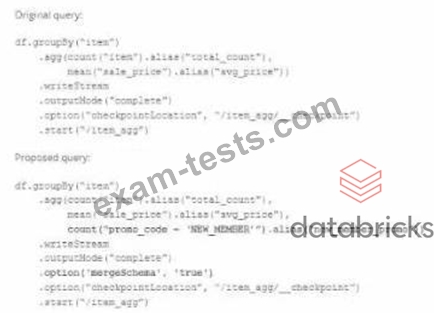
Which step must also be completed to put the proposed query into production?
Which step must also be completed to put the proposed query into production?
Question 14
A data architect has determined that a table of the following format is necessary:
Which of the following code blocks uses SQL DDL commands to create an empty Delta table in the above
format regardless of whether a table already exists with this name?
Which of the following code blocks uses SQL DDL commands to create an empty Delta table in the above
format regardless of whether a table already exists with this name?
Question 15
A team of data engineer are adding tables to a DLT pipeline that contain repetitive expectations for many of the same data quality checks.
One member of the team suggests reusing these data quality rules across all tables defined for this pipeline.
What approach would allow them to do this?
One member of the team suggests reusing these data quality rules across all tables defined for this pipeline.
What approach would allow them to do this?