

Question 6
A data scientist has replaced missing values in their feature set with each respective feature variable's median value. A colleague suggests that the data scientist is throwing away valuable information by doing this.
Which of the following approaches can they take to include as much information as possible in the feature set?
Which of the following approaches can they take to include as much information as possible in the feature set?
Question 7
A data scientist wants to use Spark ML to impute missing values in their PySpark DataFrame features_df. They want to replace missing values in all numeric columns in features_df with each respective numeric column's median value.
They have developed the following code block to accomplish this task:
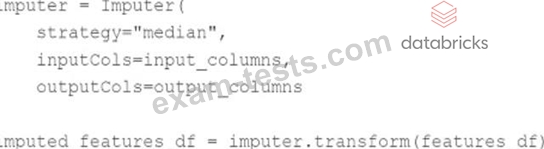
The code block is not accomplishing the task.
Which reasons describes why the code block is not accomplishing the imputation task?
They have developed the following code block to accomplish this task:
The code block is not accomplishing the task.
Which reasons describes why the code block is not accomplishing the imputation task?
Question 8
A health organization is developing a classification model to determine whether or not a patient currently has a specific type of infection. The organization's leaders want to maximize the number of positive cases identified by the model.
Which of the following classification metrics should be used to evaluate the model?
Which of the following classification metrics should be used to evaluate the model?
Question 9
A data scientist has a Spark DataFrame spark_df. They want to create a new Spark DataFrame that contains only the rows from spark_df where the value in column price is greater than 0.
Which of the following code blocks will accomplish this task?
Which of the following code blocks will accomplish this task?
Question 10
Which of the Spark operations can be used to randomly split a Spark DataFrame into a training DataFrame and a test DataFrame for downstream use?