

Question 16
A machine learning engineer is trying to scale a machine learning pipeline by distributing its single-node model tuning process. After broadcasting the entire training data onto each core, each core in the cluster can train one model at a time. Because the tuning process is still running slowly, the engineer wants to increase the level of parallelism from 4 cores to 8 cores to speed up the tuning process. Unfortunately, the total memory in the cluster cannot be increased.
In which of the following scenarios will increasing the level of parallelism from 4 to 8 speed up the tuning process?
In which of the following scenarios will increasing the level of parallelism from 4 to 8 speed up the tuning process?
Question 17
A data scientist is using MLflow to track their machine learning experiment. As a part of each of their MLflow runs, they are performing hyperparameter tuning. The data scientist would like to have one parent run for the tuning process with a child run for each unique combination of hyperparameter values. All parent and child runs are being manually started with mlflow.start_run.
Which of the following approaches can the data scientist use to accomplish this MLflow run organization?
Which of the following approaches can the data scientist use to accomplish this MLflow run organization?
Question 18
A data scientist uses 3-fold cross-validation when optimizing model hyperparameters for a regression problem. The following root-mean-squared-error values are calculated on each of the validation folds:
* 10.0
* 12.0
* 17.0
Which of the following values represents the overall cross-validation root-mean-squared error?
* 10.0
* 12.0
* 17.0
Which of the following values represents the overall cross-validation root-mean-squared error?
Question 19
A data scientist uses 3-fold cross-validation and the following hyperparameter grid when optimizing model hyperparameters via grid search for a classification problem:
* Hyperparameter 1: [2, 5, 10]
* Hyperparameter 2: [50, 100]
Which of the following represents the number of machine learning models that can be trained in parallel during this process?
* Hyperparameter 1: [2, 5, 10]
* Hyperparameter 2: [50, 100]
Which of the following represents the number of machine learning models that can be trained in parallel during this process?
Question 20
A data scientist wants to efficiently tune the hyperparameters of a scikit-learn model. They elect to use the Hyperopt library's fmin operation to facilitate this process. Unfortunately, the final model is not very accurate. The data scientist suspects that there is an issue with the objective_function being passed as an argument to fmin.
They use the following code block to create the objective_function:
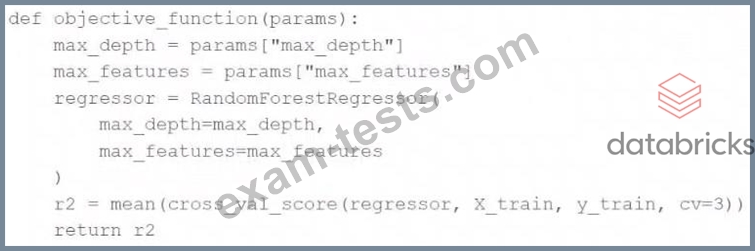
Which of the following changes does the data scientist need to make to their objective_function in order to produce a more accurate model?
They use the following code block to create the objective_function:
Which of the following changes does the data scientist need to make to their objective_function in order to produce a more accurate model?
Premium Bundle
Newest Databricks-Machine-Learning-Associate Exam PDF Dumps shared by BraindumpsPass.com for Helping Passing Databricks-Machine-Learning-Associate Exam! BraindumpsPass.com now offer the updated Databricks-Machine-Learning-Associate exam dumps, the BraindumpsPass.com Databricks-Machine-Learning-Associate exam questions have been updated and answers have been corrected get the latest BraindumpsPass.com Databricks-Machine-Learning-Associate pdf dumps with Exam Engine here: