Application administrators are reporting that nodes different from those configured in the pool are selected. The use of an iRule is suspected. How can the BIG-IP Administrator check if an iRule is used for this traffic? (Pick the 2 correct responses below)
Correct Answer: B,D
To determine if an iRule is influencing traffic for a specific Virtual Server, the administrator must verify the association between the Virtual Server object and any applied scripts. In the BIG-IP Configuration Utility (GUI), this association is found under the Resources tab of the specific Virtual Server. While there is an " iRules " sub-menu under Local Traffic, checking the Virtual Server ' s Resources tab is the definitive way to see which specific rules are currently active and in what order they are being processed for that particular traffic flow. From the Command Line Interface (CLI), the tmsh list /ltm virtual < virtual_server > command provides a full text-based output of the virtual server ' s configuration. If iRules are applied, they will appear within a " rules { ... } " block in the command output. This is more effective than Option A, which only lists the contents of the iRule itself but does not show if or where it is applied. Option C is a common misconception; while some versions of the GUI have reorganized menus, the standard location for managing the association of profiles, policies, and iRules to a Virtual Server remains the " Resources " section. By identifying the applied iRule, an administrator can then review the script logic-often containing commands like pool or node-to see if it is overriding the default pool selection based on specific HTTP headers, URI paths, or client IP addresses.
Question 7
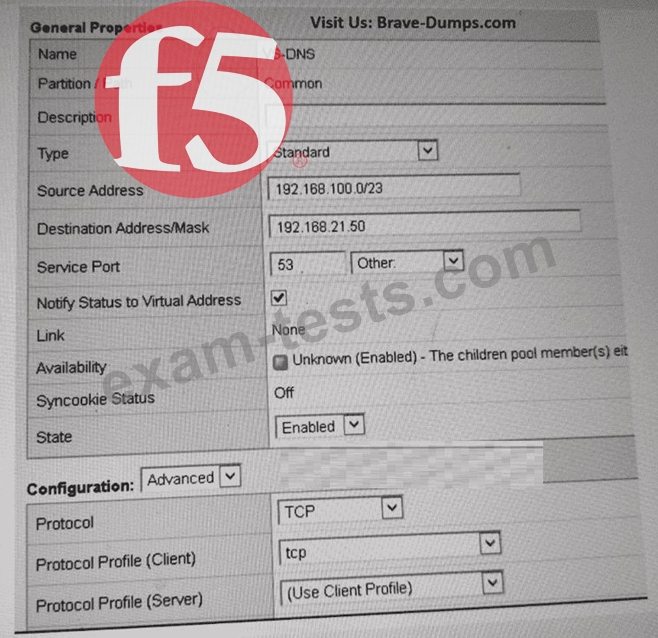
Refer to the exhibit. DNS queries from two internal DNS servers are being load-balanced to external DNS servers via a virtual server on a BIG-IP device. The DNS queries originate from: 192.168.10.100 192.168.10.200 and target: 192.168.2.150 All DNS queries destined for the external DNS servers fail. Which property change should the BIG-IP Administrator make in the Virtual Server to resolve this issue? (Choose one answer)
Correct Answer: D
DNS traffic is primarily transported using UDP port 53. In the exhibit, the Virtual Server is configured with the Protocol set to TCP, which prevents standard DNS queries from being processed correctly. BIG-IP Virtual Servers must be configured with the correct Layer 4 protocol to match the application traffic they are handling. According to the BIG-IP Administration: Data Plane Configuration documentation: The Protocol setting on a Virtual Server defines whether traffic is processed as TCP, UDP, or another supported transport protocol. Standard DNS queries and responses use UDP, while TCP is only required for DNS zone transfers (AXFR) or exceptionally large responses. When a DNS Virtual Server is incorrectly configured with TCP, UDP-based DNS queries are dropped, causing all requests to fail. Why the other options are incorrect: A). Protocol profile (Client) to DNS_OPTIMIZEDA DNS profile enhances DNS functionality but does not correct an incorrect transport protocol configuration. B). Type to Performance (HTTP)Performance (HTTP) Virtual Servers are designed for HTTP traffic and are not suitable for DNS services. C). Source Address to 192.168.10.0/24The existing source IPs already fall within the allowed range, so this setting does not address the failure. Correct Resolution: Changing the Protocol to UDP aligns the Virtual Server with standard DNS transport requirements, allowing DNS queries to be successfully processed and load-balanced.
Question 8
A BIG-IP Administrator needs to modify a virtual server that will offload web traffic compression tasks from the target server. Which two profiles must the BIG-IP Administrator apply to a virtual server to enable compression? (Pick the 2 correct responses below)
Correct Answer: B,E
HTTP Compression on a BIG-IP system is an optimization feature that reduces the size of HTTP responses sent to clients, thereby saving bandwidth and improving page load times for end-users. To implement this functionality on a Virtual Server, the system requires two specific profiles to work in tandem: an HTTP profile and a Compression profile. The HTTP profile (Option E) is a prerequisite because compression is an application-layer (Layer 7) operation. The BIG-IP must be "HTTP-aware" to parse the incoming requests and outgoing responses. The HTTP profile allows the BIG-IP to inspect the Accept-Encoding header from the client (to see if the client supports gzip or deflate) and to modify the Content-Encoding and Vary headers in the server's response. Without the HTTP profile, the Virtual Server operates at Layer 4 (TCP) and sees the traffic only as an opaque stream of bytes, making compression impossible. The Compression profile (Option B) contains the actual settings and engine for the task. It defines which content types should be compressed (e.g., text/html, application/javascript), the compression level, and the minimum content length required before compression is applied. While a Stream profile (Option D) is used for data replacement (search and replace) and SSL profiles (Option C) are used for encryption, they do not provide compression logic. By applying both the HTTP and Compression profiles, the BIG-IP can successfully intercept server responses, compress the payload according to the configured policy, and deliver the optimized data to the user, effectively offloading the CPU-intensive compression work from the backend web servers.
Question 9
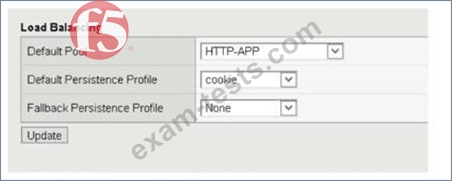
Exhibit: Due to a change in application requirements, a BIG-IP Administrator needs to modify the configuration of a Virtual Server to include a Fallback Persistence Profile. Which persistence profile type should the BIG-IP Administrator use for this purpose?
Correct Answer: B
In a BIG-IP environment, a Fallback Persistence Profile is utilized as a secondary "stickiness" mechanism when the primary (Default) persistence method fails to provide a valid persistence record. For example, if a Virtual Server uses HTTP Cookie Persistence as its primary method, but a client's browser has cookies disabled, the BIG-IP will be unable to find a persistence cookie in the request. Without a fallback method, the system would treat every request from that client as a new, independent connection, potentially breaking the application session. Source Address Affinity (also known as Source Address Persistence) is the most common and standard choice for a fallback profile. It operates at the network layer (Layer 3) by tracking the client's source IP address. Because every IP packet contains a source address, this method is virtually guaranteed to work even when application-layer data (like Cookies or SSL Session IDs) is missing or encrypted beyond the BIG-IP's visibility. While Universal (Option A) and Hash (Option D) profiles are highly flexible and can use iRules to persist on almost any data, they require specific configuration and logic that may not always be present or valid. SSL persistence (Option C) relies on the SSL Session ID, which frequently changes due to modern browser security practices (session renegotiation), making it less reliable than Source Address Affinity. By configuring Source Address Affinity as the fallback, the administrator ensures that the BIG-IP has a "safety net" to maintain session integrity based on the client's IP address when the more granular cookie-based persistence is unavailable.
Question 10
A BIG-IP Administrator creates a new Virtual Server. The end user is unable to access the page. During troubleshooting, the administrator learns that the connection between the BIG-IP system and server is NOT set up correctly. What should the administrator do to solve this issue? (Choose one answer)
Correct Answer: D
The issue described is a classic symptom of asymmetric routing, which frequently occurs when the BIG-IP system and the back-end servers reside on the same subnet (often referred to as a " one-arm " deployment). The Routing Problem: By default, the BIG-IP system preserves the original client source IP address when forwarding traffic to a pool member. If the server is in the same subnet as the client or if the server ' s default gateway is not the BIG-IP, the server will attempt to send its response directly back to the client's IP address, bypassing the BIG-IP. Stateful Failure: Since the BIG-IP is a Full Proxy, it maintains a state table. Because the response packet never returns through the BIG-IP, the system cannot complete the three-way handshake or manage the application session, resulting in a connection failure for the user. The Solution (SNAT): Enabling Source Network Address Translation (SNAT) solves this by changing the source IP address of the request to an IP address owned by the BIG-IP (typically a self-IP). Requirement for Subnet Alignment: To ensure the server sends the response back to the BIG-IP, the translation address must be reachable. By using a self-IP configured in the same subnet as the servers, the BIG-IP ensures that the server sees the request coming from a local " neighbor. " The server will then naturally send the response back to that self-IP, allowing the BIG-IP to translate the packet back and forward it to the client. Why other options are incorrect: A: Disabling address translation would ensure the server-side traffic uses the client IP, making asymmetric routing inevitable in this scenario. B: This is technically contradictory; " Auto Map " specifically uses existing self-IPs and does not require or use a " SNAT pool " configuration. C: While using a specific translation address can work, it does not inherently guarantee the Layer 2/Layer 3 reachability mentioned in the scenario as effectively as ensuring the self-IP is correctly placed in the server ' s subnet.