Correct Answer: D
Comprehensive and Detailed In-Depth Explanation:In OSPFv3, Link State Advertisements (LSAs) are used to describe the network topology and routing information. The behavior of LSAs in different area types, such as Not-So-Stubby Areas (NSSAs), is critical to understanding this question. Let's break it down step by step:
* Understanding Area 1 as an NSSA:
* An NSSA (Not-So-Stubby Area) is a special type of OSPF area that allows the importation of external routes (Type 7 LSAs, also known as NSSA LSAs) while preventing the flooding of AS- External LSAs (Type 5 LSAs) from other areas into the NSSA. This is done to reduce the amount of routing information within the area while still allowing limited external route advertisement.
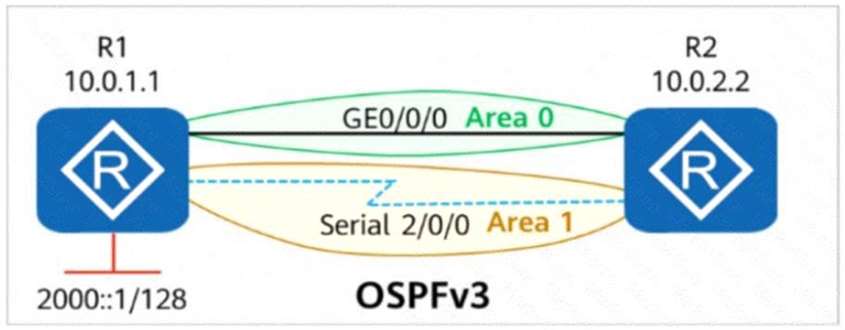
* In an NSSA, external routes (like the one imported by R1, 2000::1/128) are advertised as Type 7 LSAs within the NSSA and are translated into Type 5 LSAs by the Area Border Router (ABR) when they need to be advertised into other areas (e.g., the backbone area, Area 0). However, Type 5 LSAs (AS-External-LSAs) are not flooded into the NSSA itself.
* Analyzing the LSAs in the Options:
* A. Inter-Area-Prefix-LSA: These LSAs (Type 3 LSAs in OSPFv3) are used to advertise prefixes between areas. In an NSSA, Inter-Area-Prefix-LSAs can exist because they are used by the ABR to summarize and advertise routes from other areas (like Area 0) into Area 1. Therefore, this LSA exists in Area 1.
* B. NSSA LSA: These are Type 7 LSAs in OSPFv3, specific to NSSAs. They are used to advertise external routes (like the 2000::1/128 route imported by R1) within the NSSA. Since Area 1 is an NSSA and R1 is importing an external route, NSSA LSAs exist in Area 1.
* C. Intra-Area-Prefix-LSA: These LSAs (Type 1 and Type 2 LSAs, or their OSPFv3 equivalents) are used to advertise prefixes within the same area. In Area 1, Intra-Area-Prefix- LSAs exist to describe the internal topology and prefixes of Area 1, so this LSA is present.
* D. AS-External-LSA: These are Type 5 LSAs in OSPFv3, used to advertise external routes throughout the OSPF domain (outside the autonomous system). However, in an NSSA, Type 5 LSAs are not flooded into the area to keep it stubby-like. Instead, external routes are advertised as Type 7 LSAs (NSSA LSAs) within the NSSA and are only converted to Type 5 LSAs by the ABR when exiting the NSSA. Therefore, AS-External-LSAs (Type 5 LSAs) do not exist in Area
1.
* Role of R1 and the External Route:
* R1 is importing the external route 2000::1/128 into OSPFv3, which means it acts as an Autonomous System Boundary Router (ASBR) within Area 1. As an ASBR in an NSSA, R1 advertises this external route as a Type 7 LSA (NSSA LSA) within Area 1. This Type 7 LSA is then translated by the ABR (if R1 is not the ABR, or by another ABR in Area 1) into a Type 5 LSA for advertisement into other areas (e.g., Area 0). However, the Type 5 LSA (AS-External- LSA) does not exist within Area 1 itself, as NSSAs block Type 5 LSAs.
* Conclusion:
* Given that Area 1 is an NSSA, and Type 5 LSAs (AS-External-LSAs) are not flooded into NSSAs, the AS-External-LSA does not exist in Area 1. All other LSAs (Inter-Area-Prefix-LSA, NSSA LSA, and Intra-Area-Prefix-LSA) can exist in Area 1 based on the topology and the role of R1 as an ASBR.
Therefore, the correct answer is D, as AS-External-LSAs do not exist in Area 1.
References to HCIP-Datacom-Advanced Routing & Switching Technology Documents:
* HCIP-Datacom-Advanced Routing & Switching Technology V1.0, Section on OSPFv3: OSPF Area Types and LSA Types (specifically NSSA behavior, Type 5 and Type 7 LSAs).
* HCIP-Datacom-Advanced Routing & Switching Technology V1.0, Chapter on OSPF Routing Protocols: LSAs in Different Area Types and External Route Handling.