

Question 51
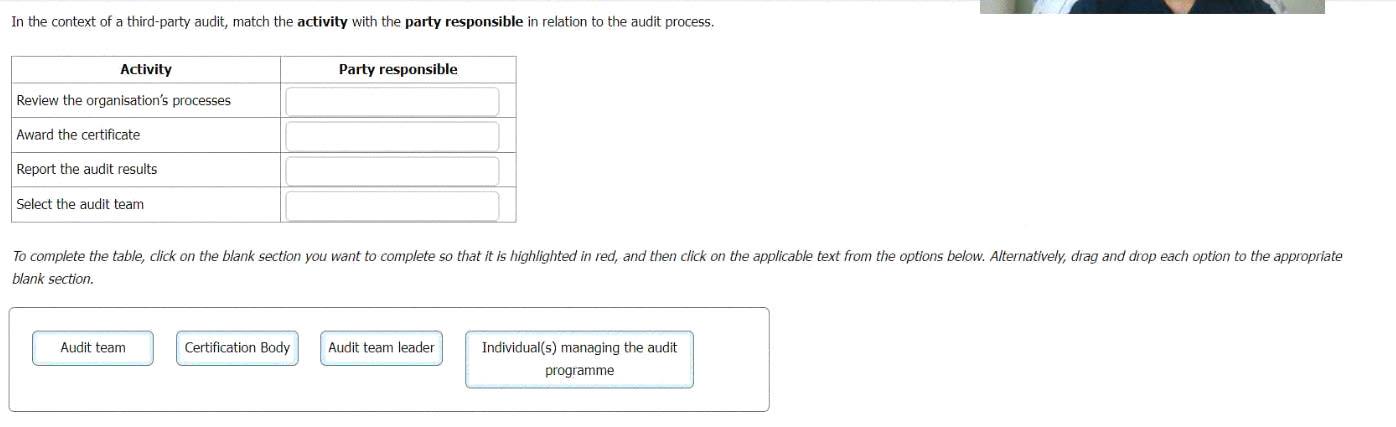
In the context of a third-party audit, match the activity with the party responsible in relation to the audit process.

Question 52
Below are four of the seven principles on which ISO 9000 series are based. Match a potential benefit to each of the quality management principles (QMP).


Question 53
You are an auditor from a construction organisation who is conducting a second party audit to ISO 9001 at a steel rolling mill producing structural steelwork. When auditing the rolling process, you find that the operator who is unloading the furnace does not use the adjacent infrared pyrometer to measure the appropriate product temperature in readiness for the next production stage.
You: "How do you tell when the billet is ready for the rolling stage?"
Operator: "I've done this job for 20 years. I can tell by the bright red colour." You: "What happens if the colour is wrong?" Operator: "The billet goes back into the furnace." You: "Is the pyrometer ever used?" Operator: "Only in borderline cases." You continue to interview the operator and find that around 25% of the billets are sent back to the furnace.
This includes 80% of the borderline cases.
Select three options that would provide evidence of conformance with clause 9.1.1 of ISO 9001.
You: "How do you tell when the billet is ready for the rolling stage?"
Operator: "I've done this job for 20 years. I can tell by the bright red colour." You: "What happens if the colour is wrong?" Operator: "The billet goes back into the furnace." You: "Is the pyrometer ever used?" Operator: "Only in borderline cases." You continue to interview the operator and find that around 25% of the billets are sent back to the furnace.
This includes 80% of the borderline cases.
Select three options that would provide evidence of conformance with clause 9.1.1 of ISO 9001.
Question 54
You, as auditor, are in dialogue with the quality lead and managing director of a small business that supplies specialist laboratory equipment and furniture.
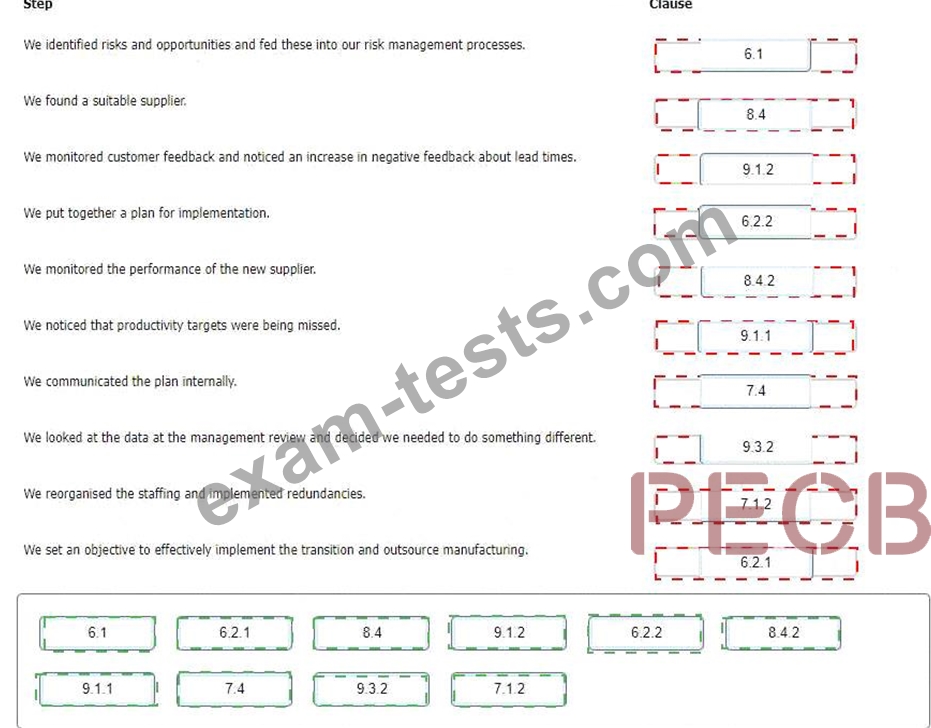
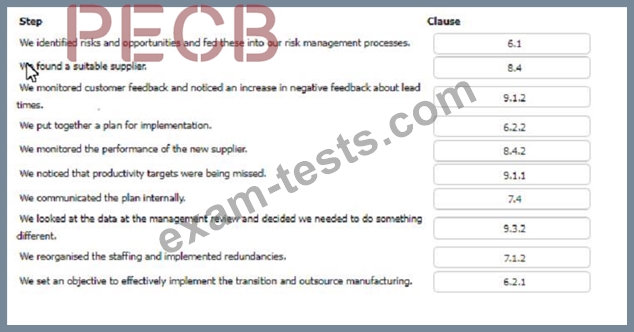
You: "I'd like to look at how you manage change in the organisation. What changes have you made as a business, say, over the last 12 months?" Auditee: "We have made some strategic changes, the main one being that we no longer manufacture our own products in house." You: "That sounds like quite a significant change. What has been the impact of that?" Auditee: "We now mainly sell other manufacturers' products, under their brand names, and have outsourced manufacture of our own brand products to one of our suppliers. Unfortunately, we had to make six members of our staff redundant. This represents about 20% of our workforce, so this has been quite a challenging time." You: "I'm sure. What were the reasons for making the change?" Auditee: "Our manufacturing section was a small operation, and we struggled to cope with fluctuations in demand. During busy periods, we found it hard to meet lead times, and in quiet periods we had staff with little to do. This was having an impact on customer satisfaction and meant we had to charge premium prices that made our product uncompetitive." You: "How did you go about the change?" In relation to the auditor's question about how the change was managed, the auditee mentions the steps listed below. Match the ISO 9001 clauses to the steps.
To complete the table, click on the blank section you want to complete so it is highlighted in red and then click on the ISO 9001 clauses listed below. Alternatively, drag and drop each clause to show which step the requirement applies to.

You: "I'd like to look at how you manage change in the organisation. What changes have you made as a business, say, over the last 12 months?" Auditee: "We have made some strategic changes, the main one being that we no longer manufacture our own products in house." You: "That sounds like quite a significant change. What has been the impact of that?" Auditee: "We now mainly sell other manufacturers' products, under their brand names, and have outsourced manufacture of our own brand products to one of our suppliers. Unfortunately, we had to make six members of our staff redundant. This represents about 20% of our workforce, so this has been quite a challenging time." You: "I'm sure. What were the reasons for making the change?" Auditee: "Our manufacturing section was a small operation, and we struggled to cope with fluctuations in demand. During busy periods, we found it hard to meet lead times, and in quiet periods we had staff with little to do. This was having an impact on customer satisfaction and meant we had to charge premium prices that made our product uncompetitive." You: "How did you go about the change?" In relation to the auditor's question about how the change was managed, the auditee mentions the steps listed below. Match the ISO 9001 clauses to the steps.
To complete the table, click on the blank section you want to complete so it is highlighted in red and then click on the ISO 9001 clauses listed below. Alternatively, drag and drop each clause to show which step the requirement applies to.
Question 55
Which two of the following should be included in an audit plan?