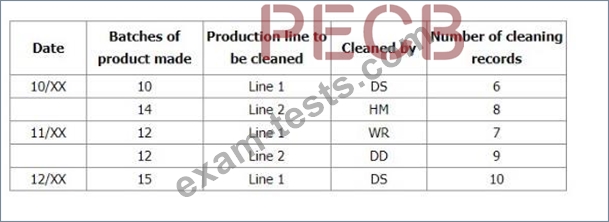
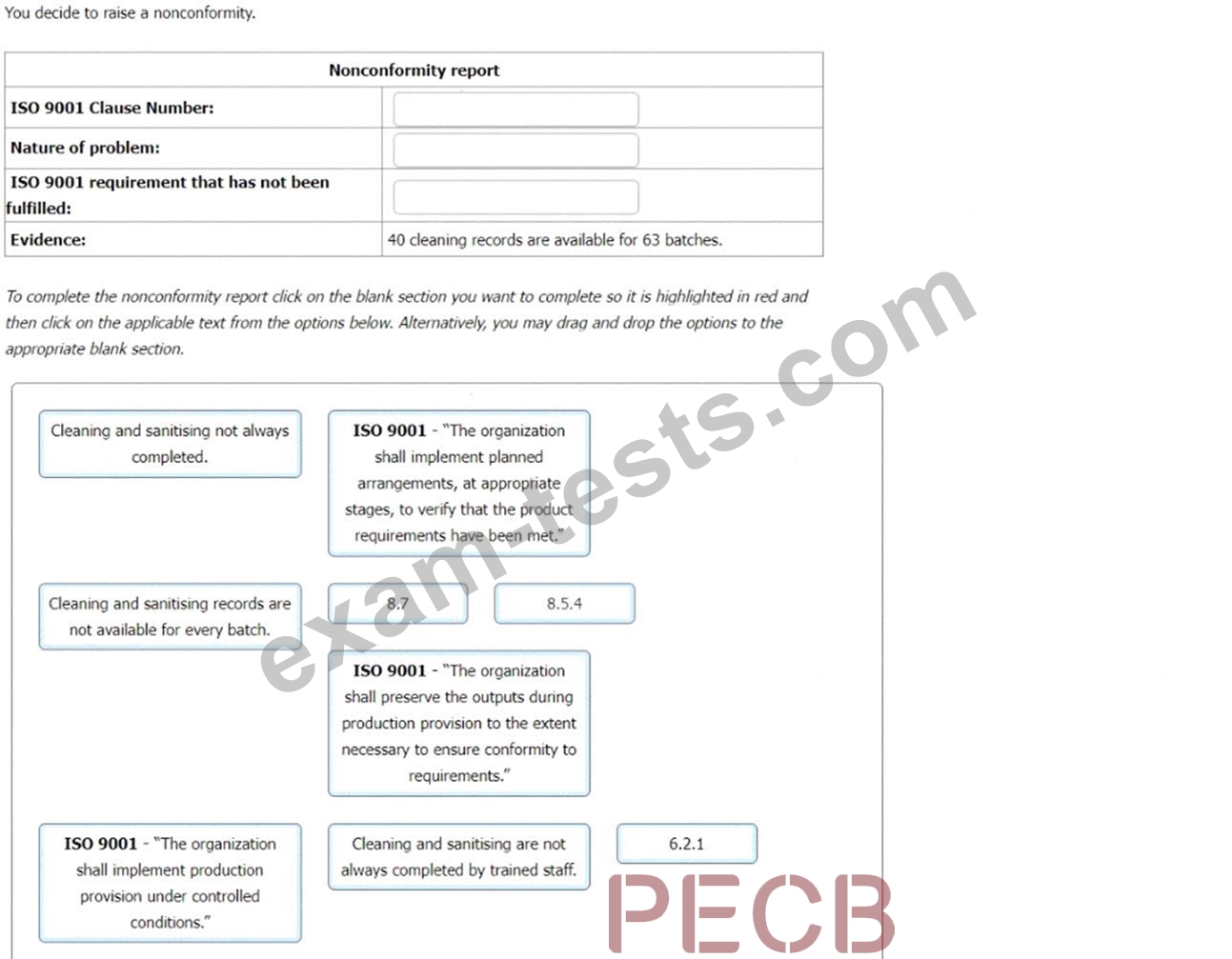
You are carrying out an audit at a single-site organisation seeking certification to ISO 9001 for the first time. The organization manufactures cosmetics for major retailers. You are interviewing the Manufacturing Manager (MM). You: "I would like to begin by looking at the cleaning controls." MM: "We record the cleaning of the equipment at the end of every batch. This document details the minimum cleaning frequency and the procedures to follow for all areas and each item of equipment. The person who carries out the cleaning puts their initial on the document and records the time and date alongside." Narrative: You sample production records over 3-days and note down evidence of nonconformity as per the table below.
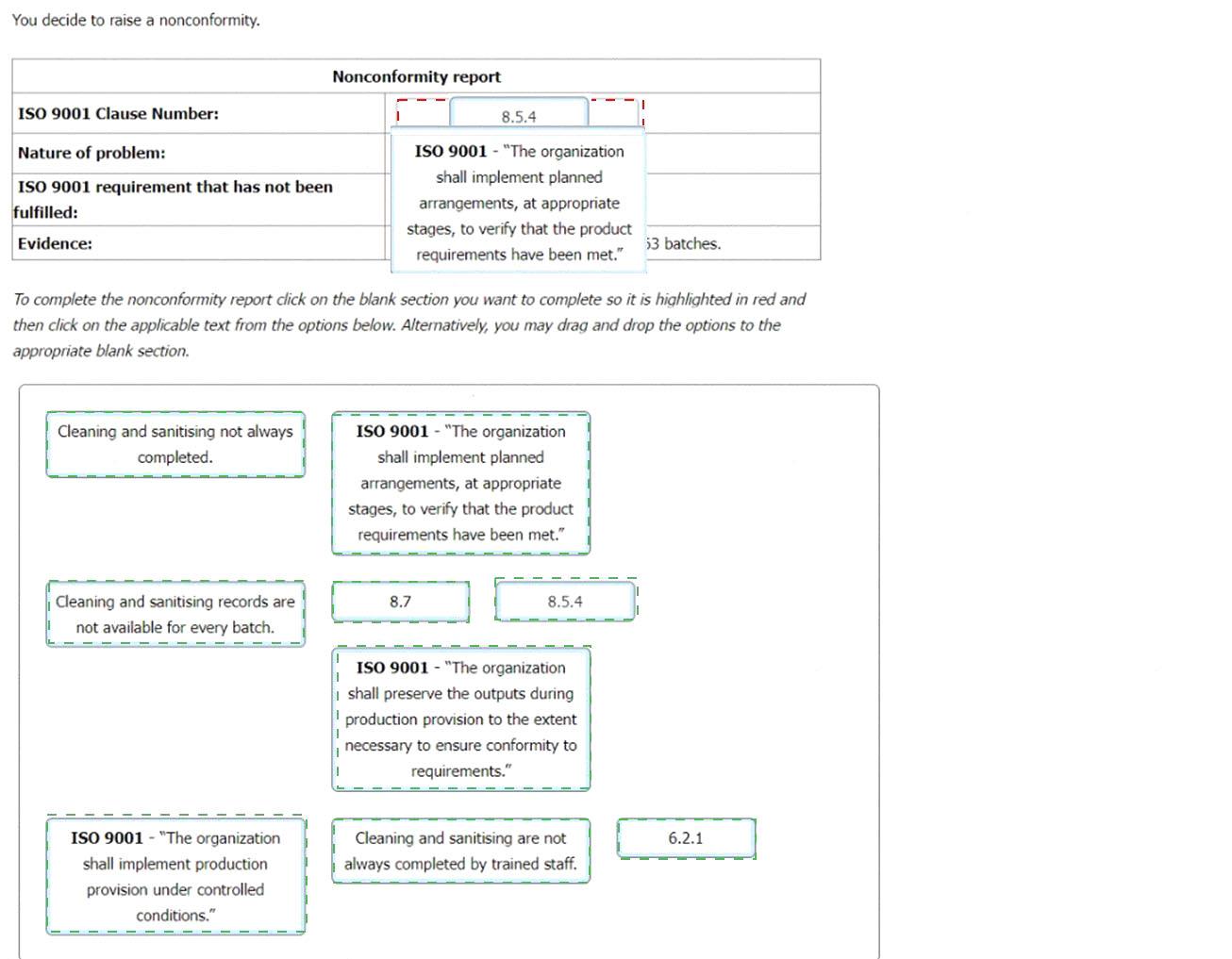
Correct Answer:
Explanation: Nonconformity report ISO 9001 Clause Number: 8.5.4 Nature of problem: Cleaning and sanitising records are not available for every batch. ISO 9001 requirement that has not been fulfilled: ISO 9001 - "The organization shall implement planned arrangements, at appropriate stages, to verify that the product requirements have been met." Evidence: 40 cleaning records are available for 63 batches.
Question 12
In the context of a third-party certification audit, it is very important to have effective communication. Which is not the responsibility of the audit team leader?
Correct Answer: A
Responsibilities of the Audit Team Leader:ISO 19011:2018 (guidelines for auditing management systems), which supports the principles in ISO 9001:2015, specifies the responsibilities of an audit team leader. These responsibilities include: * Planning the audit and establishing effective communication between the audit team and auditee. * Ensuring that formal communication channels are agreed upon and followed. * Reporting the audit progress, significant findings, and any concerns to the auditee or audit client as necessary. * Managing the audit team and ensuring adherence to the defined objectives and scope. Analysis of Options: * A. Reporting unattainable audit objectives to the accreditation body:Incorrect. This is not the responsibility of the audit team leader. The accreditation body oversees the certification body and is not directly involved in specific audits. If objectives are unattainable, the audit team leader would report them to the audit client (the certification body), not the accreditation body. * B. Planning formal communication arrangements:Correct. This is one of the responsibilities of the audit team leader. They ensure auditees can communicate with auditors as needed during the audit process. * C. Confirming communication channels during the opening meeting:Correct. During the opening meeting, the audit team leader must establish clear communication protocols to ensure effective information exchange between the audit team and auditee. * D. Communicating progress, findings, and concerns:Correct. Keeping the auditee and audit client informed about progress and significant findings is a critical responsibility of the audit team leader to maintain transparency and ensure the audit objectives are met. Why Option A is Correct:The audit team leader does not have any obligation to report unattainable objectives to the accreditation body. Instead, they are responsible for communicating issues to the audit client (typically the certification body). The accreditation body operates at a higher level and is concerned with overseeing certification bodies, not individual audits. Relevant References: * ISO 19011:2018, Clause 6.4 (Conducting the Audit): Emphasizes the responsibilities of the audit team leader, including communication with the auditee and client. * ISO 9001:2015, Clause 9.2 (Internal Audit): Highlights the importance of planning and communication during audits, which is reflected in third-party audits as well.
Question 13
'XYZ' has already sent to you a list with all documented procedures and work instructions related to the services provided to 'ABC' (a quality manual is not included in the list). To complete the audit planning which additional information would you ask to XYZ to submit? Select four.
Correct Answer: A,C,D,E
The ISO 9001 Lead Auditor exam requires the auditor to have a thorough understanding of the ISO 9001: 2015 standard and its requirements, as well as the organization's context, processes, risks, opportunities, and performance. Therefore, the auditor needs to ask for additional information that can help them verify these aspects during the audit planning stage. Some of the information that can be useful are: A description of responsibilities and authorities of the key roles of XYZ: This can help the auditor to identify who is accountable for what in the organization and how they communicate with each other. The number of personnel involved in activities related to the quality management system: This can help the auditor to assess if there are enough resources and competencies to support the QMS implementation and operation. Information to understand XYZ's operations: This can help the auditor to understand how XYZ produces or delivers its products or services and what are its main processes and inputs. The results of XYZ's last internal audit: This can help the auditor to evaluate if XYZ has implemented corrective actions based on previous audit findings and if it has maintained its QMS effectiveness. The results of the last two management reviews: This can help the auditor to determine if XYZ has monitored its QMS performance against its objectives and if it has identified any significant changes or opportunities for improvement. The quality manual (B) is not a required document for ISO 9001 certification, but it may be useful for internal reference or training purposes. It is not necessary for audit planning.
Question 14
You are a member of the audit team of a second-party audit of an organisation with 625 employees. The audit procedure recommends using sampling criteria which requires the review of the documented competence for 25 personnel. The audit team leader developed an audit plan allocating one hour to audit the Human Resources department (from 11:30 am to 12:30 pm). She told you that she could not allocate any additional time. What would you do?
Correct Answer: B
In this scenario, the time allocated by the audit team leader for the Human Resources audit is fixed, and as an auditor, you must work within that constraint. Although the sampling criteria suggests reviewing 25 personnel files, it is acceptable to adjust the sample size based on time and resource limitations. ISO 9001:2015 emphasizes risk-based thinking and practical resource management (Clause 7.1), so it is reasonable to review a smaller sample if the time is insufficient. Option B is a pragmatic approach, allowing you to focus on quality over quantity by reviewing as many cases as time allows without compromising the audit schedule. Options like extending the audit (A, C, D) are impractical in a structured audit environment, especially for second-party audits where maintaining the agreed schedule is important.
Question 15
Which two of the following are the key expected results of a quality management system that conforms to the requirements of ISO 9001:2015?
Correct Answer: A,E
The key expected results of a quality management system that conforms to the requirements of ISO 9001: 2015 are stated in clause 0.1 of the standard, which says: "The adoption of a quality management system is a strategic decision for an organization that can help to improve its overall performance and provide a sound basis for sustainable development initiatives. The potential benefits to an organization of implementing a quality management system based on this International Standard are: a) the ability to consistently provide products and services that meet customer and applicable statutory and regulatory requirements; b) facilitating opportunities to enhance customer satisfaction; c) addressing risks and opportunities associated with its context and objectives; d) the ability to demonstrate conformity to specified quality management system requirements." Therefore, the two options that best match these benefits are A and E, as they directly relate to providing products and services that meet customer requirements and enhancing customer satisfaction. The other options are not explicitly mentioned as key expected results, although they may be possible outcomes of implementing a quality management system. References: ISO 9001:2015 - Quality management systems - Requirements, Key Elements of an ISO 9001:2015 Quality Management System, What is ISO 9001 2015 as a Quality Management Systems?