Question 91
A global organization operates datacenters in many countries. There are private network links between these datacenters because all business data (but NOT metadata) must be exchanged over these private network connections.
The organization does not currently use AWS in any way.
The strategic decision has Just been made to rigorously minimize IT operations effort and investment going forward.
What combination of deployment options of the Anypoint Platform control plane and runtime plane(s) best serves this organization at the start of this strategic journey?
The organization does not currently use AWS in any way.
The strategic decision has Just been made to rigorously minimize IT operations effort and investment going forward.
What combination of deployment options of the Anypoint Platform control plane and runtime plane(s) best serves this organization at the start of this strategic journey?
Question 92
A global, high-volume shopping Mule application is being built and will be deployed to CloudHub. To improve performance, the Mule application uses a Cache scope that maintains cache state in a CloudHub object store. Web clients will access the Mule application over HTTP from all around the world, with peak volume coinciding with business hours in the web client's geographic location. To achieve optimal performance, what Anypoint Platform region should be chosen for the CloudHub object store?
Question 93
An organization currently uses a multi-node Mule runtime deployment model within their datacenter, so each Mule runtime hosts several Mule applications. The organization is planning to transition to a deployment model based on Docker containers in a Kubernetes cluster. The organization has already created a standard Docker image containing a Mule runtime and all required dependencies (including a JVM), but excluding the Mule application itself.
What is an expected outcome of this transition to container-based Mule application deployments?
What is an expected outcome of this transition to container-based Mule application deployments?
Question 94
A Mule application uses the Database connector.
What condition can the Mule application automatically adjust to or recover from without needing to restart or redeploy the Mule application?
What condition can the Mule application automatically adjust to or recover from without needing to restart or redeploy the Mule application?
Question 95
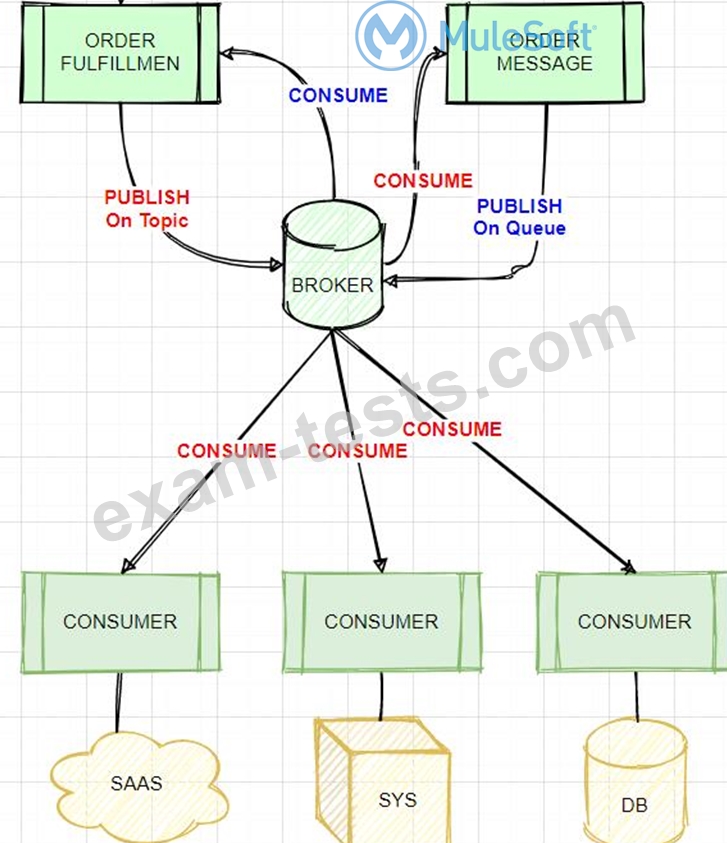
An Order microservice and a Fulfillment microservice are being designed to communicate with their dients through message-based integration (and NOT through API invocations).
The Order microservice publishes an Order message (a kind of command message) containing the details of an order to be fulfilled. The intention is that Order messages are only consumed by one Mute application, the Fulfillment microservice.
The Fulfilment microservice consumes Order messages, fulfills the order described therein, and then publishes an OrderFulfilted message (a kind of event message). Each OrderFulfilted message can be consumed by any interested Mule application, and the Order microservice is one such Mute application.
What is the most appropriate choice of message broker(s) and message destination(s) in this scenario?
The Order microservice publishes an Order message (a kind of command message) containing the details of an order to be fulfilled. The intention is that Order messages are only consumed by one Mute application, the Fulfillment microservice.
The Fulfilment microservice consumes Order messages, fulfills the order described therein, and then publishes an OrderFulfilted message (a kind of event message). Each OrderFulfilted message can be consumed by any interested Mule application, and the Order microservice is one such Mute application.
What is the most appropriate choice of message broker(s) and message destination(s) in this scenario?