

Question 6
An integration Mule application is being designed to process orders by submitting them to a backend system for offline processing. Each order will be received by the Mule application through an HTTPS POST and must be acknowledged immediately. Once acknowledged, the order will be submitted to a backend system. Orders that cannot be successfully submitted due to rejections from the backend system will need to be processed manually (outside the backend system).
The Mule application will be deployed to a customer-hosted runtime and is able to use an existing ActiveMQ broker if needed.
The backend system has a track record of unreliability both due to minor network connectivity issues and longer outages.
What idiomatic (used for their intended purposes) combination of Mule application components and ActiveMQ queues are required to ensure automatic submission of orders to the backend system, while minimizing manual order processing?
The Mule application will be deployed to a customer-hosted runtime and is able to use an existing ActiveMQ broker if needed.
The backend system has a track record of unreliability both due to minor network connectivity issues and longer outages.
What idiomatic (used for their intended purposes) combination of Mule application components and ActiveMQ queues are required to ensure automatic submission of orders to the backend system, while minimizing manual order processing?
Question 7
Refer to the exhibit.
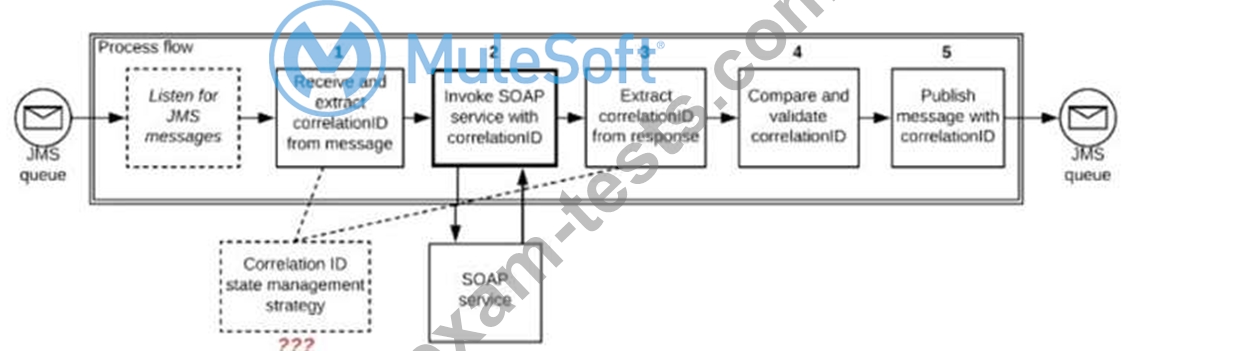
A Mule application is deployed to a multi-node Mule runtime cluster. The Mule application uses the competing consumer pattern among its cluster replicas to receive JMS messages from a JMS queue. To process each received JMS message, the following steps are performed in a flow:
Step l: The JMS Correlation ID header is read from the received JMS message.
Step 2: The Mule application invokes an idempotent SOAP webservice over HTTPS, passing the JMS Correlation ID as one parameter in the SOAP request.
Step 3: The response from the SOAP webservice also returns the same JMS Correlation ID.
Step 4: The JMS Correlation ID received from the SOAP webservice is validated to be identical to the JMS Correlation ID received in Step 1.
Step 5: The Mule application creates a response JMS message, setting the JMS Correlation ID message header to the validated JMS Correlation ID and publishes that message to a response JMS queue.
Where should the Mule application store the JMS Correlation ID values received in Step 1 and Step 3 so that the validation in Step 4 can be performed, while also making the overall Mule application highly available, fault-tolerant, performant, and maintainable?
A Mule application is deployed to a multi-node Mule runtime cluster. The Mule application uses the competing consumer pattern among its cluster replicas to receive JMS messages from a JMS queue. To process each received JMS message, the following steps are performed in a flow:
Step l: The JMS Correlation ID header is read from the received JMS message.
Step 2: The Mule application invokes an idempotent SOAP webservice over HTTPS, passing the JMS Correlation ID as one parameter in the SOAP request.
Step 3: The response from the SOAP webservice also returns the same JMS Correlation ID.
Step 4: The JMS Correlation ID received from the SOAP webservice is validated to be identical to the JMS Correlation ID received in Step 1.
Step 5: The Mule application creates a response JMS message, setting the JMS Correlation ID message header to the validated JMS Correlation ID and publishes that message to a response JMS queue.
Where should the Mule application store the JMS Correlation ID values received in Step 1 and Step 3 so that the validation in Step 4 can be performed, while also making the overall Mule application highly available, fault-tolerant, performant, and maintainable?
Question 8
A leading e-commerce giant will use Mulesoft API's on runtime fabric (RTF) to process customer orders. Some customer's sensitive information such as credit card information is also there as a part of a API payload.
What approach minimizes the risk of matching sensitive data to the original and can convert back to the original value whenever and wherever required?
What approach minimizes the risk of matching sensitive data to the original and can convert back to the original value whenever and wherever required?
Question 9
In preparation for a digital transformation initiative, an organization is reviewing related IT integration projects that failed for various for reason.
According to MuleSoft's surveys of global IT leaders, what is a common cause of IT project failure that this organization may likely discover in its assessment?
According to MuleSoft's surveys of global IT leaders, what is a common cause of IT project failure that this organization may likely discover in its assessment?
Question 10
An integration Mute application is being designed to process orders by submitting them to a backend system for offline processing. Each order will be received by the Mute application through an HTTPS POST and must be acknowledged immediately. Once acknowledged, the order will be submitted to a backend system. Orders that cannot be successfully submitted due to rejections from the backend system will need to be processed manually (outside the backend system).
The Mule application will be deployed to a customer-hosted runtime and is able to use an existing ActiveMQ broker if needed.
The backend system has a track record of unreliability both due to minor network connectivity issues and longer outages.
What idiomatic (used for their intended purposes) combination of Mule application components and ActiveMQ queues are required to ensure automatic submission of orders to the backend system, while minimizing manual order processing?
The Mule application will be deployed to a customer-hosted runtime and is able to use an existing ActiveMQ broker if needed.
The backend system has a track record of unreliability both due to minor network connectivity issues and longer outages.
What idiomatic (used for their intended purposes) combination of Mule application components and ActiveMQ queues are required to ensure automatic submission of orders to the backend system, while minimizing manual order processing?