

Question 11
An organization uses a set of customer-hosted Mule runtimes that are managed using the Mulesoft-hosted control plane. What is a condition that can be alerted on from Anypoint Runtime Manager without any custom components or custom coding?
Question 12
A set of integration Mule applications, some of which expose APIs, are being created to enable a new business process. Various stakeholders may be impacted by this. These stakeholders are a combination of semi-technical users (who understand basic integration terminology and concepts such as JSON and XML) and technically skilled potential consumers of the Mule applications and APIs.
What Is an effective way for the project team responsible for the Mule applications and APIs being built to communicate with these stakeholders using Anypoint Platform and its supplied toolset?
What Is an effective way for the project team responsible for the Mule applications and APIs being built to communicate with these stakeholders using Anypoint Platform and its supplied toolset?
Question 13
Refer to the exhibit.
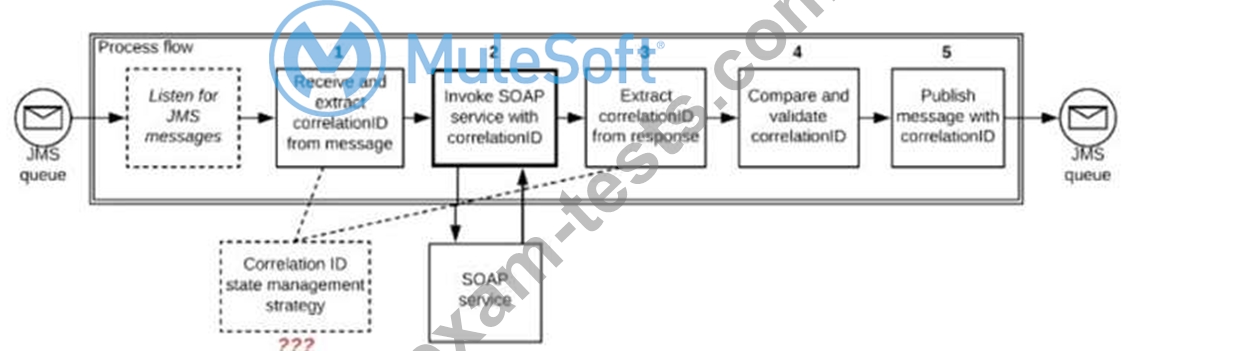
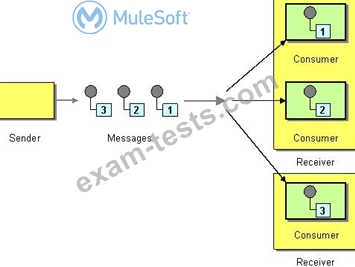
A Mule application is deployed to a multi-node Mule runtime cluster. The Mule application uses the competing consumer pattern among its cluster replicas to receive JMS messages from a JMS queue. To process each received JMS message, the following steps are performed in a flow:
Step l: The JMS Correlation ID header is read from the received JMS message.
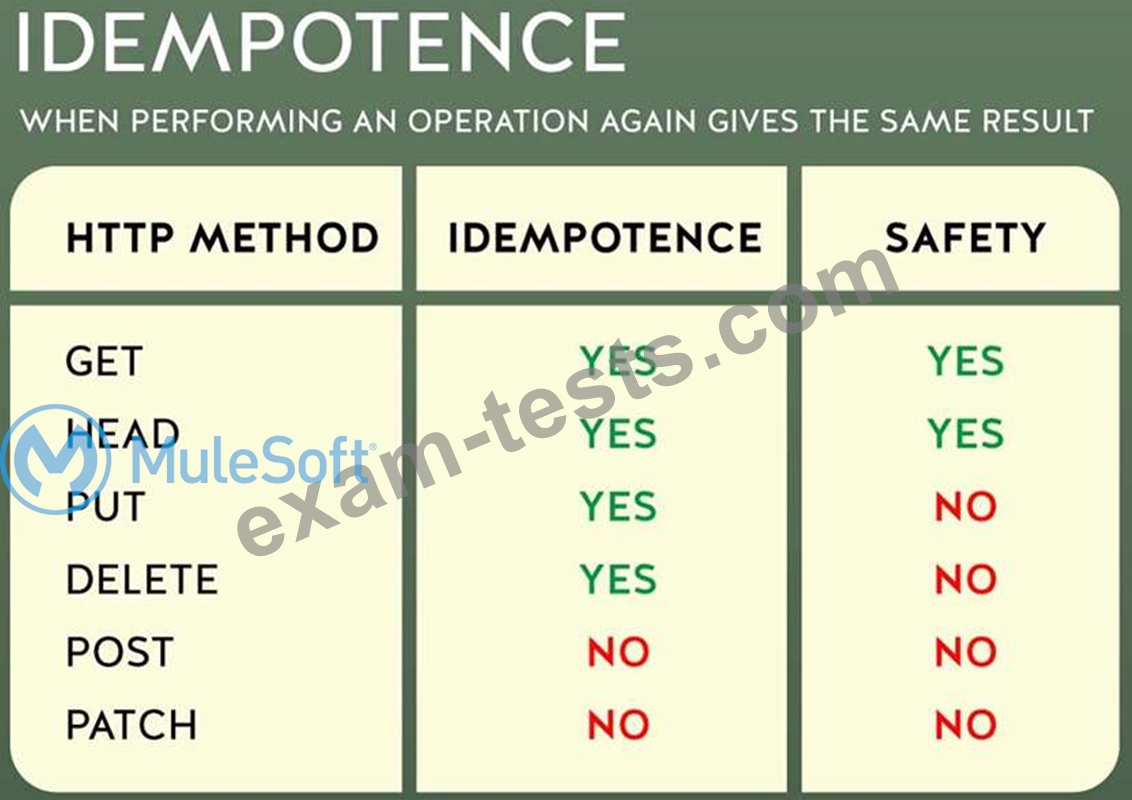
Step 2: The Mule application invokes an idempotent SOAP webservice over HTTPS, passing the JMS Correlation ID as one parameter in the SOAP request.
Step 3: The response from the SOAP webservice also returns the same JMS Correlation ID.
Step 4: The JMS Correlation ID received from the SOAP webservice is validated to be identical to the JMS Correlation ID received in Step 1.
Step 5: The Mule application creates a response JMS message, setting the JMS Correlation ID message header to the validated JMS Correlation ID and publishes that message to a response JMS queue.
Where should the Mule application store the JMS Correlation ID values received in Step 1 and Step 3 so that the validation in Step 4 can be performed, while also making the overall Mule application highly available, fault-tolerant, performant, and maintainable?
A Mule application is deployed to a multi-node Mule runtime cluster. The Mule application uses the competing consumer pattern among its cluster replicas to receive JMS messages from a JMS queue. To process each received JMS message, the following steps are performed in a flow:
Step l: The JMS Correlation ID header is read from the received JMS message.
Step 2: The Mule application invokes an idempotent SOAP webservice over HTTPS, passing the JMS Correlation ID as one parameter in the SOAP request.
Step 3: The response from the SOAP webservice also returns the same JMS Correlation ID.
Step 4: The JMS Correlation ID received from the SOAP webservice is validated to be identical to the JMS Correlation ID received in Step 1.
Step 5: The Mule application creates a response JMS message, setting the JMS Correlation ID message header to the validated JMS Correlation ID and publishes that message to a response JMS queue.
Where should the Mule application store the JMS Correlation ID values received in Step 1 and Step 3 so that the validation in Step 4 can be performed, while also making the overall Mule application highly available, fault-tolerant, performant, and maintainable?
Question 14
An organization has strict unit test requirement that mandate every mule application must have an MUnit test suit with a test case defined for each flow and a minimum test coverage of 80%.
A developer is building Munit test suit for a newly developed mule application that sends API request to an external rest API.
What is the effective approach for successfully executing the Munit tests of this new application while still achieving the required test coverage for the Munit tests?
A developer is building Munit test suit for a newly developed mule application that sends API request to an external rest API.
What is the effective approach for successfully executing the Munit tests of this new application while still achieving the required test coverage for the Munit tests?
Question 15
An organization has various integrations implemented as Mule applications. Some of these Mule applications are deployed to custom hosted Mule runtimes (on-premises) while others execute in the MuleSoft-hosted runtime plane (CloudHub). To perform the Integra functionality, theseMule applications connect to various backend systems, with multiple applications typically needing to access the backend systems.
How can the organization most effectively avoid creating duplicates in each Mule application of the credentials required to access the backend systems?
How can the organization most effectively avoid creating duplicates in each Mule application of the credentials required to access the backend systems?