

Question 11
Mule applications that implement a number of REST APIs are deployed to their own subnet that is inaccessible from outside the organization.
External business-partners need to access these APIs, which are only allowed to be invoked from a separate subnet dedicated to partners - called Partner-subnet. This subnet is accessible from the public internet, which allows these external partners to reach it.
Anypoint Platform and Mule runtimes are already deployed in Partner-subnet. These Mule runtimes can already access the APIs.
What is the most resource-efficient solution to comply with these requirements, while having the least impact on other applications that are currently using the APIs?
External business-partners need to access these APIs, which are only allowed to be invoked from a separate subnet dedicated to partners - called Partner-subnet. This subnet is accessible from the public internet, which allows these external partners to reach it.
Anypoint Platform and Mule runtimes are already deployed in Partner-subnet. These Mule runtimes can already access the APIs.
What is the most resource-efficient solution to comply with these requirements, while having the least impact on other applications that are currently using the APIs?
Question 12
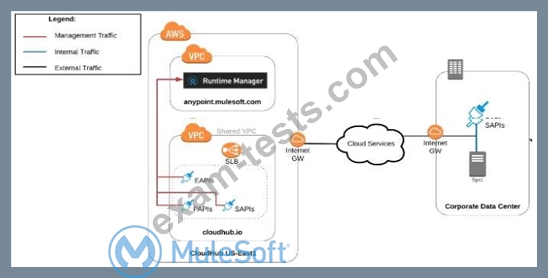
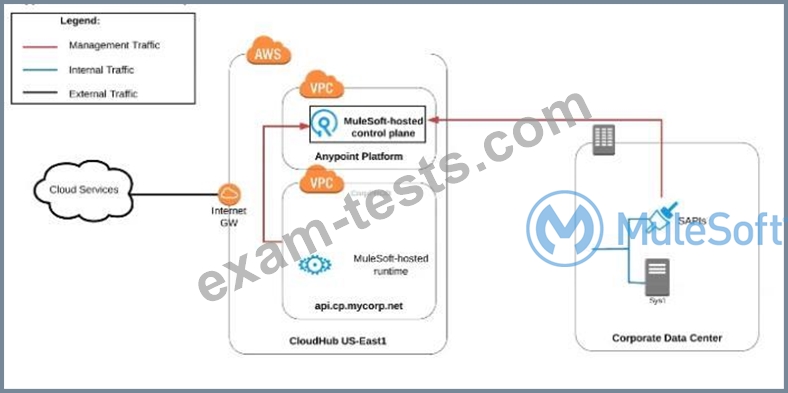
An organization uses various cloud-based SaaS systems and multiple on-premises systems. The on-premises systems are an important part of the organization's application network and can only be accessed from within the organization's intranet.
What is the best way to configure and use Anypoint Platform to support integrations with both the cloud-based SaaS systems and on-premises systems?
A) Use CloudHub-deployed Mule runtimes in an Anypoint VPC managed by Anypoint Platform Private Cloud Edition control plane

B) Use CloudHub-deployed Mule runtimes in the shared worker cloud managed by the MuleSoft-hosted Anypoint Platform control plane
C) Use an on-premises installation of Mule runtimes that are completely isolated with NO external network access, managed by the Anypoint Platform Private Cloud Edition control plane

D) Use a combination of Cloud Hub-deployed and manually provisioned on-premises Mule runtimes managed by the MuleSoft-hosted Anypoint Platform control plane
What is the best way to configure and use Anypoint Platform to support integrations with both the cloud-based SaaS systems and on-premises systems?
A) Use CloudHub-deployed Mule runtimes in an Anypoint VPC managed by Anypoint Platform Private Cloud Edition control plane
B) Use CloudHub-deployed Mule runtimes in the shared worker cloud managed by the MuleSoft-hosted Anypoint Platform control plane
C) Use an on-premises installation of Mule runtimes that are completely isolated with NO external network access, managed by the Anypoint Platform Private Cloud Edition control plane
D) Use a combination of Cloud Hub-deployed and manually provisioned on-premises Mule runtimes managed by the MuleSoft-hosted Anypoint Platform control plane
Question 13
Mule applications that implement a number of REST APIs are deployed to their own subnet that is inaccessible from outside the organization.
External business-partners need to access these APIs, which are only allowed to be invoked from a separate subnet dedicated to partners - called Partner-subnet. This subnet is accessible from the public internet, which allows these external partners to reach it.
Anypoint Platform and Mule runtimes are already deployed in Partner-subnet. These Mule runtimes can already access the APIs.
What is the most resource-efficient solution to comply with these requirements, while having the least impact on other applications that are currently using the APIs?
External business-partners need to access these APIs, which are only allowed to be invoked from a separate subnet dedicated to partners - called Partner-subnet. This subnet is accessible from the public internet, which allows these external partners to reach it.
Anypoint Platform and Mule runtimes are already deployed in Partner-subnet. These Mule runtimes can already access the APIs.
What is the most resource-efficient solution to comply with these requirements, while having the least impact on other applications that are currently using the APIs?
Question 14
An API implementation is being designed that must invoke an Order API, which is known to repeatedly experience downtime.
For this reason, a fallback API is to be called when the Order API is unavailable.
What approach to designing the invocation of the fallback API provides the best resilience?
For this reason, a fallback API is to be called when the Order API is unavailable.
What approach to designing the invocation of the fallback API provides the best resilience?
Question 15
What should be ensured before sharing an API through a public Anypoint Exchange portal?