

Question 21
What API policy would be LEAST LIKELY used when designing an Experience API that is intended to work with a consumer mobile phone or tablet application?
Question 22
A retail company with thousands of stores has an API to receive data about purchases and insert it into a single database. Each individual store sends a batch of purchase data to the API about every 30 minutes. The API implementation uses a database bulk insert command to submit all the purchase data to a database using a custom JDBC driver provided by a data analytics solution provider. The API implementation is deployed to a single CloudHub worker. The JDBC driver processes the data into a set of several temporary disk files on the CloudHub worker, and then the data is sent to an analytics engine using a proprietary protocol. This process usually takes less than a few minutes. Sometimes a request fails. In this case, the logs show a message from the JDBC driver indicating an out-of-file-space message. When the request is resubmitted, it is successful. What is the best way to try to resolve this throughput issue?
Question 23
What is true about API implementations when dealing with legal regulations that require all data processing to be performed within a certain jurisdiction (such as in the USA or the EU)?
Question 24
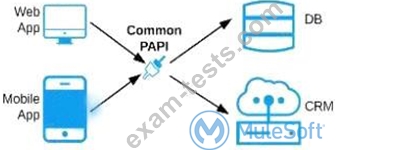
Refer to the exhibit. An organization needs to enable access to their customer data from both a mobile app and a web application, which each need access to common fields as well as certain unique fields.
The data is available partially in a database and partially in a 3rd-party CRM system.
What APIs should be created to best fit these design requirements?

A) A Process API that contains the data required by both the web and mobile apps, allowing these applications to invoke it directly and access the data they need thereby providing the flexibility to add more fields in the future without needing API changes
B) One set of APIs (Experience API, Process API, and System API) for the web app, and another set for the mobile app
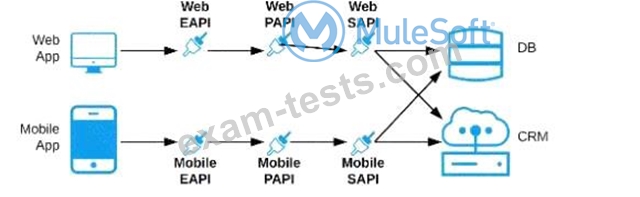
C) Separate Experience APIs for the mobile and web app, but a common Process API that invokes separate System APIs created for the database and CRM system

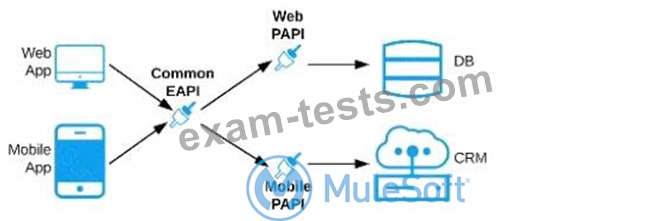
D) A common Experience API used by both the web and mobile apps, but separate Process APIs for the web and mobile apps that interact with the database and the CRM System
The data is available partially in a database and partially in a 3rd-party CRM system.
What APIs should be created to best fit these design requirements?
A) A Process API that contains the data required by both the web and mobile apps, allowing these applications to invoke it directly and access the data they need thereby providing the flexibility to add more fields in the future without needing API changes
B) One set of APIs (Experience API, Process API, and System API) for the web app, and another set for the mobile app
C) Separate Experience APIs for the mobile and web app, but a common Process API that invokes separate System APIs created for the database and CRM system
D) A common Experience API used by both the web and mobile apps, but separate Process APIs for the web and mobile apps that interact with the database and the CRM System
Question 25
When designing an upstream API and its implementation, the development team has been advised to NOT set timeouts when invoking a downstream API, because that downstream API has no SLA that can be relied upon.
This is the only downstream API dependency of that upstream API.
This is the only downstream API dependency of that upstream API.