

Question 46
How are an API implementation, API client, and API consumer combined to invoke and process an API?
Question 47
Refer to the exhibit.
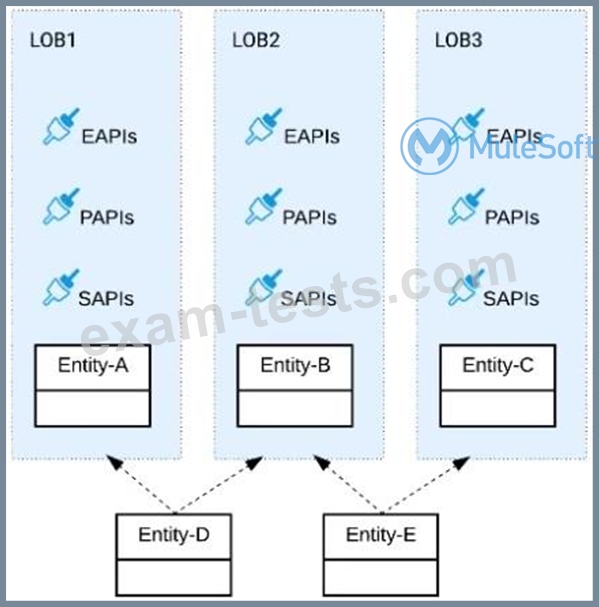
Three business processes need to be implemented, and the implementations need to communicate with several different SaaS applications.
These processes are owned by separate (siloed) LOBs and are mainly independent of each other, but do share a few business entities. Each LOB has one development team and their own budget In this organizational context, what is the most effective approach to choose the API data models for the APIs that will implement these business processes with minimal redundancy of the data models?
A) Build several Bounded Context Data Models that align with coherent parts of the business processes and the definitions of associated business entities
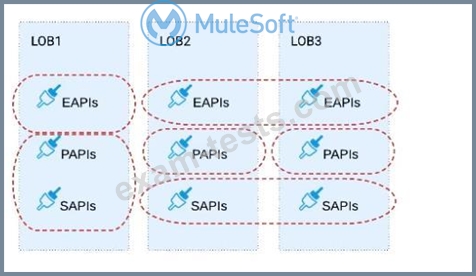
B) Build distinct data models for each API to follow established micro-services and Agile API-centric practices
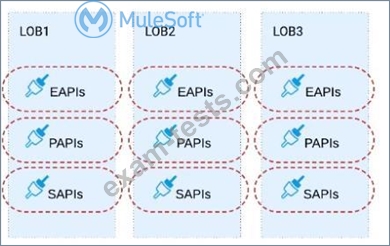
C) Build all API data models using XML schema to drive consistency and reuse across the organization

D) Build one centralized Canonical Data Model (Enterprise Data Model) that unifies all the data types from all three business processes, ensuring the data model is consistent and non-redundant
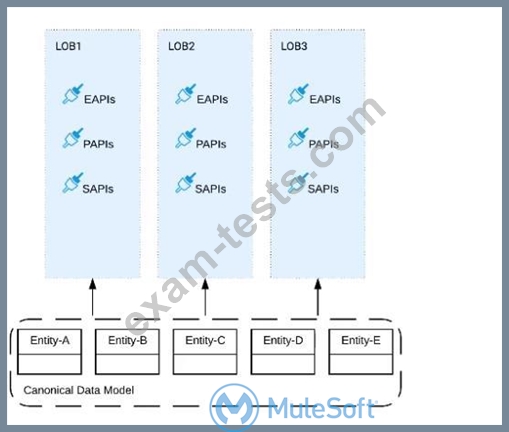
Three business processes need to be implemented, and the implementations need to communicate with several different SaaS applications.
These processes are owned by separate (siloed) LOBs and are mainly independent of each other, but do share a few business entities. Each LOB has one development team and their own budget In this organizational context, what is the most effective approach to choose the API data models for the APIs that will implement these business processes with minimal redundancy of the data models?
A) Build several Bounded Context Data Models that align with coherent parts of the business processes and the definitions of associated business entities
B) Build distinct data models for each API to follow established micro-services and Agile API-centric practices
C) Build all API data models using XML schema to drive consistency and reuse across the organization
D) Build one centralized Canonical Data Model (Enterprise Data Model) that unifies all the data types from all three business processes, ensuring the data model is consistent and non-redundant
Question 48
Which component monitors APIs and endpoints at scheduled intervals, receives reports about whether tests pass or fail, and displays statistics about API and endpoint performance?
Question 49
Refer to the exhibit. An organization needs to enable access to their customer data from both a mobile app and a web application, which each need access to common fields as well as certain unique fields.
The data is available partially in a database and partially in a 3rd-party CRM system.
What APIs should be created to best fit these design requirements?

A)A Process API that contains the data required by both the web and mobile apps, allowing these applications to invoke it directly and access the data they need thereby providing the flexibility to add more fields in the future without needing API changes

B)One set of APIs (Experience API, Process API, and System API) for the web app, and another set for the mobile app

C)Separate Experience APIs for the mobile and web app, but a common Process API that invokes separate System APIs created for the database and CRM system

D)A common Experience API used by both the web and mobile apps, but separate Process APIs for the web and mobile apps that interact with the database and the CRM System

The data is available partially in a database and partially in a 3rd-party CRM system.
What APIs should be created to best fit these design requirements?
A)A Process API that contains the data required by both the web and mobile apps, allowing these applications to invoke it directly and access the data they need thereby providing the flexibility to add more fields in the future without needing API changes
B)One set of APIs (Experience API, Process API, and System API) for the web app, and another set for the mobile app
C)Separate Experience APIs for the mobile and web app, but a common Process API that invokes separate System APIs created for the database and CRM system
D)A common Experience API used by both the web and mobile apps, but separate Process APIs for the web and mobile apps that interact with the database and the CRM System
Question 50
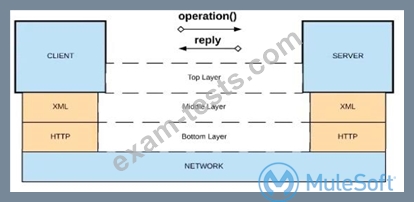
Refer to the exhibit.
What is a valid API in the sense of API-led connectivity and application networks?
A) Java RMI over TCP
B) Java RMI over TCP
C) CORBA over HOP
D) XML over UDP
What is a valid API in the sense of API-led connectivity and application networks?
A) Java RMI over TCP
B) Java RMI over TCP
C) CORBA over HOP
D) XML over UDP
