

Question 51
What condition requires using a CloudHub Dedicated Load Balancer?
Question 52
When designing an upstream API and its implementation, the development team has been advised to NOT set timeouts when invoking a downstream API, because that downstream API has no SLA that can be relied upon.
This is the only downstream API dependency of that upstream API.
Assume the downstream API runs uninterrupted without crashing. What is the impact of this advice?
This is the only downstream API dependency of that upstream API.
Assume the downstream API runs uninterrupted without crashing. What is the impact of this advice?
Question 53
A set of tests must be performed prior to deploying API implementations to a staging environment. Due to data security and access restrictions, untested APIs cannot be granted access to the backend systems, so instead mocked data must be used for these tests. The amount of available mocked data and its contents is sufficient to entirely test the API implementations with no active connections to the backend systems. What type of tests should be used to incorporate this mocked data?
Question 54
Say, there is a legacy CRM system called CRM-Z which is offering below functions:
1. Customer creation
2. Amend details of an existing customer
3. Retrieve details of a customer
4. Suspend a customer
1. Customer creation
2. Amend details of an existing customer
3. Retrieve details of a customer
4. Suspend a customer
Question 55
Refer to the exhibit.
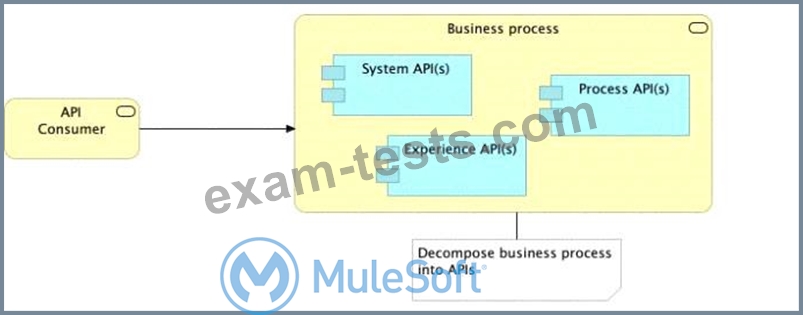
What is the best way to decompose one end-to-end business process into a collaboration of Experience, Process, and System APIs?
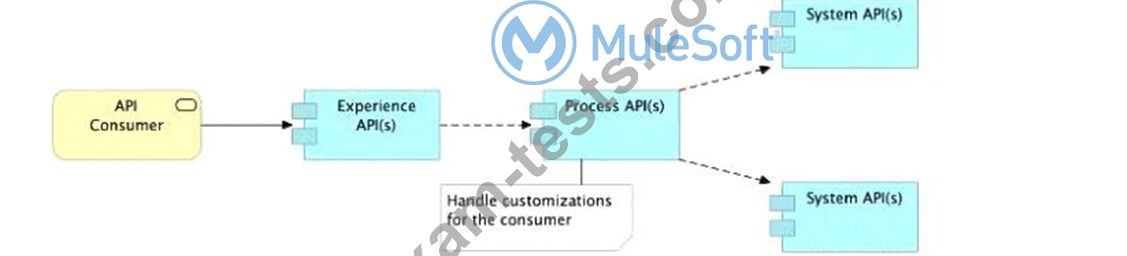
A) Handle customizations for the end-user application at the Process API level rather than the Experience API level
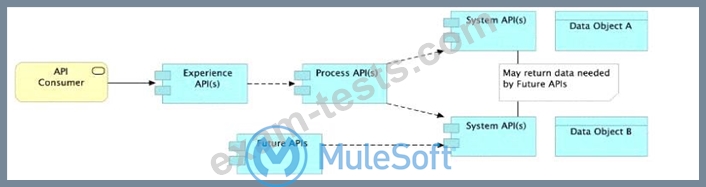
B) Allow System APIs to return data that is NOT currently required by the identified Process or Experience APIs
C) Always use a tiered approach by creating exactly one API for each of the 3 layers (Experience, Process and System APIs)

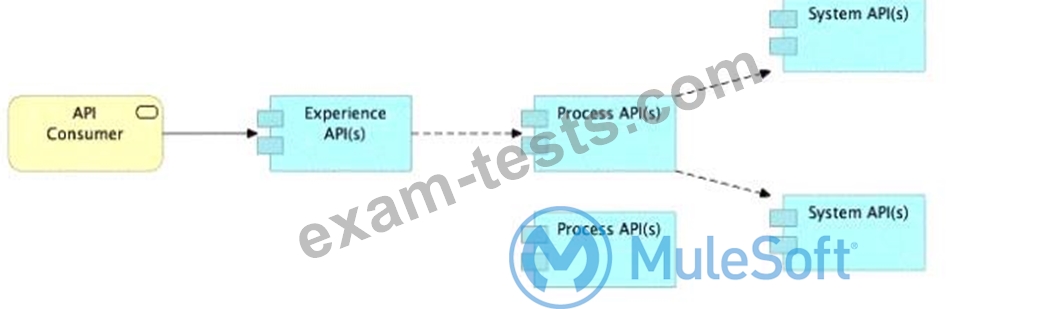
D) Use a Process API to orchestrate calls to multiple System APIs, but NOT to other Process APIs
What is the best way to decompose one end-to-end business process into a collaboration of Experience, Process, and System APIs?
A) Handle customizations for the end-user application at the Process API level rather than the Experience API level
B) Allow System APIs to return data that is NOT currently required by the identified Process or Experience APIs
C) Always use a tiered approach by creating exactly one API for each of the 3 layers (Experience, Process and System APIs)
D) Use a Process API to orchestrate calls to multiple System APIs, but NOT to other Process APIs