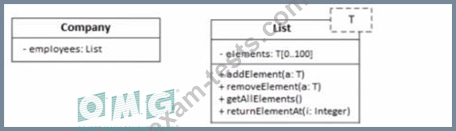
Choose the correct answer: Consider the following diagram fragment: Which statement is correct about the diagram fragment?
Correct Answer: D
The provided diagram fragment seems to indicate a situation involving a template. In UML, a template is a parameterizable element, and a bound element is a specific manifestation of that template wherein the parameters have been replaced with actual values or types. If 'List' is a template class, it cannot be directly used as a type. Instead, one must use a bound element of the List, meaning the template parameters of List must be bound to actual types before it can beused. For instance, if List is a template expecting a type T, then a concrete class might be List<Customer> or List<Order>, where Customer or Order are actual types replacing the template parameter T. This use of templates and bound elements is according to the UML specification, which details how templates are defined and instantiated within UML models.
Question 7
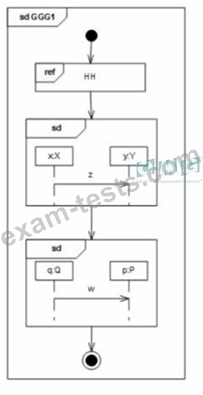
Choose the correct answer: Consider the following diagram: When this behavior is executed, which event will occur last?
Correct Answer: C
The sequence diagram depicts interactions over time between different entities. To determine the order of events, one must follow the flow of messages from top to bottom, as this represents the chronological order in which these interactions occur. In the given diagram, 'HH' is a lifeline that is eventually destroyed, indicated by the finalization (cross) symbol at the bottom of its lifeline. The reception of 'z' is an event that happens between the lifelines labeled 'xX' and 'yY', and the reception of 'w' is an event that happens between 'q:Q' and 'p:P'. Since sequence diagrams are read from top to bottom, the message 'w' is the last one before the destruction of 'q:Q', which isindicated by the destruction occurrence specification (cross) at the bottom of 'q:Q'. Therefore, the last event that occurs according to the diagram is the reception of 'w'. References to UML 2 specifications include: * UML 2.5 Specification (formal/2017-12-05), by Object Management Group, which describes the semantics of sequence diagrams, interactions, and the interpretation of message flows and lifeline termination. * Sequence Diagrams in UML, which explain the order of interaction and message passing between lifelines.
Question 8
Choose the correct answer: A group of programming language designers want to create classes that model typical data collections such as arrays, lists, maps. etc. Their design must satisfy three conditions: 1. The collections must be parameterizable to support any data type. 2. Some collections must inherit from other collections to leverage reuse of functionality. 3. The implementation of the collection functions cannot be overridden. Which UML concept should these designers use?
Correct Answer: D
In UML, class templates are the concept used to create classes that can be parameterized with different data types. This feature satisfies the first condition, allowing collections to support any data type. Class templates can be specialized, fulfilling the second condition, where some collections can inherit from others, thus enabling the reuse of functionality. Additionally, UML allows for operations to be defined in such a way that they cannot be overridden, by specifying them as non-virtual or final, which meets the third condition. Therefore, the use of class templates would be the most suitable approach for the design criteria specified by the programming language designers. This approach is consistent with the capabilities of class templates as described in the UML 2.x Superstructure Specification.
Question 9
Choose the correct answer: Which capability Is provided by the Profile mechanism?
Correct Answer: C
The Profile mechanism in UML provides the capability to adapt existing metamodel elements for specific purposes. Profiles allow modelers to extend the standard UML metamodel with additional semantics by defining stereotypes, tagged values, and constraints that are specific to a particular domain, platform, or methodology. This means that profiles tailor the existing UML metamodel elements to create domain-specific models without changing the underlying metamodel itself. This adaptation mechanism is described in the UML 2.x Superstructure and Infrastructure Specifications, which detail how profiles can be used to customize the UML for particular domains or purposes.
Question 10
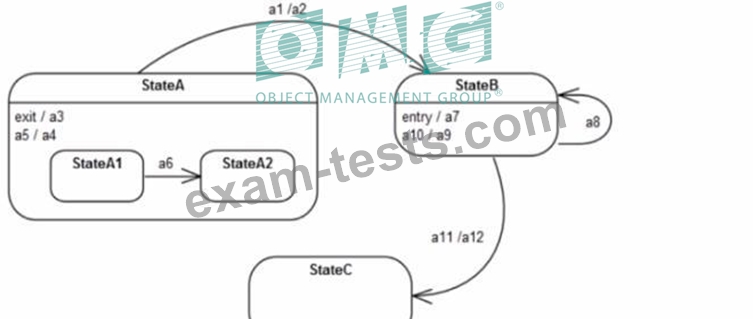
Choose the correct answer: Consider the following diagram fragment: Assume that the system is in StateAl Which sequence of triggers will move the system to StateC?
Correct Answer: C
Given that the system is inStateA1, the sequence of triggers that will move the system toStateCmust take into account the transitions and their associated triggers as defined in the UML state diagram. Starting from StateA1, the triggera5will cause a transition withinStateA, followed bya6, which moves toStateA2. The triggera5is not relevant as it is an internal transition inStateA1. Then,a3(the exit action forStateA) anda2 would be followed to leaveStateAaltogether. Once out ofStateA,a1is used to transition toStateB, wherea10is an entry action, not a trigger. Finally, to get fromStateBtoStateC, the triggersa11followed bya12are needed. This sequence of triggers reflects the correct usage of exit, entry, and transition triggers as defined by UML state machine semantics.