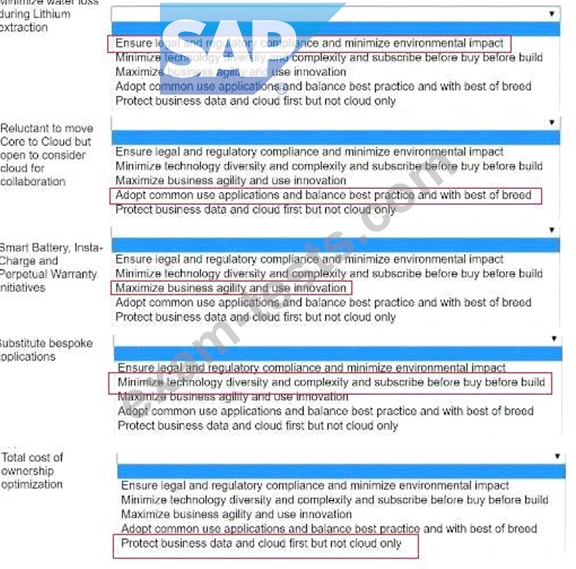
As the Chief Enterprise Architect of Wanderlust GmbH, you are aware that EA principles should correlate to the Business and IT Strategic Objectives and decisions. In the list given below, the left column has some Wanderlust Business/IT objectives and decisions and the right column has some EA principles. Which objectives and decisions correlate best to which principle?
Correct Answer:
Question 2
A custom web application developed with SAPUI5 and running on SAP Business Technology Platform uses large custom data objects deployed in a central data store (SAP HANA Cloud). The solution architect of the application is unsure about which tools to use for integration of this data from different SAP Sources into the central data store and asks you as the Enterprise Architect for guidance. Under which conditions is a data-oriented integration approach (Data Integration) preferable to other integration styles?
Correct Answer: B
Explanation Data-oriented integration is a method of integrating data from different sources into a single data store. This approach is often used when the data is heterogeneous, meaning that it comes from different sources and in different formats. Data-oriented integration can also be used when the data is frequently updated, as it allows for the data to be updated in real time. The following are some of the benefits of using data-oriented integration: It can help to improve the performance of applications that access the data. It can help to reduce the complexity of the integration process. It can help to improve the quality of the data. However, data-oriented integration can also be more complex to implement than other integration styles. The conditions under which data-oriented integration is preferable to other integration styles are: When the data is heterogeneous and comes from different sources. When the data is frequently updated. When the data needs to be cleansed, correlated, and partly newly calculated. In the case of the custom web application, the data objects are built with data from different SAP and non-SAP sources that can be structured and unstructured, change with high frequency, and need to be cleansed, correlated, and partly newly calculated. Therefore, a data-oriented integration approach is preferable to other integration styles.
Question 3
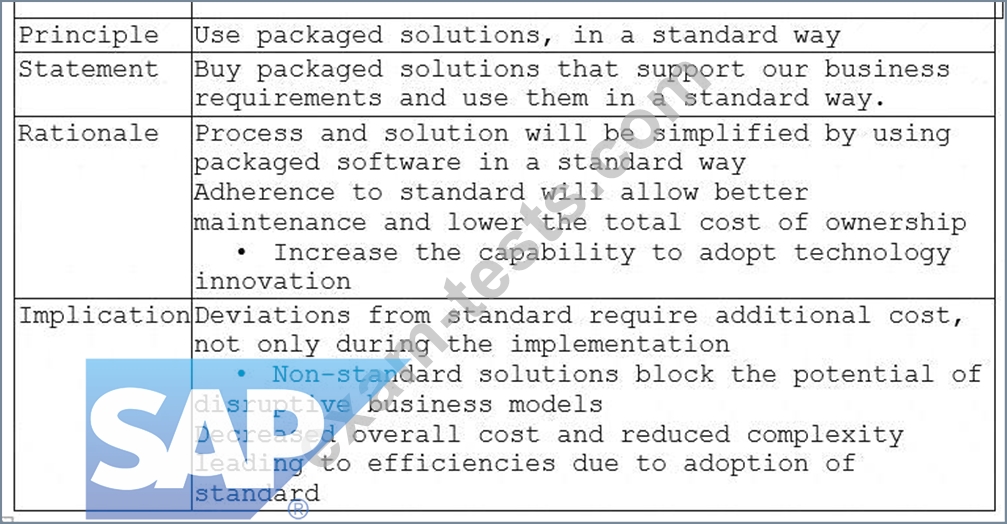
Green Elk & Company is the world s leading manufacturer of agricultural and forestry machinery. The former company slogan "Elk always runs has recently been changed to Elk feeds the world". One of Green Elk's strategic goals is to increase its revenue in the emerging markets of China, India, and other parts of Asia by 80 % within three years. This requires a new business model that caters to significantly smaller farms with limited budgets. You are the Chief Enterprise Architect and the CIO asks you to assess the new business model for smaller farms with smaller budgets. Given the principle and statement, which of the following combinations of rationale and implication do you consider well-defined?
Correct Answer: D
Explanation The rationale and implication in this combination are well-defined because they both support the principle of using packaged solutions in a standard way. The rationale explains the benefits of using packaged solutions, while the implication outlines the steps that need to be taken to ensure that packaged solutions are used in a standard way. According to the SAP Enterprise Architecture Framework, which is a methodology and toolset by the German multinational software company SAP that helps enterprise architects define and implement an architecture strategy for their organizations, a principle is a general rule or guideline that expresses a fundamental value or belief, and that guides the design and implementation of the architecture. A principle consists of four elements: a name, a statement, a rationale, and an implication. The name is a short and memorable label that summarizes the principle. The statement is a concise and precise description of the principle. The rationale is an explanation of why the principle is important and beneficial for the organization. The implication is a description of the consequences or impacts of applying or not applying the principle. The principle in option D is: Name: Use packaged solutions, in a standard way. Statement: Buy packaged solutions that support our business requirements and use them in a standard way. Rationale: Process and solution will be simplified by using packaged software in a standard way. Adherence to standard will allow better maintenance and lower the total cost of ownership. Increase the capability to adopt technology innovation. Implication: In case custom developments are required, adhere to defined best practices, standards, and guidelines (extensibility concept, side-by-side extensions). Reuse before buy, before build. Enable easier transition to the cloud in the future. This combination of rationale and implication is well-defined because it clearly and logically explains the benefits and consequences of following or not following the principle. The rationale shows how using packaged solutions in a standard way can simplify the process and solution, reduce the cost and effort of maintenance, and increase the ability to adopt new technologies. The implication shows how custom developments should be minimized and standardized, how reuse should be preferred over buying or building new solutions, and how cloud readiness should be considered for future scalability. The other options (A, B, C) are not correct for the combination of rationale and implication that is well-defined because they either mix up or confuse some of the elements of the principle. For example: Option A is not correct because it mixes up the rationale and implication elements. The first sentence of the rationale ("Process and solution will be simplified by using packaged software in a standard way") is actually an implication of following the principle, not a reason for following it. The first sentence of the implication ("Reuse vendor and industry best practices, reference architectures and pre-delivered content") is actually a rationale for following the principle, not a consequence of following it. Option B is not correct because it confuses the rationale and implication elements. The first sentence of the rationale ("In case custom developments are required, adhere to defined best practices, standards, and guidelines (extensibility concept, side-by-side extensions)") is actually an implication of following the principle, not a reason for following it. The first sentence of the implication ("Process and solution will be simplified by using packaged software in a standard way") is actually a rationale for following the principle, not a consequence of following it. Option C is not correct because it confuses the rationale and implication elements. The second sentence of the rationale ("Adherence to standard will allow better maintenance and lower the total cost of ownership") is actually an implication of following the principle, not a reason for following it. The second sentence of the implication ("Reuse before buy, before build") is actually a rationale for following the principle, not a consequence of following it.
Question 4
In the SAP Enterprise Architecture Framework, which of the following artifacts are part of the opportunities & solution phase? Note: There are 3 correct answers to this question.
Correct Answer: A,C,E
In the SAP Enterprise Architecture Framework, the opportunities & solution phase includes developing artifacts that help in visualizing the progression from current operations to the future state. The Business Architecture Roadmap outlines how business strategies will evolve, linking business goals with architectural changes. The Implementation Roadmap provides a detailed plan for the deployment of SAP solutions, including time frames and stages of implementation. The Migration Plan offers a comprehensive strategy for moving from legacy systems to modern SAP solutions, detailing the necessary steps for data migration and system transition. = These artifacts are described within the framework and guidelines for enterprise architecture development provided by SAP, focusing on ensuring that the solutions proposed are feasible, properly planned, and aligned with the business strategies and objectives.
Question 5
What are important factors of the SAP BTP. Cloud Foundry environment during runtime that you need to consider?
Correct Answer: A
In the SAP BTP Cloud Foundry environment, several factors are critical during runtime to ensure optimal application performance and scalability. The correct answer, A, highlights two fundamental aspects: Programming language: This determines the specific buildpack to be used, as Cloud Foundry supports multiple programming languages through different buildpacks which provide framework and runtime support for applications. Buildpacks: These are key components in the Cloud Foundry architecture that provide runtime and framework support necessary to build and deploy applications in various programming languages effectively. These elements are crucial as they directly impact how applications are built, deployed, and run within the Cloud Foundry environment, influencing performance, compatibility, and scalability. Reference: SAP BTP Cloud Foundry documentation. Buildpacks and programming language support in SAP BTP.