

Question 6
A company's product range includes Product N. The costs relating to Product N are shown below:

The direct labour costs relate to specialists employed to work wholly and exclusively with Product N.
If the company stopped making Product N, the insurance overhead cost would cease, but overhead cost J would be unaffected. Both overheads are absorbed in direct proportion to material costs.
Which of the following costs should be used in the decision whether to stop making Product N?
Question 7
A budgetary control report for the latest period is shown below:

Which TWO of the following statements are correct?
Which TWO of the following statements are correct?
Question 8
A company's product has the following standard selling price, variable costs and contribution:

Budgeted sales and production was 20,000 units and actual was 19,500 units.
Due to a market downturn the production and sales budget should have been 10% lower.
What is the operational sales volume contribution variance?
Budgeted sales and production was 20,000 units and actual was 19,500 units.
Due to a market downturn the production and sales budget should have been 10% lower.
What is the operational sales volume contribution variance?
Question 9
Information about a company's two products is as follows:
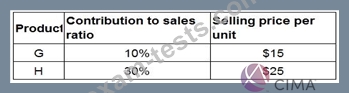
The products are currently sold in equal quantities.
Monthly fixed costs are $360,000.
What is the monthly breakeven sales revenue assuming a sales quantity mix of 50/50?
Give your answer to the nearest $.
The products are currently sold in equal quantities.
Monthly fixed costs are $360,000.
What is the monthly breakeven sales revenue assuming a sales quantity mix of 50/50?
Give your answer to the nearest $.
Question 10
TP makes wedding cakes that are sold to specialist retail outlets which decorate the cakes according to the customers' specific requirements. The standard cost per unit of its most popular cake is as follows:
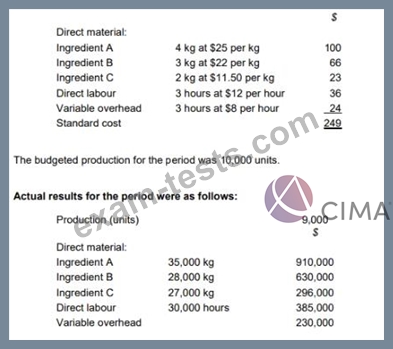
The general market prices at the time of purchase for Ingredient A and Ingredient B were $23 per kg and
$20 per kg respectively. TP operates a JIT purchasing system for ingredients and a JIT production system; therefore, there was no inventory during the period.
What was the material yield variance?