

Question 16
A company makes Product A and Product B. The production process for both products uses one type of material, one type of labour, and utilises one machine. All three of these resources will be limited in November. The company has performed a linear programming model and the constraints and optimal solution, to maximise contribution, are as follows:
Constraints:
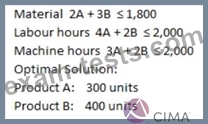
For November, which of the above constraints are binding, and which are non-binding?

Constraints:
For November, which of the above constraints are binding, and which are non-binding?

Question 17
A company's markets are affected by fluctuating exchange rates. It is difficult to forecast more than two or three months ahead.
Which of the following budgeting systems would be most useful in this company's circumstances?
Which of the following budgeting systems would be most useful in this company's circumstances?
Question 18
A company produces a product that requires two materials, Material A and Material B. Details of the material quantities and costs for August are given in the table below.
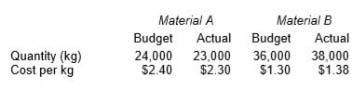
Budgeted and actual output of the product for August was 12,000 units.
The material yield variance for August is:
Budgeted and actual output of the product for August was 12,000 units.
The material yield variance for August is:
Question 19
A manufacturing company has a capacity of 10,000 units. The flexed production cost budget of the company is as follows:

All costs are either fixed, variable or semi-variable.
What is the budgeted total production cost if the company operates at 85% capacity?
All costs are either fixed, variable or semi-variable.
What is the budgeted total production cost if the company operates at 85% capacity?
Question 20
A company is preparing its annual budget and is estimating the number of units of Product A that it will sell in each quarter of year 2. Past experience has shown that the trend for sales of the product is represented by the following relationship:
y = a + bx where
y = number of sales units in the quarter a = 10,000 units b = 3,000 units x = the quarter number where 1
= quarter 1 of year 1
Actual sales of Product A in Year 1 were affected by seasonal variations and were as follows:
Quarter 1:14,000 units Quarter2: 18,000 units Quarter 3: 18,000 units Quarter 4: 20,000 units Calculate the expected sales of Product A (in units) for each quarter of year 2, after adjusting for seasonal variations using the additive model.
y = a + bx where
y = number of sales units in the quarter a = 10,000 units b = 3,000 units x = the quarter number where 1
= quarter 1 of year 1
Actual sales of Product A in Year 1 were affected by seasonal variations and were as follows:
Quarter 1:14,000 units Quarter2: 18,000 units Quarter 3: 18,000 units Quarter 4: 20,000 units Calculate the expected sales of Product A (in units) for each quarter of year 2, after adjusting for seasonal variations using the additive model.