

Question 76
Additional Information
Extract from the Communication Management Strategy.
The project information in the table below is true, but it may not be recorded under the correct heading or be in the correct document.
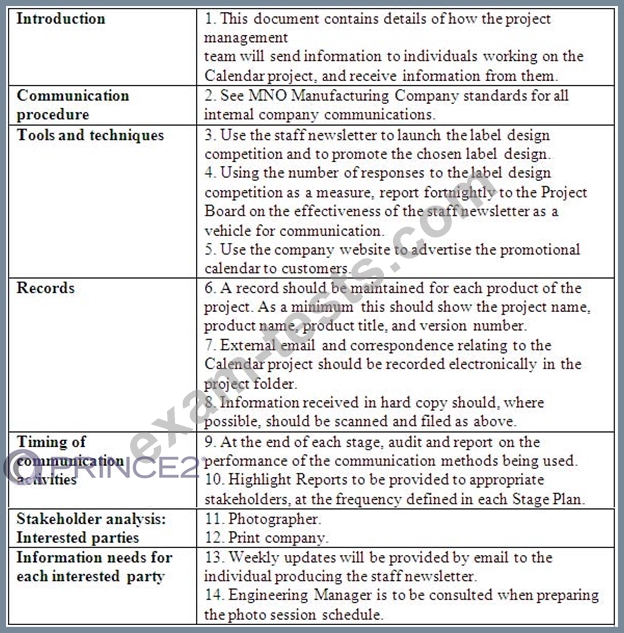
Using the Project Scenario, select the appropriate response to each of the following 5 questions which have been raised by the Project Board.
The project is now at the end of the initiation stage. Having decided that the Calendar project is a relatively simple project, the Project Manager combined the Starting Up a Project process and the Initiating a Project process. No Project Brief has been produced. Instead the Project Manager used the project mandate to produce a simple Project Initiation Documentation (PlO). The PlO includes the Business Case, a product checklist and several Product Descriptions, Including the Project Product Description. Short sections are also included for each of the strategies and the controls to be applied. The Project Manager has elected to use the Daily Log to record all risks, issues. lessons and quality results.
After the initiation stage there will be two further stages during which a small number of Work Packages will be authorized. While these are being managed, the Project Manager will hold regular checkpoints, which will support the production of weekly Highlight Reports to the Project Board.
There is no Project Brief. How can there be a common understanding of the desired outcomes for the prepared calendar pack?
Extract from the Communication Management Strategy.
The project information in the table below is true, but it may not be recorded under the correct heading or be in the correct document.
Using the Project Scenario, select the appropriate response to each of the following 5 questions which have been raised by the Project Board.
The project is now at the end of the initiation stage. Having decided that the Calendar project is a relatively simple project, the Project Manager combined the Starting Up a Project process and the Initiating a Project process. No Project Brief has been produced. Instead the Project Manager used the project mandate to produce a simple Project Initiation Documentation (PlO). The PlO includes the Business Case, a product checklist and several Product Descriptions, Including the Project Product Description. Short sections are also included for each of the strategies and the controls to be applied. The Project Manager has elected to use the Daily Log to record all risks, issues. lessons and quality results.
After the initiation stage there will be two further stages during which a small number of Work Packages will be authorized. While these are being managed, the Project Manager will hold regular checkpoints, which will support the production of weekly Highlight Reports to the Project Board.
There is no Project Brief. How can there be a common understanding of the desired outcomes for the prepared calendar pack?
Question 77
The service level agreement looks like any other MFH document.
Question 78
The project is at the start of stage 3, and there will be six teams working on product delivery. In order to
exercise control, the project manager has asked each team to submit a detailed team plan for approval. The
external team manager for the 'e-learning course' has agreed to submit a summary to the project manager, but
will submit the detailed team plan to the senior supplier to review and approve.
Is the team manager's response appropriate, and why?
exercise control, the project manager has asked each team to submit a detailed team plan for approval. The
external team manager for the 'e-learning course' has agreed to submit a summary to the project manager, but
will submit the detailed team plan to the senior supplier to review and approve.
Is the team manager's response appropriate, and why?
Question 79
Scenario
A central government department, the Ministry of Food Hygiene (MFH), faces increasing pressure to cut costs, better manage suppliers' performance and reduce the confusion caused by inadequate internal controls, outdated standards and outdated technology. External consultants were employed to conduct a feasibility study to identify options to address the problems, and the likely costs and benefits. The following options were considered:
# Do nothing.
# Re-engineer selected business functions.
# Outsource selected business functions.
The feasibility study concluded that there was a case for outsourcing the MFH Information Technology Division and the Facilities Division (maintenance of buildings and grounds). The recommendations were:
# One service provider should be contracted to provide the services currently provided by the Information Technology Division and the Facilities Division.
# A 10-year service contract should be agreed with the selected service provider.
The feasibility study developed high-level designs of the current organization, processes, systems and operating models, plus an outline Business Case for the required project. The external consultants also made the following recommendations for the management of the project:
# Use PRINCE2.
# Set up the project with 4 management stages:
Stage 1. Standard PRINCE2 initiation activities.
Stage 2. Create detailed designs (future organization, processes, systems and operating models) and the service level agreement between MFH and the future service provider.
Stage 3. Request and evaluate proposals, select service provider and agree contract.
Stage 4. Transfer equipment and staff, transfer responsibility for service provision and run trial period.
Initial estimates indicated that the project would cost £2.5m and take two years to complete.
MFH senior management agreed that there was a case for outsourcing, and accepted the recommendations as a basis for the project. There is an expected saving of £20m over 10 years.
The Outsourcing project has completed the Starting up a Project process and is now in the initiation stage.
Because of the strategic importance of the project, the MFH Chief Executive Officer has taken the role of Executive. A PRINCE2-experienced Project Manager has been appointed from within MFH. Staff within the business functions being outsourced will work with the external consultants who conducted the feasibility study to define the detailed designs.
Which 2 statements should be recorded under the Business options heading?
A central government department, the Ministry of Food Hygiene (MFH), faces increasing pressure to cut costs, better manage suppliers' performance and reduce the confusion caused by inadequate internal controls, outdated standards and outdated technology. External consultants were employed to conduct a feasibility study to identify options to address the problems, and the likely costs and benefits. The following options were considered:
# Do nothing.
# Re-engineer selected business functions.
# Outsource selected business functions.
The feasibility study concluded that there was a case for outsourcing the MFH Information Technology Division and the Facilities Division (maintenance of buildings and grounds). The recommendations were:
# One service provider should be contracted to provide the services currently provided by the Information Technology Division and the Facilities Division.
# A 10-year service contract should be agreed with the selected service provider.
The feasibility study developed high-level designs of the current organization, processes, systems and operating models, plus an outline Business Case for the required project. The external consultants also made the following recommendations for the management of the project:
# Use PRINCE2.
# Set up the project with 4 management stages:
Stage 1. Standard PRINCE2 initiation activities.
Stage 2. Create detailed designs (future organization, processes, systems and operating models) and the service level agreement between MFH and the future service provider.
Stage 3. Request and evaluate proposals, select service provider and agree contract.
Stage 4. Transfer equipment and staff, transfer responsibility for service provision and run trial period.
Initial estimates indicated that the project would cost £2.5m and take two years to complete.
MFH senior management agreed that there was a case for outsourcing, and accepted the recommendations as a basis for the project. There is an expected saving of £20m over 10 years.
The Outsourcing project has completed the Starting up a Project process and is now in the initiation stage.
Because of the strategic importance of the project, the MFH Chief Executive Officer has taken the role of Executive. A PRINCE2-experienced Project Manager has been appointed from within MFH. Staff within the business functions being outsourced will work with the external consultants who conducted the feasibility study to define the detailed designs.
Which 2 statements should be recorded under the Business options heading?
Question 80
The project has a cost tolerance of +5% I .5%, of which stage 2 has a tolerance of +£45k 1-£45k.
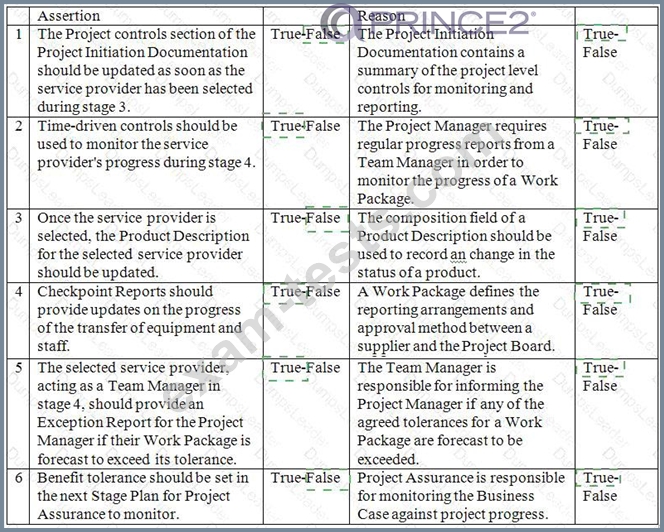
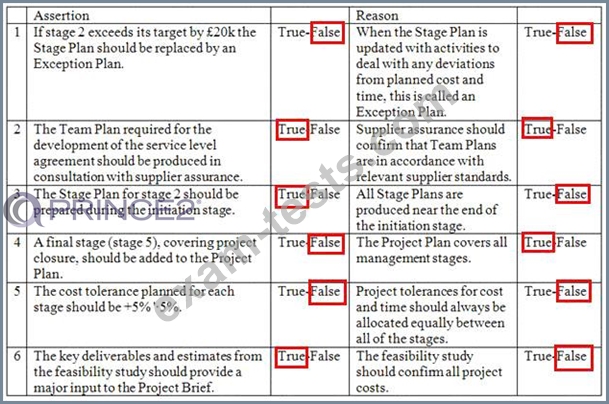
Lines 1 to 6 in the table below consist of an assertion statement and a reason statement. For each line identify the appropriate option, from options A to E, that applies. Each option can be used once, more than once or not at all.
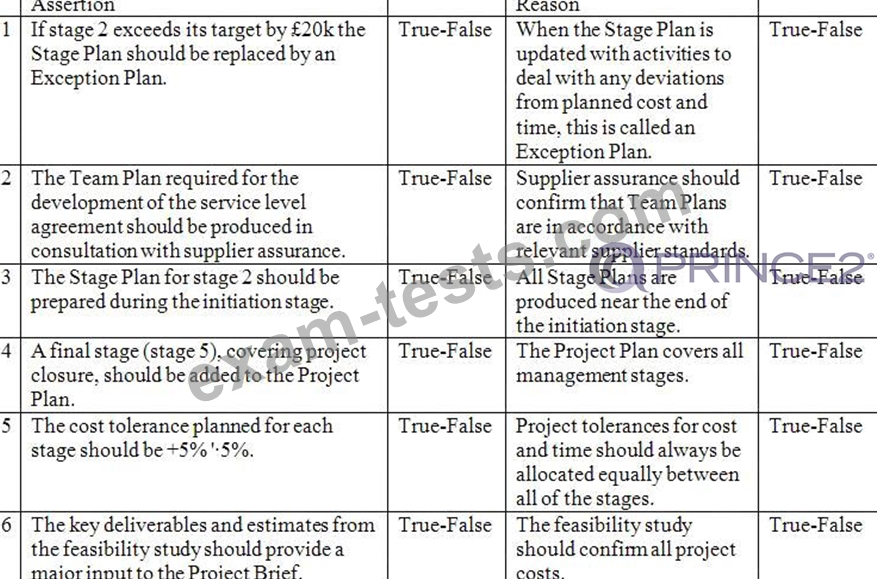
Lines 1 to 6 in the table below consist of an assertion statement and a reason statement. For each line identify the appropriate option, from options A to E, that applies. Each option can be used once, more than once or not at all.
Premium Bundle
Newest PRINCE2Practitioner Exam PDF Dumps shared by BraindumpsPass.com for Helping Passing PRINCE2Practitioner Exam! BraindumpsPass.com now offer the updated PRINCE2Practitioner exam dumps, the BraindumpsPass.com PRINCE2Practitioner exam questions have been updated and answers have been corrected get the latest BraindumpsPass.com PRINCE2Practitioner pdf dumps with Exam Engine here: