

Question 56
You are training an LSTM-based model on Al Platform to summarize text using the following job submission script:
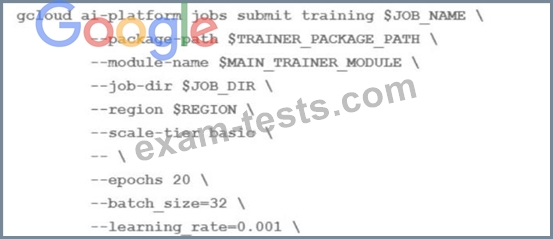
You want to ensure that training time is minimized without significantly compromising the accuracy of your model. What should you do?
You want to ensure that training time is minimized without significantly compromising the accuracy of your model. What should you do?
Question 57
A manufacturing company has a large set of labeled historical sales data. The manufacturer would like to predict how many units of a particular part should be produced each quarter.
Which machine learning approach should be used to solve this problem?
Which machine learning approach should be used to solve this problem?
Question 58
You are designing an architecture with a serverless ML system to enrich customer support tickets with informative metadata before they are routed to a support agent. You need a set of models to predict ticket priority, predict ticket resolution time, and perform sentiment analysis to help agents make strategic decisions when they process support requests. Tickets are not expected to have any domain-specific terms or jargon.
The proposed architecture has the following flow:
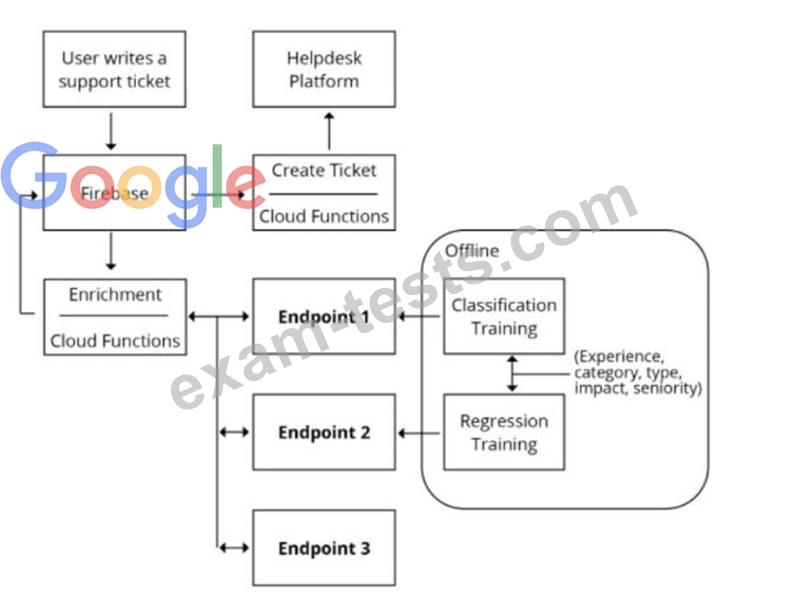
Which endpoints should the Enrichment Cloud Functions call?
The proposed architecture has the following flow:
Which endpoints should the Enrichment Cloud Functions call?
Question 59
You are developing a custom TensorFlow classification model based on tabular dat a. Your raw data is stored in BigQuery contains hundreds of millions of rows, and includes both categorical and numerical features. You need to use a MaxMin scaler on some numerical features, and apply a one-hot encoding to some categorical features such as SKU names. Your model will be trained over multiple epochs. You want to minimize the effort and cost of your solution. What should you do?
Question 60
You work for a large technology company that wants to modernize their contact center. You have been asked to develop a solution to classify incoming calls by product so that requests can be more quickly routed to the correct support team. You have already transcribed the calls using the Speech-to-Text API. You want to minimize data preprocessing and development time. How should you build the model?