

Question 106
You have successfully deployed to production a large and complex TensorFlow model trained on tabular data.
You want to predict the lifetime value (LTV) field for each subscription stored in the BigQuery table named subscription. subscriptionPurchase in the project named my-fortune500-company-project.
You have organized all your training code, from preprocessing data from the BigQuery table up to deploying the validated model to the Vertex AI endpoint, into a TensorFlow Extended (TFX) pipeline. You want to prevent prediction drift, i.e., a situation when afeature data distribution in production changes significantly over time. What should you do?
You want to predict the lifetime value (LTV) field for each subscription stored in the BigQuery table named subscription. subscriptionPurchase in the project named my-fortune500-company-project.
You have organized all your training code, from preprocessing data from the BigQuery table up to deploying the validated model to the Vertex AI endpoint, into a TensorFlow Extended (TFX) pipeline. You want to prevent prediction drift, i.e., a situation when afeature data distribution in production changes significantly over time. What should you do?
Question 107
You developed a Transformer model in TensorFlow to translate text Your training data includes millions of documents in a Cloud Storage bucket. You plan to use distributed training to reduce training time. You need to configure the training job while minimizing the effort required to modify code and to manage the clusters configuration. What should you do?
Question 108
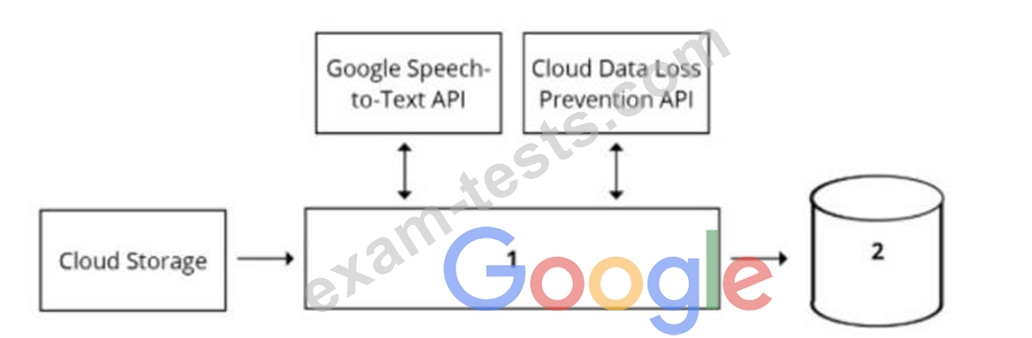
Your organization's call center has asked you to develop a model that analyzes customer sentiments in each call. The call center receives over one million calls daily, and data is stored in Cloud Storage. The data collected must not leave the region in which the call originated, and no Personally Identifiable Information (Pll) can be stored or analyzed. The data science team has a third-party tool for visualization and access which requires a SQL ANSI-2011 compliant interface. You need to select components for data processing and for analytics. How should the data pipeline be designed?
Question 109
You have built a model that is trained on data stored in Parquet files. You access the data through a Hive table hosted on Google Cloud. You preprocessed these data with PySpark and exported it as a CSV file into Cloud Storage. After preprocessing, you execute additional steps to train and evaluate your model. You want to parametrize this model training in Kubeflow Pipelines. What should you do?
Question 110
You recently used XGBoost to train a model in Python that will be used for online serving Your model prediction service will be called by a backend service implemented in Golang running on a Google Kubemetes Engine (GKE) cluster Your model requires pre and postprocessing steps You need to implement the processing steps so that they run at serving time You want to minimize code changes and infrastructure maintenance and deploy your model into production as quickly as possible. What should you do?