

Question 196
Your company has a Microsoft 365 tenant.
All users have computers that run Windows 10 and are joined to the Azure Active Directory (Azure AD) tenant.
The company subscribes to a third-party cloud service named Service1. Service1 supports Azure AD authentication and authorization based on OAuth. Service1 is published to the Azure AD gallery.
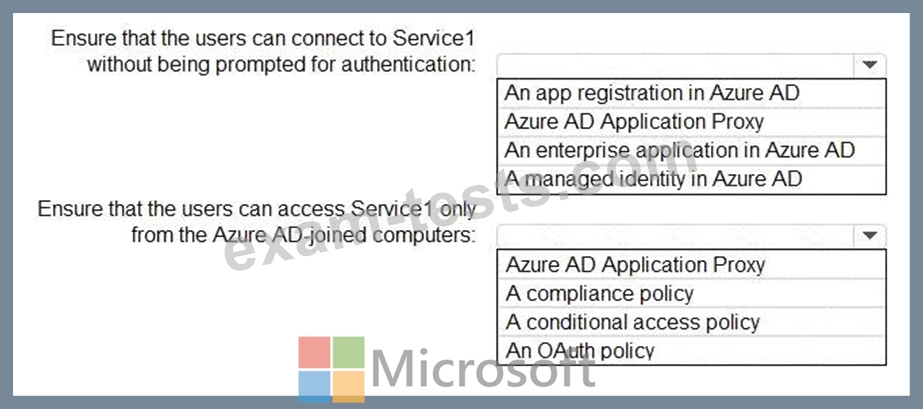
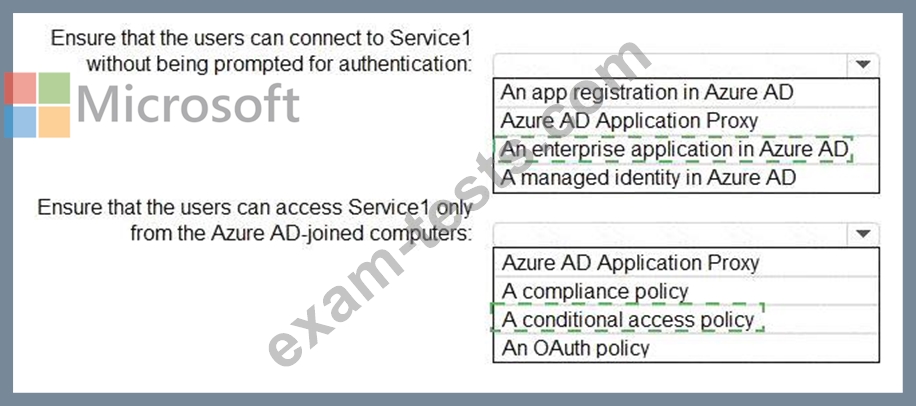
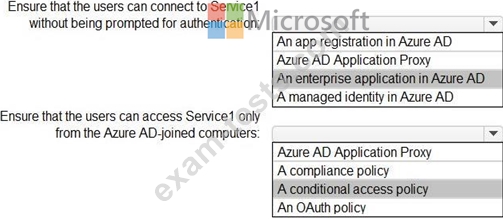
You need to recommend a solution to ensure that the users can connect to Service1 without being prompted for authentication. The solution must ensure that the users can access Service1 only from Azure AD-joined computers. The solution must minimize administrative effort.
What should you recommend for each requirement? To answer, select the appropriate options in the answer area.
NOTE: Each correct selection is worth one point.
All users have computers that run Windows 10 and are joined to the Azure Active Directory (Azure AD) tenant.
The company subscribes to a third-party cloud service named Service1. Service1 supports Azure AD authentication and authorization based on OAuth. Service1 is published to the Azure AD gallery.
You need to recommend a solution to ensure that the users can connect to Service1 without being prompted for authentication. The solution must ensure that the users can access Service1 only from Azure AD-joined computers. The solution must minimize administrative effort.
What should you recommend for each requirement? To answer, select the appropriate options in the answer area.
NOTE: Each correct selection is worth one point.
Question 197
You have an Azure Active Directory (Azure AD) tenant that has Security defaults disabled.
You are creating a conditional access policy as shown in the following exhibit.

Use the drop-down menus to select the answer choice that completes each statement based on the information presented in the graphic.
NOTE: Each correct selection is worth one point.

You are creating a conditional access policy as shown in the following exhibit.
Use the drop-down menus to select the answer choice that completes each statement based on the information presented in the graphic.
NOTE: Each correct selection is worth one point.

Question 198
Your company has an Azure Active Directory (Azure AD) tenant named contoso.com.
The company is developing a web service named App1.
You need to ensure that App1 can use Microsoft Graph to read directory data in contoso.com.
Which three actions should yon perform in sequence? To answer, move the appropriate actions from the list of actions to the answer area and arrange them In the correct order.

The company is developing a web service named App1.
You need to ensure that App1 can use Microsoft Graph to read directory data in contoso.com.
Which three actions should yon perform in sequence? To answer, move the appropriate actions from the list of actions to the answer area and arrange them In the correct order.


Question 199
You have a Microsoft 365 tenant that uses the domain named fabrikam.com. The Guest invite settings for Azure Active Directory (Azure AD) are configured as shown in the exhibit. (Click the Exhibit tab.)

A user named [email protected] shares a Microsoft SharePoint Online document library to the users shown in the following table.

Which users will be emailed a passcode?
A user named [email protected] shares a Microsoft SharePoint Online document library to the users shown in the following table.
Which users will be emailed a passcode?
Question 200
You have an Azure Active Directory (Azure AD) tenant that contains the groups shown in the following table.

For which groups can you create an access review?
For which groups can you create an access review?