
- Home
- ISC Certification
- SSCP Exam
- ISC.SSCP.v2024-11-11.q999 Practice Test

Question 986
What can best be described as a domain of trust that shares a single security policy and single management?
Correct Answer: B
Explanation/Reference:
A security domain is a domain of trust that shares a single security policy and single management.
The term security domain just builds upon the definition of domain by adding the fact that resources within this logical structure (domain) are working under the same security policy and managed by the same group.
So, a network administrator may put all of the accounting personnel, computers, and network resources in Domain 1 and all of the management personnel, computers, and network resources in Domain 2. These items fall into these individual containers because they not only carry out similar types of business functions, but also, and more importantly, have the same type of trust level. It is this common trust level that allows entities to be managed by one single security policy.
The different domains are separated by logical boundaries, such as firewalls with ACLs, directory services making access decisions, and objects that have their own ACLs indicating which individuals and groups can carry out operations on them.
All of these security mechanisms are examples of components that enforce the security policy for each domain. Domains can be architected in a hierarchical manner that dictates the relationship between the different domains and the ways in which subjects within the different domains can communicate. Subjects can access resources in domains of equal or lower trust levels.
The following are incorrect answers:
The reference monitor is an abstract machine which must mediate all access to subjects to objects, be protected from modification, be verifiable as correct, and is always invoked. Concept that defines a set of design requirements of a reference validation mechanism (security kernel), which enforces an access control policy over subjects' (processes, users) ability to perform operations (read, write, execute) on objects (files, resources) on a system. The reference monitor components must be small enough to test properly and be tamperproof.
The security kernel is the hardware, firmware and software elements of a trusted computing base that implement the reference monitor concept.
The security perimeter includes the security kernel as well as other security-related system functions that are within the boundary of the trusted computing base. System elements that are outside of the security perimeter need not be trusted. not every process and resource falls within the TCB, so some of these components fall outside of an imaginary boundary referred to as the security perimeter. A security perimeter is a boundary that divides the trusted from the untrusted. For the system to stay in a secure and trusted state, precise communication standards must be developed to ensure that when a component within the TCB needs to communicate with a component outside the TCB, the communication cannot expose the system to unexpected security compromises. This type of communication is handled and controlled through interfaces.
Reference(s) used for this question:
Harris, Shon (2012-10-25). CISSP All-in-One Exam Guide, 6th Edition (Kindle Locations 28548-28550).
McGraw-Hill. Kindle Edition.
Harris, Shon (2012-10-25). CISSP All-in-One Exam Guide, 6th Edition (Kindle Locations 7873-7877).
McGraw-Hill. Kindle Edition.
Harris, Shon (2012-10-25). CISSP All-in-One Exam Guide, 6th Edition , Access Control, Page 214-217 Schneiter, Andrew (2013-04-15). Official (ISC)2 Guide to the CISSP CBK, Third Edition : Security Architecture and Design (Kindle Locations 1280-1283). . Kindle Edition.
TIPTON, Hal, (ISC)2, Introduction to the CISSP Exam presentation.
AIO 6th edition chapter 3 access control page 214-217 defines Security domains. Reference monitor, Security Kernel, and Security Parameter are defined in Chapter 4, Security Architecture and Design.
A security domain is a domain of trust that shares a single security policy and single management.
The term security domain just builds upon the definition of domain by adding the fact that resources within this logical structure (domain) are working under the same security policy and managed by the same group.
So, a network administrator may put all of the accounting personnel, computers, and network resources in Domain 1 and all of the management personnel, computers, and network resources in Domain 2. These items fall into these individual containers because they not only carry out similar types of business functions, but also, and more importantly, have the same type of trust level. It is this common trust level that allows entities to be managed by one single security policy.
The different domains are separated by logical boundaries, such as firewalls with ACLs, directory services making access decisions, and objects that have their own ACLs indicating which individuals and groups can carry out operations on them.
All of these security mechanisms are examples of components that enforce the security policy for each domain. Domains can be architected in a hierarchical manner that dictates the relationship between the different domains and the ways in which subjects within the different domains can communicate. Subjects can access resources in domains of equal or lower trust levels.
The following are incorrect answers:
The reference monitor is an abstract machine which must mediate all access to subjects to objects, be protected from modification, be verifiable as correct, and is always invoked. Concept that defines a set of design requirements of a reference validation mechanism (security kernel), which enforces an access control policy over subjects' (processes, users) ability to perform operations (read, write, execute) on objects (files, resources) on a system. The reference monitor components must be small enough to test properly and be tamperproof.
The security kernel is the hardware, firmware and software elements of a trusted computing base that implement the reference monitor concept.
The security perimeter includes the security kernel as well as other security-related system functions that are within the boundary of the trusted computing base. System elements that are outside of the security perimeter need not be trusted. not every process and resource falls within the TCB, so some of these components fall outside of an imaginary boundary referred to as the security perimeter. A security perimeter is a boundary that divides the trusted from the untrusted. For the system to stay in a secure and trusted state, precise communication standards must be developed to ensure that when a component within the TCB needs to communicate with a component outside the TCB, the communication cannot expose the system to unexpected security compromises. This type of communication is handled and controlled through interfaces.
Reference(s) used for this question:
Harris, Shon (2012-10-25). CISSP All-in-One Exam Guide, 6th Edition (Kindle Locations 28548-28550).
McGraw-Hill. Kindle Edition.
Harris, Shon (2012-10-25). CISSP All-in-One Exam Guide, 6th Edition (Kindle Locations 7873-7877).
McGraw-Hill. Kindle Edition.
Harris, Shon (2012-10-25). CISSP All-in-One Exam Guide, 6th Edition , Access Control, Page 214-217 Schneiter, Andrew (2013-04-15). Official (ISC)2 Guide to the CISSP CBK, Third Edition : Security Architecture and Design (Kindle Locations 1280-1283). . Kindle Edition.
TIPTON, Hal, (ISC)2, Introduction to the CISSP Exam presentation.
AIO 6th edition chapter 3 access control page 214-217 defines Security domains. Reference monitor, Security Kernel, and Security Parameter are defined in Chapter 4, Security Architecture and Design.
Question 987
Which division of the Orange Book deals with discretionary protection (need-to-know)?
Correct Answer: B
Section: Access Control
Explanation/Reference:
C deals with discretionary protection. See matric below:
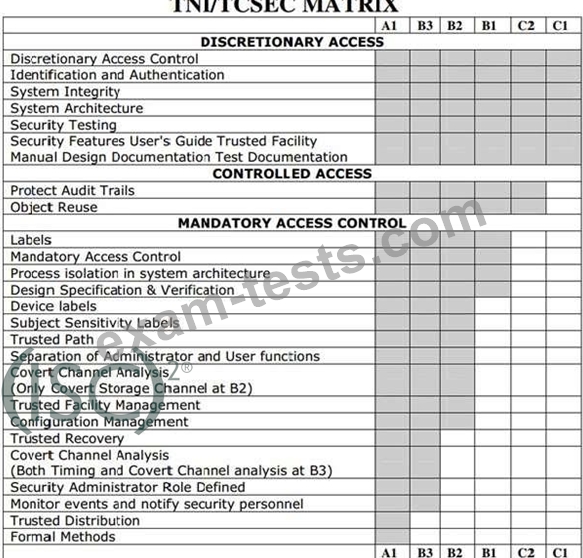
TCSEC Matric
The following are incorrect answers:
D is incorrect. D deals with minimal security.
B is incorrect. B deals with mandatory protection.
A is incorrect. A deals with verified protection.
Reference(s) used for this question:
CBK, p. 329 - 330
and
Shon Harris, CISSP All In One (AIO), 6th Edition , page 392-393
Explanation/Reference:
C deals with discretionary protection. See matric below:
TCSEC Matric
The following are incorrect answers:
D is incorrect. D deals with minimal security.
B is incorrect. B deals with mandatory protection.
A is incorrect. A deals with verified protection.
Reference(s) used for this question:
CBK, p. 329 - 330
and
Shon Harris, CISSP All In One (AIO), 6th Edition , page 392-393
Question 988
What is the main focus of the Bell-LaPadula security model?
Correct Answer: C
Section: Access Control
Explanation/Reference:
The Bell-LaPadula model is a formal model dealing with confidentiality.
The Bell-LaPadula Model (abbreviated BLP) is a state machine model used for enforcing access control in government and military applications. It was developed by David Elliott Bell and Leonard J. LaPadula, subsequent to strong guidance from Roger R. Schell to formalize the U.S. Department of Defense (DoD) multilevel security (MLS) policy. The model is a formal state transition model of computer security policy that describes a set of access control rules which use security labels on objects and clearances for subjects.
Security labels range from the most sensitive (e.g."Top Secret"), down to the least sensitive (e.g.,
"Unclassified" or "Public").
The Bell-LaPadula model focuses on data confidentiality and controlled access to classified information, in contrast to the Biba Integrity Model which describes rules for the protection of data integrity. In this formal model, the entities in an information system are divided into subjects and objects.
The notion of a "secure state" is defined, and it is proven that each state transition preserves security by moving from secure state to secure state, thereby inductively proving that the system satisfies the security objectives of the model. The Bell-LaPadula model is built on the concept of a state machine with a set of allowable states in a computer network system. The transition from one state to another state is defined by transition functions.
A system state is defined to be "secure" if the only permitted access modes of subjects to objects are in accordance with a security policy. To determine whether a specific access mode is allowed, the clearance of a subject is compared to the classification of the object (more precisely, to the combination of classification and set of compartments, making up the security level) to determine if the subject is authorized for the specific access mode.
The clearance/classification scheme is expressed in terms of a lattice. The model defines two mandatory access control (MAC) rules and one discretionary access control (DAC) rule with three security properties:
The Simple Security Property - a subject at a given security level may not read an object at a higher security level (no read-up).
The -property (read "star"-property) - a subject at a given security level must not write to any object at a lower security level (no write-down). The -property is also known as the Confinement property.
The Discretionary Security Property - use of an access matrix to specify the discretionary access control.
The following are incorrect answers:
Accountability is incorrect. Accountability requires that actions be traceable to the user that performed them and is not addressed by the Bell-LaPadula model.
Integrity is incorrect. Integrity is addressed in the Biba model rather than Bell-Lapadula.
Availability is incorrect. Availability is concerned with assuring that data/services are available to authorized users as specified in service level objectives and is not addressed by the Bell-Lapadula model.
References:
CBK, pp. 325-326
AIO3, pp. 279 - 284
AIOv4 Security Architecture and Design (pages 333 - 336)
AIOv5 Security Architecture and Design (pages 336 - 338)
Wikipedia at https://en.wikipedia.org/wiki/Bell-La_Padula_model
Explanation/Reference:
The Bell-LaPadula model is a formal model dealing with confidentiality.
The Bell-LaPadula Model (abbreviated BLP) is a state machine model used for enforcing access control in government and military applications. It was developed by David Elliott Bell and Leonard J. LaPadula, subsequent to strong guidance from Roger R. Schell to formalize the U.S. Department of Defense (DoD) multilevel security (MLS) policy. The model is a formal state transition model of computer security policy that describes a set of access control rules which use security labels on objects and clearances for subjects.
Security labels range from the most sensitive (e.g."Top Secret"), down to the least sensitive (e.g.,
"Unclassified" or "Public").
The Bell-LaPadula model focuses on data confidentiality and controlled access to classified information, in contrast to the Biba Integrity Model which describes rules for the protection of data integrity. In this formal model, the entities in an information system are divided into subjects and objects.
The notion of a "secure state" is defined, and it is proven that each state transition preserves security by moving from secure state to secure state, thereby inductively proving that the system satisfies the security objectives of the model. The Bell-LaPadula model is built on the concept of a state machine with a set of allowable states in a computer network system. The transition from one state to another state is defined by transition functions.
A system state is defined to be "secure" if the only permitted access modes of subjects to objects are in accordance with a security policy. To determine whether a specific access mode is allowed, the clearance of a subject is compared to the classification of the object (more precisely, to the combination of classification and set of compartments, making up the security level) to determine if the subject is authorized for the specific access mode.
The clearance/classification scheme is expressed in terms of a lattice. The model defines two mandatory access control (MAC) rules and one discretionary access control (DAC) rule with three security properties:
The Simple Security Property - a subject at a given security level may not read an object at a higher security level (no read-up).
The -property (read "star"-property) - a subject at a given security level must not write to any object at a lower security level (no write-down). The -property is also known as the Confinement property.
The Discretionary Security Property - use of an access matrix to specify the discretionary access control.
The following are incorrect answers:
Accountability is incorrect. Accountability requires that actions be traceable to the user that performed them and is not addressed by the Bell-LaPadula model.
Integrity is incorrect. Integrity is addressed in the Biba model rather than Bell-Lapadula.
Availability is incorrect. Availability is concerned with assuring that data/services are available to authorized users as specified in service level objectives and is not addressed by the Bell-Lapadula model.
References:
CBK, pp. 325-326
AIO3, pp. 279 - 284
AIOv4 Security Architecture and Design (pages 333 - 336)
AIOv5 Security Architecture and Design (pages 336 - 338)
Wikipedia at https://en.wikipedia.org/wiki/Bell-La_Padula_model
Question 989
As per the Orange Book, what are two types of system assurance?
Correct Answer: D
Explanation/Reference:
Are the two types of assurance mentioned in the Orange book.
The following answers are incorrect:
Operational Assurance and Architectural Assurance. Is incorrect because Architectural Assurance is not a type of assurance mentioned in the Orange book.
Design Assurance and Implementation Assurance. Is incorrect because neither are types of assurance mentioned in the Orange book.
Architectural Assurance and Implementation Assurance. Is incorrect because neither are types of assurance mentioned in the Orange book.
Are the two types of assurance mentioned in the Orange book.
The following answers are incorrect:
Operational Assurance and Architectural Assurance. Is incorrect because Architectural Assurance is not a type of assurance mentioned in the Orange book.
Design Assurance and Implementation Assurance. Is incorrect because neither are types of assurance mentioned in the Orange book.
Architectural Assurance and Implementation Assurance. Is incorrect because neither are types of assurance mentioned in the Orange book.
Question 990
Recovery Site Strategies for the technology environment depend on how much downtime an organization can tolerate before the recovery must be completed. What would you call a strategy where the alternate site is internal, standby ready, with all the technology and equipment necessary to run the applications?
Correct Answer: C
Internal Hot Site-This site is standby ready with all the technology and equipment necessary to run the applications positioned there. The planner will be able to effectively restart an application in a hot site recovery without having to perform any bare metal recovery of servers. If this is an internal solution, then often the organization will run non-time sensitive processes there such as development or test environments, which will be pushed aside for recovery of production when needed. When employing this strategy, it is important that the two environments be kept as close to identical as possible to avoid problems with O/S levels, hardware differences, capacity differences, etc., from preventing or delaying recovery. Recovery Site Strategies Depending on how much downtime an organization has before the technology recovery must be complete, recovery strategies selected for the technology environment could be any one of the following: Dual Data Center-This strategy is employed for applications, which cannot accept any downtime without negatively impacting the organization. The applications are split between two geographically dispersed data centers and either load balanced between the two centers or hot swapped between the two centers. The surviving data center must have enough head room to carry the full production load in either case.
External Hot Site-This strategy has equipment on the floor waiting, but the environment must be rebuilt for the recovery. These are services contracted through a recovery service
provider. Again, it is important that the two environments be kept as close to identical as
possible to avoid problems with O/S levels, hardware differences, capacity differences,
etc., from preventing or delaying recovery. Hot site vendors tend to have the most
commonly used hardware and software products to attract the largest number of customers
to utilize the site. Unique equipment or software would generally need to be provided by the
organization either at time of disaster or stored there ahead of time.
Warm Site-A leased or rented facility that is usually partially configured with some
equipment, but not the actual computers. It will generally have all the cooling, cabling, and
networks in place to accommodate the recovery but the actual servers, mainframe, etc.,
equipment are delivered to the site at time of disaster.
Cold Site-A cold site is a shell or empty data center space with no technology on the floor.
All technology must be purchased or acquired at the time of disaster.
Reference(s) used for this question:
Hernandez CISSP, Steven (2012-12-21). Official (ISC)2 Guide to the CISSP CBK, Third
Edition ((ISC)2 Press) (Kindle Locations 21265-21291). Auerbach Publications. Kindle
Edition.
External Hot Site-This strategy has equipment on the floor waiting, but the environment must be rebuilt for the recovery. These are services contracted through a recovery service
provider. Again, it is important that the two environments be kept as close to identical as
possible to avoid problems with O/S levels, hardware differences, capacity differences,
etc., from preventing or delaying recovery. Hot site vendors tend to have the most
commonly used hardware and software products to attract the largest number of customers
to utilize the site. Unique equipment or software would generally need to be provided by the
organization either at time of disaster or stored there ahead of time.
Warm Site-A leased or rented facility that is usually partially configured with some
equipment, but not the actual computers. It will generally have all the cooling, cabling, and
networks in place to accommodate the recovery but the actual servers, mainframe, etc.,
equipment are delivered to the site at time of disaster.
Cold Site-A cold site is a shell or empty data center space with no technology on the floor.
All technology must be purchased or acquired at the time of disaster.
Reference(s) used for this question:
Hernandez CISSP, Steven (2012-12-21). Official (ISC)2 Guide to the CISSP CBK, Third
Edition ((ISC)2 Press) (Kindle Locations 21265-21291). Auerbach Publications. Kindle
Edition.
- Other Version
- 12154ISC.SSCP.v2024-05-23.q965
- 23437ISC.SSCP.v2022-08-26.q999
- 20482ISC.SSCP.v2022-01-29.q657
- 36ISC.Prepawaypdf.SSCP.v2021-11-05.by.harvey.888q.pdf
- Latest Upload
- 200PaloAltoNetworks.NGFW-Engineer.v2026-05-01.q43
- 292Nokia.4A0-113.v2026-05-01.q69
- 250EC-COUNCIL.312-49v11.v2026-04-30.q214
- 227Microsoft.MB-820.v2026-04-30.q101
- 207Salesforce.MC-202.v2026-04-30.q57
- 204BICSI.INSTC_V8.v2026-04-29.q53
- 332NMLS.MLO.v2026-04-28.q82
- 241NCARB.Project-Management.v2026-04-28.q27
- 457EMC.D-AV-DY-23.v2026-04-27.q184
- 1108ServiceNow.CSA.v2026-04-27.q483