
- Home
- ISC Certification
- SSCP Exam
- ISC.SSCP.v2024-11-11.q999 Practice Test

Question 991
Which of the following would best describe certificate path validation?
Correct Answer: A
With the advent of public key cryptography (PKI), it is now possible to communicate securely with untrusted parties over the Internet without prior arrangement. One of the necessities arising from such communication is the ability to accurately verify someone's identity (i.e. whether the person you are communicating with is indeed the person who he/she claims to be). In order to be able to perform identity check for a given entity, there should be a fool-proof method of "binding" the entity's public key to its unique domain name (DN).
A X.509 digital certificate issued by a well known certificate authority (CA), like Verisign, Entrust, Thawte, etc., provides a way of positively identifying the entity by placing trust on the CA to have performed the necessary verifications. A X.509 certificate is a cryptographically sealed data object that contains the entity's unique DN, public key, serial number, validity period, and possibly other extensions.
The Windows Operating System offers a Certificate Viewer utility which allows you to double-click on any certificate and review its attributes in a human-readable format. For instance, the "General" tab in the Certificate Viewer Window (see below) shows who the certificate was issued to as well as the certificate's issuer, validation period and usage functions.
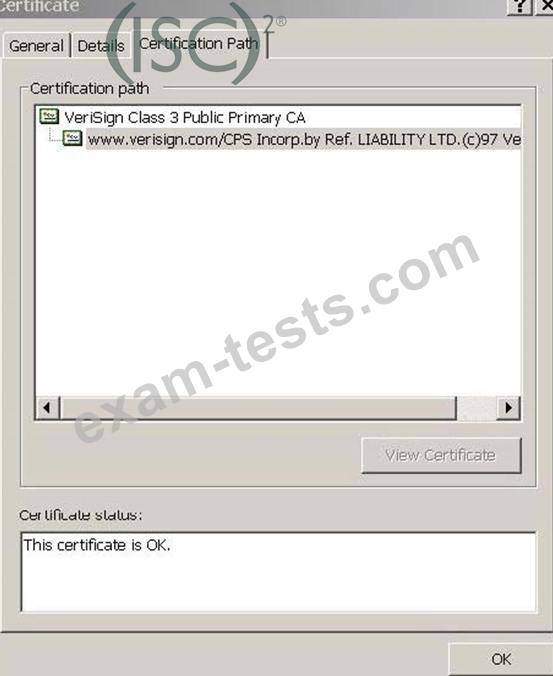
Certification Path graphic
Certification Path graphic The "Certification Path" tab contains the hierarchy for the chain of certificates. It allows you to select the certificate issuer or a subordinate certificate and then click on "View Certificate" to open the certificate in the Certificate Viewer.
Each end-user certificate is signed by its issuer, a trusted CA, by taking a hash value (MD5 or SHA-1) of ASN.1 DER (Distinguished Encoding Rule) encoded object and then encrypting the resulting hash with the issuer's private key (CA's Private Key) which is a digital signature. The encrypted data is stored in the "signatureValue" attribute of the entity's (CA) public certificate.
Once the certificate is signed by the issuer, a party who wishes to communicate with this
entity can then take the entity's public certificate and find out who the issuer of the
certificate is. Once the issuer's of the certificate (CA) is identified, it would be possible to
decrypt the value of the "signatureValue" attribute in the entity's certificate using the
issuer's public key to retrieve the hash value. This hash value will be compared with the
independently calculated hash on the entity's certificate. If the two hash values match, then
the information contained within the certificate must not have been altered and, therefore,
one must trust that the CA has done enough background check to ensure that all details in
the entity's certificate are accurate.
The process of cryptographically checking the signatures of all certificates in the certificate
chain is called "key chaining". An additional check that is essential to key chaining is
verifying that the value of the "subjectKeyIdentifier" extension in one certificate matches the
same in the subsequent certificate.
Similarly, the process of comparing the subject field of the issuer certificate to the issuer
field of the subordinate certificate is called "name chaining". In this process, these values
must match for each pair of adjacent certificates in the certification path in order to
guarantee that the path represents unbroken chain of entities relating directly to one
another and that it has no missing links.
The two steps above are the steps to validate the Certification Path by ensuring the validity
of all certificates of the certificate chain to the root certificate as described in the two
paragraphs above.
Reference(s) used for this question:
FORD, Warwick & BAUM, Michael S., Secure Electronic Commerce: Building the
Infrastructure for Digital Signatures and Encryption (2nd Edition), 2000, Prentice Hall PTR,
Page 262.
and
https://www.tibcommunity.com/docs/DOC-2197
A X.509 digital certificate issued by a well known certificate authority (CA), like Verisign, Entrust, Thawte, etc., provides a way of positively identifying the entity by placing trust on the CA to have performed the necessary verifications. A X.509 certificate is a cryptographically sealed data object that contains the entity's unique DN, public key, serial number, validity period, and possibly other extensions.
The Windows Operating System offers a Certificate Viewer utility which allows you to double-click on any certificate and review its attributes in a human-readable format. For instance, the "General" tab in the Certificate Viewer Window (see below) shows who the certificate was issued to as well as the certificate's issuer, validation period and usage functions.
Certification Path graphic
Certification Path graphic The "Certification Path" tab contains the hierarchy for the chain of certificates. It allows you to select the certificate issuer or a subordinate certificate and then click on "View Certificate" to open the certificate in the Certificate Viewer.
Each end-user certificate is signed by its issuer, a trusted CA, by taking a hash value (MD5 or SHA-1) of ASN.1 DER (Distinguished Encoding Rule) encoded object and then encrypting the resulting hash with the issuer's private key (CA's Private Key) which is a digital signature. The encrypted data is stored in the "signatureValue" attribute of the entity's (CA) public certificate.
Once the certificate is signed by the issuer, a party who wishes to communicate with this
entity can then take the entity's public certificate and find out who the issuer of the
certificate is. Once the issuer's of the certificate (CA) is identified, it would be possible to
decrypt the value of the "signatureValue" attribute in the entity's certificate using the
issuer's public key to retrieve the hash value. This hash value will be compared with the
independently calculated hash on the entity's certificate. If the two hash values match, then
the information contained within the certificate must not have been altered and, therefore,
one must trust that the CA has done enough background check to ensure that all details in
the entity's certificate are accurate.
The process of cryptographically checking the signatures of all certificates in the certificate
chain is called "key chaining". An additional check that is essential to key chaining is
verifying that the value of the "subjectKeyIdentifier" extension in one certificate matches the
same in the subsequent certificate.
Similarly, the process of comparing the subject field of the issuer certificate to the issuer
field of the subordinate certificate is called "name chaining". In this process, these values
must match for each pair of adjacent certificates in the certification path in order to
guarantee that the path represents unbroken chain of entities relating directly to one
another and that it has no missing links.
The two steps above are the steps to validate the Certification Path by ensuring the validity
of all certificates of the certificate chain to the root certificate as described in the two
paragraphs above.
Reference(s) used for this question:
FORD, Warwick & BAUM, Michael S., Secure Electronic Commerce: Building the
Infrastructure for Digital Signatures and Encryption (2nd Edition), 2000, Prentice Hall PTR,
Page 262.
and
https://www.tibcommunity.com/docs/DOC-2197
Question 992
Which of the following would BEST be defined as an absence or weakness of safeguard that could be exploited?
Correct Answer: B
It is a software , hardware or procedural weakness that may provide an attacker the open door he is looking for to enter a computer or network and have unauthorized access to resources within the environment. A vulnerability characterizes the absence or weakness of a safeguard that could be exploited. This vulnerability may be a service running on a server, unpatched applications or operating system software etc.
The following answers are incorrect because: Threat: A threat is defined as a potential danger to information or systems. The threat is someone or something will identify a specific vulnerability and use it against the company or individual. The entity that takes advantage of a vulnerability is referred to as a 'Threat Agent'. A threat agent could be an intruder accessing the network through a port on the firewall , a process accessing data that violates the security policy. Risk:A risk is the likelihood of a threat agent taking advantage of a vulnerability and the corresponding business impact. If a firewall has several ports open , there is a higher likelihood that an intruder will use one to access the network in an unauthorized method.
Exposure: An exposure is an instance of being exposed to losses from a threat agent.
REFERENCES: SHON HARRIS , ALL IN ONE THIRD EDITION : Chapter 3 : Security Management Practices , Pages: 57-59
The following answers are incorrect because: Threat: A threat is defined as a potential danger to information or systems. The threat is someone or something will identify a specific vulnerability and use it against the company or individual. The entity that takes advantage of a vulnerability is referred to as a 'Threat Agent'. A threat agent could be an intruder accessing the network through a port on the firewall , a process accessing data that violates the security policy. Risk:A risk is the likelihood of a threat agent taking advantage of a vulnerability and the corresponding business impact. If a firewall has several ports open , there is a higher likelihood that an intruder will use one to access the network in an unauthorized method.
Exposure: An exposure is an instance of being exposed to losses from a threat agent.
REFERENCES: SHON HARRIS , ALL IN ONE THIRD EDITION : Chapter 3 : Security Management Practices , Pages: 57-59
Question 993
Which of the following statements is true about data encryption as a method of protecting data?
Correct Answer: D
In cryptography, you always assume the "bad guy" has the encryption algorithm (indeed, many algorithms such as DES, Triple DES, AES, etc. are public domain). What the bad guy lacks is the key used to complete that algorithm and encrypt/decrypt information. Therefore, protection of the key, controlled distribution, scheduled key change, timely destruction, and several other factors require careful consideration. All of these factors are covered under the umbrella term of "key management".
Another significant consideration is the case of "data encryption as a method of protecting data" as the question states. If that data is to be stored over a long period of time (such as on backup), you must ensure that your key management scheme stores old keys for as long as they will be needed to decrypt the information they encrypted.
The other answers are not correct because:
"It should sometimes be used for password files." - Encryption is often used to encrypt passwords stored within password files, but it is not typically effective for the password file itself. On most systems, if a user cannot access the contents of a password file, they cannot authenticate. Encrypting the entire file prevents that access.
"It is usually easily administered." - Developments over the last several years have made cryptography significantly easier to manage and administer. But it remains a significant challenge. This is not a good answer.
"It makes few demands on system resources." - Cryptography is, essentially, a large complex mathematical algorithm. In order to encrypt and decrypt information, the system must perform this algorithm hundreds, thousands, or even millions/billions/trillions of times. This becomes system resource intensive, making this a very bad answer.
Reference:
Official ISC2 Guide page: 266 (poor explanation)
All in One Third Edition page: 657 (excellent explanation)
Key Management - Page 732, All in One Fourth Edition
Another significant consideration is the case of "data encryption as a method of protecting data" as the question states. If that data is to be stored over a long period of time (such as on backup), you must ensure that your key management scheme stores old keys for as long as they will be needed to decrypt the information they encrypted.
The other answers are not correct because:
"It should sometimes be used for password files." - Encryption is often used to encrypt passwords stored within password files, but it is not typically effective for the password file itself. On most systems, if a user cannot access the contents of a password file, they cannot authenticate. Encrypting the entire file prevents that access.
"It is usually easily administered." - Developments over the last several years have made cryptography significantly easier to manage and administer. But it remains a significant challenge. This is not a good answer.
"It makes few demands on system resources." - Cryptography is, essentially, a large complex mathematical algorithm. In order to encrypt and decrypt information, the system must perform this algorithm hundreds, thousands, or even millions/billions/trillions of times. This becomes system resource intensive, making this a very bad answer.
Reference:
Official ISC2 Guide page: 266 (poor explanation)
All in One Third Edition page: 657 (excellent explanation)
Key Management - Page 732, All in One Fourth Edition
Question 994
Packet Filtering Firewalls examines both the source and destination address of the:
Correct Answer: A
Packeting filtering firewalls are devices that enforce administrative security policies by filtering incoming traffic as well as outgoing traffic based on rules that can include the source and/or destination addresses.
"Outgoing data packets" is incorrect. Firewalls filter incoming as well as outgoing traffic. This is sometimes called Egress and Ingress filtering.
"Incoming data packets only" is incorrect. (see previous explantion)
"User data packet" is incorrect. A packet filtering firewall does not typicallly look into the data portion of the packet.
References
CBK, p. 464 AIO3, pp. 482 - 484
"Outgoing data packets" is incorrect. Firewalls filter incoming as well as outgoing traffic. This is sometimes called Egress and Ingress filtering.
"Incoming data packets only" is incorrect. (see previous explantion)
"User data packet" is incorrect. A packet filtering firewall does not typicallly look into the data portion of the packet.
References
CBK, p. 464 AIO3, pp. 482 - 484
Question 995
Sensitivity labels are an example of what application control type?
Correct Answer: A
Sensitivity labels are a preventive security application controls, such as are firewalls, reference monitors, traffic padding, encryption, data classification, one-time passwords, contingency planning, separation of development, application and test environments.
The incorrect answers are:
Detective security controls - Intrusion detection systems (IDS), monitoring activities, and audit trails.
Compensating administrative controls - There no such application control.
Preventive accuracy controls - data checks, forms, custom screens, validity checks, contingency planning, and backups.
The incorrect answers are:
Detective security controls - Intrusion detection systems (IDS), monitoring activities, and audit trails.
Compensating administrative controls - There no such application control.
Preventive accuracy controls - data checks, forms, custom screens, validity checks, contingency planning, and backups.
- Other Version
- 12140ISC.SSCP.v2024-05-23.q965
- 23437ISC.SSCP.v2022-08-26.q999
- 20482ISC.SSCP.v2022-01-29.q657
- 36ISC.Prepawaypdf.SSCP.v2021-11-05.by.harvey.888q.pdf
- Latest Upload
- 200PaloAltoNetworks.NGFW-Engineer.v2026-05-01.q43
- 291Nokia.4A0-113.v2026-05-01.q69
- 250EC-COUNCIL.312-49v11.v2026-04-30.q214
- 227Microsoft.MB-820.v2026-04-30.q101
- 205Salesforce.MC-202.v2026-04-30.q57
- 203BICSI.INSTC_V8.v2026-04-29.q53
- 332NMLS.MLO.v2026-04-28.q82
- 241NCARB.Project-Management.v2026-04-28.q27
- 454EMC.D-AV-DY-23.v2026-04-27.q184
- 1107ServiceNow.CSA.v2026-04-27.q483