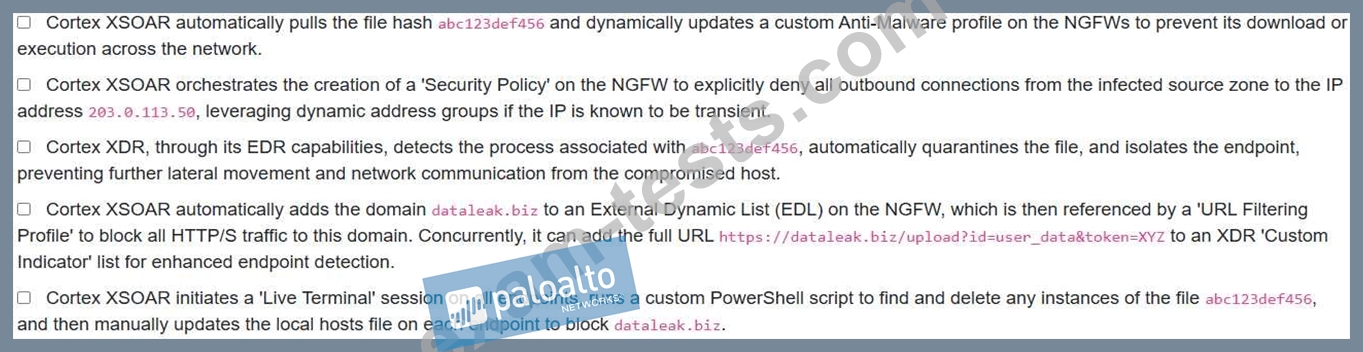
This question assesses the ability to integrate multiple indicator types dynamically across Cortex products for Zero Trust enforcement. A (Incorrect): While XSOAR can integrate with NGFWs, updating an Anti-Malware profile with a specific file hash is not a typical dynamic or real-time action for NGFWs. NGFWs primarily use WildFire for file-based prevention, which receives dynamic updates from Palo Alto Networks. XDR is better suited for endpoint file blocking. B (Correct): This is a prime example of dynamic micro-segmentation. XSOAR can automatically create or update NGFW security policies. Using dynamic address groups for the ephemeral IP allows for flexible blocking as the IP changes. This directly enforces Zero Trust by limiting network access based on threat intelligence (IP indicator). C (Correct): This is a core capability of Cortex XDR. Upon detection of a malicious file (file hash indicator), XDR's EDR functions will automatically quarantine the file and isolate the endpoint. This is crucial for preventing lateral movement and containing the threat at the host level, aligning with Zero Trust principles of 'never trust, always verify'. D (Correct): XSOAR can effectively operationalize domain and URL indicators. Automatically adding the domain to an EDL consumed by the NGFW's URL Filtering Profile provides immediate network-wide blocking of communication to the suspicious domain. Additionally, adding the full URL to XDR's 'Custom Indicator' list enhances endpoint-specific detection, allowing XDR to alert or prevent access to that exact URL pattern, even if the domain is partially allowed for other purposes. This comprehensive approach covers both network and endpoint layers for URL/domain indicators. E (Incorrect): While 'Live Terminal' can be used for remediation, relying on manual PowerShell scripts and local hosts file updates is not scalable, automated, or aligned with dynamic Zero Trust enforcement for an enterprise. XDR's built-in prevention policies and XSOAR's orchestration are the correct tools.
Question 42
An organization is considering replacing its legacy EDR with Cortex XDR primarily due to challenges in demonstrating regulatory compliance (e.g., GDPR, HIPAA) related to data exfiltration and insider threats. Their current EDR provides endpoint logs but lacks integrated tools for comprehensive data visibility and policy enforcement. Which benefit of Cortex XDR, specifically regarding data and user activity, would be most compelling for compliance and data loss prevention (DLP) requirements beyond what a typical EDR offers?
Correct Answer: B
Regulatory compliance, especially for data protection (GDPR, HIPAA), requires comprehensive visibility into who accessed what data, from where, and how it moved. A typical EDR provides endpoint context but struggles to connect user actions across network shares, cloud storage, or even SaaS applications for data exfiltration. Cortex XDR's integrated UEBA capabilities and its ability to ingest data from endpoints, network, and cloud sources provide the granular visibility needed to detect anomalous data access patterns and potential exfiltration attempts. This cross-domain correlation is critical for proving compliance and conducting thorough forensic investigations, which goes significantly beyond the scope of a standalone EDR.
Question 43
A custom application running on a Linux server is suspected of being compromised. The threat actor is believed to be leveraging a zero-day vulnerability in the application to execute arbitrary code and establish a reverse shell. Cortex XDR agents are deployed on this Linux server. You, as a SOC analyst, need to identify the exact process that initiated the reverse shell, its parent process, and any outbound network connections to suspicious external IPs. Which XDR Query Language (XQL) query against Cortex Data Lake would be most effective for this specific investigation, assuming the reverse shell typically connects to port 443 on an unprivileged user's behalf from an unusual location?
Correct Answer: B
To identify the reverse shell's process, its parent, and outbound connections, we need to correlate network connection events with process execution events. Option B starts by filtering for relevant network connections (outbound on port 443), then joins this with process execution data using the process ID. This allows for identifying the process responsible for the network connection and its parent , process_events.actor_process_command_line'), and the destination IP. Option A has an incorrect join condition; it tries to filter for bash/sh first and then join based on process_id, which might miss other reverse shell binaries. Options C, D, and E are irrelevant to the specific goal of tracing a reverse shell's process and network activity.
Question 44
A SOC is implementing a comprehensive 'Zero Trust' architecture using Palo Alto Networks products. As part of this, they need to ensure that even internal lateral movement is strictly controlled and monitored. A critical internal application server (APP SERVER) hosts sensitive customer data and is only accessed by a specific administrative workstation (ADMIN WS) for maintenance. All other internal traffic to APP SERVER should be blocked. Which of the following NGFW security policy configuration elements, combined with a best practice, would most effectively enforce this principle, allowing only the ADMIN WS to access APP SERVER on necessary ports, while logging all other attempts?
Correct Answer: D
Option D represents the most granular and secure implementation of the Zero Trust principle for this scenario. 1. Specific Source Address: Explicitly defines the ADMIN_WS IP as the only allowed source. 2. Specific Applications/Ports: Instead of 'any' service or application, it whitelists only the absolutely necessary applications (e.g., SSH for management, the specific application service, and potentially the Palo Alto Networks web GUI if the server hosts it). Using 'application-default' for services leverages Palo Alto's App-ID for accurate port identification. 3. Action (Allow) and Logging: Allows the legitimate traffic and logs its activity. 4. Default Deny Rule: This is a crucial Zero Trust best practice. By having an implicit or explicit 'deny all' rule at the end of the policy list, any traffic not explicitly allowed by a preceding rule is blocked and can be logged, fulfilling the requirement to 'log all other attempts'. Let's look at why other options are less ideal: A: While functionally similar, using 'Application (all)' and 'Service (any)' in the first rule is less granular and goes against Zero Trust's principle of least privilege. The second rule is redundant if a default deny is in place. B: Using Source User (AdminGroup) is good for user-ID, but if the ADMIN_WS is compromised, any user logging in could gain access. It's better to combine user-ID with specific source IPs/hosts. Also, 'Application (service-http, ssh)' is better but still can be more precise. C: Policy-Based Forwarding is for routing decisions, not for security access control (allow/deny). Logging all traffic by default is good but not a complete access control solution. E: While EDLs are powerful, defining a single IP in an EDL for a specific server is an over-complication for this simple scenario. Threat Prevention and WildFire are good additions, but the core access control is paramount here.
Question 45
A large enterprise is implementing a new incident response playbooks within Palo Alto Networks Cortex XSOAR. They need to define a comprehensive incident categorization schema that supports dynamic prioritization based on the MITRE ATT&CK framework and internal asset criticality ratings. Which of the following XSOAR automation snippets, when integrated, best demonstrates an approach to dynamically categorize and prioritize an incident based on the detection of a 'Lateral Movement' technique (T 1021 - Remote Services) and the involved asset's 'Crown Jewel' status?
Correct Answer: B
Option B best demonstrates dynamic categorization and prioritization. It checks for the presence of the MITRE ATT&CK technique ID (T1021) in the incident's tags (assuming these tags are applied by initial detection mechanisms or XSOAR ingestion). Crucially, it then checks the criticality of the involved assets. If both 'Tl 021' and 'CrownJewel' criticality are present, it elevates the category to 'Advanced Persistent Threat' and sets the severity to 'Critical', indicating a high-priority incident. If only 'T 1021' is present, it assigns a 'High' severity, still acknowledging the threat but indicating a potentially lower business impact. This logic directly maps to a robust categorization and prioritization scheme.
Newest SecOps-Pro Exam PDF Dumps shared by BraindumpsPass.com for Helping Passing SecOps-Pro Exam! BraindumpsPass.com now offer the updated SecOps-Pro exam dumps, the BraindumpsPass.com SecOps-Pro exam questions have been updated and answers have been corrected get the latest BraindumpsPass.com SecOps-Pro pdf dumps with Exam Engine here: