

Question 71
The core routers within a transit AS are running both IBGP and IGP. The edge routers within the transit AS are using the next-hop-self option to establish the IBGP sessions. What can be implemented to improve the routing performance to all external prefixes?
Question 72
Refer to the exhibit.

Routers R1, R2. R3, and R4 have been configured to run OSPF. and router R5 is running EIGRP Traffic from R1 to R5 is expected to pass via R4. but OSPF routing has calculated the best path via R3. Which action corrects the problem?
Routers R1, R2. R3, and R4 have been configured to run OSPF. and router R5 is running EIGRP Traffic from R1 to R5 is expected to pass via R4. but OSPF routing has calculated the best path via R3. Which action corrects the problem?
Question 73
Refer to the exhibit.
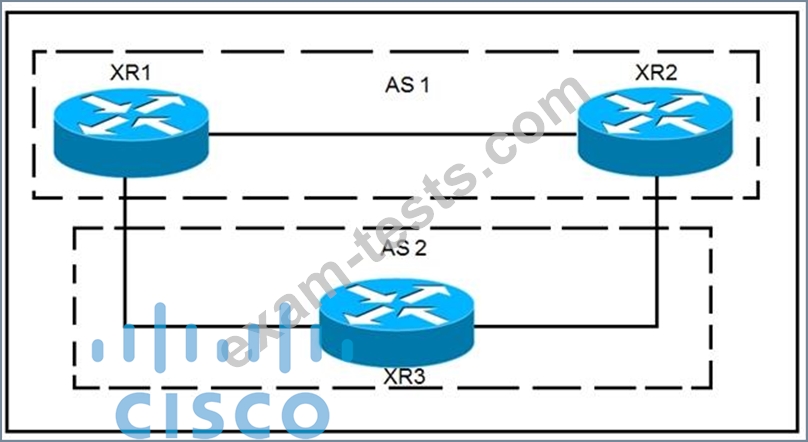
XR1 and XR2 are sending the prefix 10.11.11.0/24 to XR3. A configured policy on XR1 is incorrectly prepending AS path 11 11 12 12 onto this prefix. A network operator wants to add a policy onto XR3 that will not allow the falsely prepending prefix from being installed. Which policy configuration applied to the XR3 neighbor configuration for XR1 can accomplish this requirement without impact to other or future received routes?
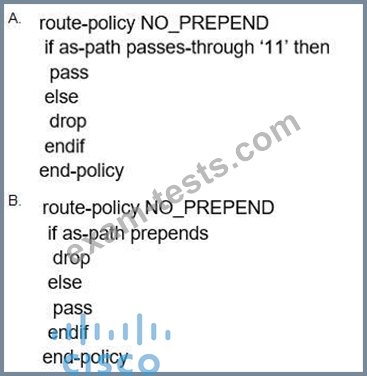
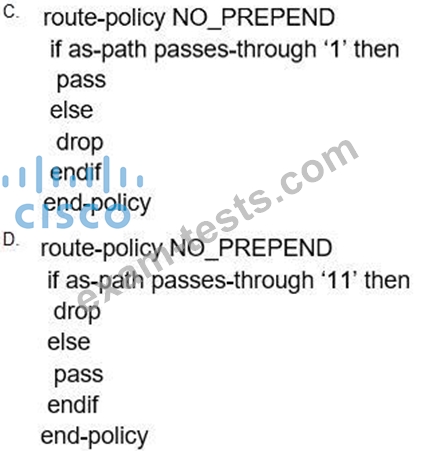
XR1 and XR2 are sending the prefix 10.11.11.0/24 to XR3. A configured policy on XR1 is incorrectly prepending AS path 11 11 12 12 onto this prefix. A network operator wants to add a policy onto XR3 that will not allow the falsely prepending prefix from being installed. Which policy configuration applied to the XR3 neighbor configuration for XR1 can accomplish this requirement without impact to other or future received routes?
Question 74
Refer to the exhibit.

Refer to the exhibit. After a recent network implementation project, customer A is performing stress testing to verify network redundancy at the branch office connected to R4. When the link from R2 is shut Oown as shown, the SLA tracking object fails and the cost of the link between R2 and R4 increases to 100. However, a traceroute operation from a PC in the Branch office shows that traffic to HQ is still routed via R2. Which solution corrects the problem and optimizes traffic flow via R3 without creating operational overhead?
Refer to the exhibit. After a recent network implementation project, customer A is performing stress testing to verify network redundancy at the branch office connected to R4. When the link from R2 is shut Oown as shown, the SLA tracking object fails and the cost of the link between R2 and R4 increases to 100. However, a traceroute operation from a PC in the Branch office shows that traffic to HQ is still routed via R2. Which solution corrects the problem and optimizes traffic flow via R3 without creating operational overhead?
Question 75
Refer to the exhibit.

Routers R1 and R2 cannot form a neighbor relationship, but the network is otherwise configured correctly and operating normally. Which two statements describe the problem? (Choose two.)
Routers R1 and R2 cannot form a neighbor relationship, but the network is otherwise configured correctly and operating normally. Which two statements describe the problem? (Choose two.)