
- Home
- ISACA Certification
- CISA Exam
- ISACA.CISA.v2026-02-11.q999 Practice Test

Question 246
The purpose of a mainframe audit is to provide assurance that (choose all that apply):
Correct Answer: A,B,C,D,E
Explanation/Reference:
Explanation:
The purpose of a mainframe audit is to provide assurance that processes are being implemented as required, the mainframe is operating as it should, security is strong, and that procedures in place are working and are updated as needed. The auditor may accordingly make recommendations for improvement.
Explanation:
The purpose of a mainframe audit is to provide assurance that processes are being implemented as required, the mainframe is operating as it should, security is strong, and that procedures in place are working and are updated as needed. The auditor may accordingly make recommendations for improvement.
Question 247
When auditing the alignment of IT to the business strategy, it is MOST Important for the IS auditor to:
Correct Answer: D
When auditing the alignment of IT to the business strategy, it is most important for the IS auditor to evaluate deliverables of new IT initiatives against planned business services. This can help the IS auditor to assess whether the IT initiatives are meeting the business needs and expectations, delivering value and benefits, and supporting the business objectives and goals. Comparing the organization's strategic plan against industry best practice is a possible technique for auditing the alignment of IT to the business strategy, but it is not the most important thing for the IS auditor to do, as industry best practice may not be applicable or relevant to the specific context or situation of the organization. Interviewing senior managers for their opinion of the IT function is a possible technique for auditing the alignment of IT to the business strategy, but it is not the most important thing for the IS auditor to do, as senior managers' opinions may be subjective or biased, and may not reflect the actual performance or outcomes of the IT function. Ensuring an IT steering committee is appointed to monitor new IT projects is a possible control for ensuring the alignment of IT to the business strategy, but it is not the most important thing for the IS auditor to do, as an IT steering committee may not be effective or efficient in monitoring new IT projects, and may not have sufficient authority or influence over the IT function.
Question 248
Which of the following is a concern associated with virtualization?
Correct Answer: B
Question 249
Which of the following term in business continuity determines the maximum tolerable amount of time needed to bring all critical systems back online after disaster occurs?
Correct Answer: B
Explanation/Reference:
The recovery time objective (RTO) is the duration of time and a service level within which a business process must be restored after a disaster (or disruption) in order to avoid unacceptable consequences associated with a break in business continuity.
It can include the time for trying to fix the problem without a recovery, the recovery itself, testing, and the communication to the users. Decision time for users representative is not included.
The business continuity timeline usually runs parallel with an incident management timeline and may start at the same, or different, points.
In accepted business continuity planning methodology, the RTO is established during the Business Impact Analysis (BIA) by the owner of a process (usually in conjunction with the business continuity planner). The RTOs are then presented to senior management for acceptance.
The RTO attaches to the business process and not the resources required to support the process.
The RTO and the results of the BIA in its entirety provide the basis for identifying and analyzing viable strategies for inclusion in the business continuity plan. Viable strategy options would include any which would enable resumption of a business process in a time frame at or near the RTO. This would include alternate or manual workaround procedures and would not necessarily require computer systems to meet the RTOs.
For your exam you should know below information about RPO, RTO, WRT and MTD :
Stage 1: Business as usual
Business as usual

Image Reference - http://defaultreasoning.files.wordpress.com/2013/12/bcdr-01.png At this stage all systems are running production and working correctly.
Stage 2: Disaster occurs
Disaster Occurs

Image Reference - http://defaultreasoning.files.wordpress.com/2013/12/bcdr-02.png On a given point in time, disaster occurs and systems needs to be recovered. At this point the Recovery Point Objective (RPO) determines the maximum acceptable amount of data loss measured in time. For example, the maximum tolerable data loss is 15 minutes.
Stage 3: Recovery
Recovery

Image Reference - http://defaultreasoning.files.wordpress.com/2013/12/bcdr-03.png At this stage the system are recovered and back online but not ready for production yet. The Recovery Time Objective (RTO) determines the maximum tolerable amount of time needed to bring all critical systems back online. This covers, for example, restore data from back-up or fix of a failure. In most cases this part is carried out by system administrator, network administrator, storage administrator etc.
Stage 4: Resume Production
Resume Production
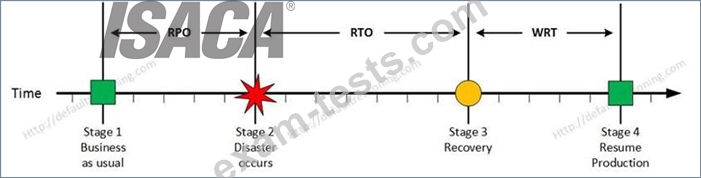
Image Reference - http://defaultreasoning.files.wordpress.com/2013/12/bcdr-04.png At this stage all systems are recovered, integrity of the system or data is verified and all critical systems can resume normal operations. The Work Recovery Time (WRT) determines the maximum tolerable amount of time that is needed to verify the system and/or data integrity. This could be, for example, checking the databases and logs, making sure the applications or services are running and are available.
In most cases those tasks are performed by application administrator, database administrator etc. When all systems affected by the disaster are verified and/or recovered, the environment is ready to resume the production again.
MTD
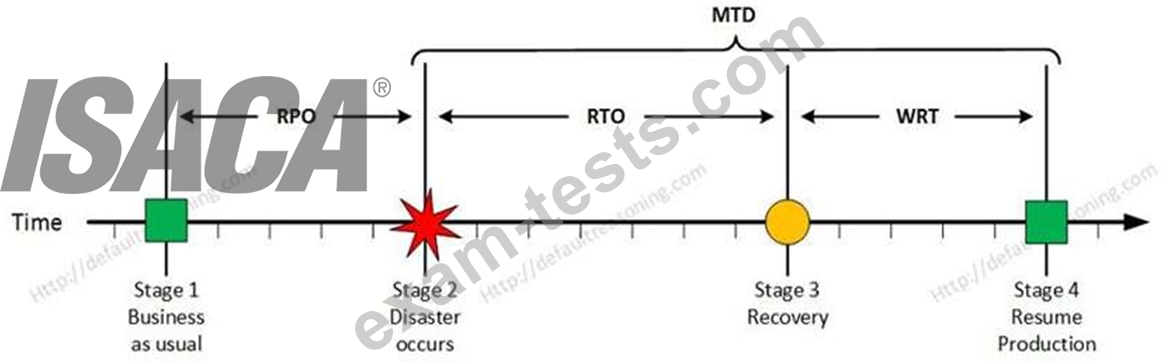
Image Reference - http://defaultreasoning.files.wordpress.com/2013/12/bcdr-05.png The sum of RTO and WRT is defined as the Maximum Tolerable Downtime (MTD) which defines the total amount of time that a business process can be disrupted without causing any unacceptable consequences. This value should be defined by the business management team or someone like CTO, CIO or IT manager.
The following answers are incorrect:
RPO - Recovery Point Objective (RPO) determines the maximum acceptable amount of data loss measured in time. For example, the maximum tolerable data loss is 15 minutes.
WRT - The Work Recovery Time (WRT) determines the maximum tolerable amount of time that is needed to verify the system and/or data integrity. This could be, for example, checking the databases and logs, making sure the applications or services are running and are available. In most cases those tasks are performed by application administrator, database administrator etc. When all systems affected by the disaster are verified and/or recovered, the environment is ready to resume the production again.
MTD - The sum of RTO and WRT is defined as the Maximum Tolerable Downtime (MTD) which defines the total amount of time that a business process can be disrupted without causing any unacceptable consequences. This value should be defined by the business management team or someone like CTO, CIO or IT manager.
The following reference(s) were/was used to create this question:
CISA review manual 2014 page number 284
http://en.wikipedia.org/wiki/Recovery_time_objective
http://defaultreasoning.com/2013/12/10/rpo-rto-wrt-mtdwth/
The recovery time objective (RTO) is the duration of time and a service level within which a business process must be restored after a disaster (or disruption) in order to avoid unacceptable consequences associated with a break in business continuity.
It can include the time for trying to fix the problem without a recovery, the recovery itself, testing, and the communication to the users. Decision time for users representative is not included.
The business continuity timeline usually runs parallel with an incident management timeline and may start at the same, or different, points.
In accepted business continuity planning methodology, the RTO is established during the Business Impact Analysis (BIA) by the owner of a process (usually in conjunction with the business continuity planner). The RTOs are then presented to senior management for acceptance.
The RTO attaches to the business process and not the resources required to support the process.
The RTO and the results of the BIA in its entirety provide the basis for identifying and analyzing viable strategies for inclusion in the business continuity plan. Viable strategy options would include any which would enable resumption of a business process in a time frame at or near the RTO. This would include alternate or manual workaround procedures and would not necessarily require computer systems to meet the RTOs.
For your exam you should know below information about RPO, RTO, WRT and MTD :
Stage 1: Business as usual
Business as usual
Image Reference - http://defaultreasoning.files.wordpress.com/2013/12/bcdr-01.png At this stage all systems are running production and working correctly.
Stage 2: Disaster occurs
Disaster Occurs
Image Reference - http://defaultreasoning.files.wordpress.com/2013/12/bcdr-02.png On a given point in time, disaster occurs and systems needs to be recovered. At this point the Recovery Point Objective (RPO) determines the maximum acceptable amount of data loss measured in time. For example, the maximum tolerable data loss is 15 minutes.
Stage 3: Recovery
Recovery
Image Reference - http://defaultreasoning.files.wordpress.com/2013/12/bcdr-03.png At this stage the system are recovered and back online but not ready for production yet. The Recovery Time Objective (RTO) determines the maximum tolerable amount of time needed to bring all critical systems back online. This covers, for example, restore data from back-up or fix of a failure. In most cases this part is carried out by system administrator, network administrator, storage administrator etc.
Stage 4: Resume Production
Resume Production
Image Reference - http://defaultreasoning.files.wordpress.com/2013/12/bcdr-04.png At this stage all systems are recovered, integrity of the system or data is verified and all critical systems can resume normal operations. The Work Recovery Time (WRT) determines the maximum tolerable amount of time that is needed to verify the system and/or data integrity. This could be, for example, checking the databases and logs, making sure the applications or services are running and are available.
In most cases those tasks are performed by application administrator, database administrator etc. When all systems affected by the disaster are verified and/or recovered, the environment is ready to resume the production again.
MTD
Image Reference - http://defaultreasoning.files.wordpress.com/2013/12/bcdr-05.png The sum of RTO and WRT is defined as the Maximum Tolerable Downtime (MTD) which defines the total amount of time that a business process can be disrupted without causing any unacceptable consequences. This value should be defined by the business management team or someone like CTO, CIO or IT manager.
The following answers are incorrect:
RPO - Recovery Point Objective (RPO) determines the maximum acceptable amount of data loss measured in time. For example, the maximum tolerable data loss is 15 minutes.
WRT - The Work Recovery Time (WRT) determines the maximum tolerable amount of time that is needed to verify the system and/or data integrity. This could be, for example, checking the databases and logs, making sure the applications or services are running and are available. In most cases those tasks are performed by application administrator, database administrator etc. When all systems affected by the disaster are verified and/or recovered, the environment is ready to resume the production again.
MTD - The sum of RTO and WRT is defined as the Maximum Tolerable Downtime (MTD) which defines the total amount of time that a business process can be disrupted without causing any unacceptable consequences. This value should be defined by the business management team or someone like CTO, CIO or IT manager.
The following reference(s) were/was used to create this question:
CISA review manual 2014 page number 284
http://en.wikipedia.org/wiki/Recovery_time_objective
http://defaultreasoning.com/2013/12/10/rpo-rto-wrt-mtdwth/
Question 250
Which of the following should an IS auditor recommend to BEST enforce alignment of an IT project portfolio with strategic organizational priorities?
Correct Answer: C
Explanation/Reference:
Explanation:
Prioritization of projects on the basis of their expected benefit(s) to business, and the related risks, is the best measure for achieving alignment of the project portfolio to an organization's strategic priorities.
Modifying the yearly process of the projects portfolio definition might improve the situation, but only if the portfolio definition process is currently not tied to the definition of corporate strategies; however, this is unlikely since the difficulties are in maintaining the alignment, and not in setting it up initially. Measures such as balanced scorecard (BSC) and key performance indicators (KPIs) are helpful, but they do not guarantee that the projects are aligned with business strategy.
Explanation:
Prioritization of projects on the basis of their expected benefit(s) to business, and the related risks, is the best measure for achieving alignment of the project portfolio to an organization's strategic priorities.
Modifying the yearly process of the projects portfolio definition might improve the situation, but only if the portfolio definition process is currently not tied to the definition of corporate strategies; however, this is unlikely since the difficulties are in maintaining the alignment, and not in setting it up initially. Measures such as balanced scorecard (BSC) and key performance indicators (KPIs) are helpful, but they do not guarantee that the projects are aligned with business strategy.
- Other Version
- 6270ISACA.CISA.v2026-01-26.q999
- 9857ISACA.CISA.v2025-05-24.q773
- 3472ISACA.CISA.v2024-10-22.q310
- 7907ISACA.CISA.v2023-10-02.q715
- 4903ISACA.CISA.v2023-03-29.q119
- 3754ISACA.CISA.v2023-02-09.q181
- 2305ISACA.CISA.v2023-02-06.q107
- 3841ISACA.CISA.v2022-08-28.q129
- 5302ISACA.CISA.v2022-02-25.q148
- 130ISACA.Actualtestpdf.CISA.v2021-11-13.by.sarah.721q.pdf
- 6984ISACA.CISA.v2021-11-11.q194
- 10488ISACA.CISA.v2021-10-08.q198
- 11558ISACA.CISA.v2021-09-28.q199
- 13810ISACA.CISA.v2021-09-11.q201
- Latest Upload
- 286PaloAltoNetworks.NGFW-Engineer.v2026-05-01.q43
- 414Nokia.4A0-113.v2026-05-01.q69
- 447EC-COUNCIL.312-49v11.v2026-04-30.q214
- 414Microsoft.MB-820.v2026-04-30.q101
- 284Salesforce.MC-202.v2026-04-30.q57
- 327BICSI.INSTC_V8.v2026-04-29.q53
- 462NMLS.MLO.v2026-04-28.q82
- 303NCARB.Project-Management.v2026-04-28.q27
- 555EMC.D-AV-DY-23.v2026-04-27.q184
- 1402ServiceNow.CSA.v2026-04-27.q483
[×]
Download PDF File
Enter your email address to download ISACA.CISA.v2026-02-11.q999 Practice Test