
- Home
- ISACA Certification
- CISA Exam
- ISACA.CISA.v2026-02-11.q999 Practice Test

Question 256
In which of the following WAN message transmission technique does two network nodes establish a dedicated communications channel through the network before the nodes may communicate?
Correct Answer: C
Explanation/Reference:
For your exam you should know below information about WAN message transmission technique:
Message Switching
Message switching is a network switching technique in which data is routed in its entirety from the source node to the destination node, one hope at a time. During message routing, every intermediate switch in the network stores the whole message. If the entire network's resources are engaged or the network becomes blocked, the message-switched network stores and delays the message until ample resources become available for effective transmission of the message.
Message Switching
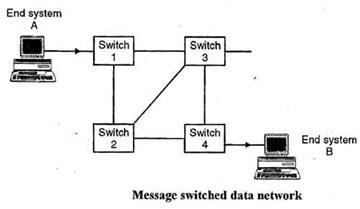
Image from: http://ecomputernotes.com/images/Message-Switched-data-Network.jpg Packet Switching Refers to protocols in which messages are divided into packets before they are sent. Each packet is then transmitted individually and can even follow different routes to its destination. Once all the packets forming a message arrive at the destination, they are recompiled into the original message.
Packet Switching

Image from: http://upload.wikimedia.org/wikipedia/commons/f/f6/Packet_Switching.gif Circuit Switching Circuit switching is a methodology of implementing a telecommunications network in which two network nodes establish a dedicated communications channel (circuit) through the network before the nodes may communicate.
The circuit guarantees the full bandwidth of the channel and remains connected for the duration of the session. The circuit functions as if the nodes were physically connected similar to an electrical circuit.
The defining example of a circuit-switched network is the early analog telephone network. When a call is made from one telephone to another, switches within the telephone exchanges create a continuous wire circuit between the two telephones, for as long as the call lasts.
In circuit switching, the bit delay is constant during a connection, as opposed to packet switching, where packet queues may cause varying and potentially indefinitely long packet transfer delays. No circuit can be degraded by competing users because it is protected from use by other callers until the circuit is released and a new connection is set up. Even if no actual communication is taking place, the channel remains reserved and protected from competing users.
Circuit Switching

Image from: http://www.louiewong.com/wp-content/uploads/2010/09/Circuit_Switching.jpg See a table below comparing Circuit Switched versus Packet Switched networks:
Difference between Circuit and packet switching
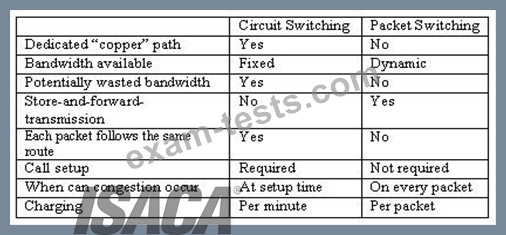
Image from:http://www.hardware-one.com/reviews/network-guide-2/images/packet-vs-circuit.gif Virtual circuit In telecommunications and computer networks, a virtual circuit (VC), synonymous with virtual connection and virtual channel, is a connection oriented communication service that is delivered by means of packet mode communication.
After a connection or virtual circuit is established between two nodes or application processes, a bit stream or byte stream may be delivered between the nodes; a virtual circuit protocol allows higher level protocols to avoid dealing with the division of data into segments, packets, or frames.
Virtual circuit communication resembles circuit switching, since both are connection oriented, meaning that in both cases data is delivered in correct order, and signaling overhead is required during a connection establishment phase. However, circuit switching provides constant bit rate and latency, while these may vary in a virtual circuit service due to factors such as:
varying packet queue lengths in the network nodes,
varying bit rate generated by the application,
varying load from other users sharing the same network resources by means of statistical multiplexing, etc.
The following were incorrect answers:
The other options presented are not valid choices.
The following reference(s) were/was used to create this question:
CISA review manual 2014 Page number 265
For your exam you should know below information about WAN message transmission technique:
Message Switching
Message switching is a network switching technique in which data is routed in its entirety from the source node to the destination node, one hope at a time. During message routing, every intermediate switch in the network stores the whole message. If the entire network's resources are engaged or the network becomes blocked, the message-switched network stores and delays the message until ample resources become available for effective transmission of the message.
Message Switching
Image from: http://ecomputernotes.com/images/Message-Switched-data-Network.jpg Packet Switching Refers to protocols in which messages are divided into packets before they are sent. Each packet is then transmitted individually and can even follow different routes to its destination. Once all the packets forming a message arrive at the destination, they are recompiled into the original message.
Packet Switching
Image from: http://upload.wikimedia.org/wikipedia/commons/f/f6/Packet_Switching.gif Circuit Switching Circuit switching is a methodology of implementing a telecommunications network in which two network nodes establish a dedicated communications channel (circuit) through the network before the nodes may communicate.
The circuit guarantees the full bandwidth of the channel and remains connected for the duration of the session. The circuit functions as if the nodes were physically connected similar to an electrical circuit.
The defining example of a circuit-switched network is the early analog telephone network. When a call is made from one telephone to another, switches within the telephone exchanges create a continuous wire circuit between the two telephones, for as long as the call lasts.
In circuit switching, the bit delay is constant during a connection, as opposed to packet switching, where packet queues may cause varying and potentially indefinitely long packet transfer delays. No circuit can be degraded by competing users because it is protected from use by other callers until the circuit is released and a new connection is set up. Even if no actual communication is taking place, the channel remains reserved and protected from competing users.
Circuit Switching
Image from: http://www.louiewong.com/wp-content/uploads/2010/09/Circuit_Switching.jpg See a table below comparing Circuit Switched versus Packet Switched networks:
Difference between Circuit and packet switching
Image from:http://www.hardware-one.com/reviews/network-guide-2/images/packet-vs-circuit.gif Virtual circuit In telecommunications and computer networks, a virtual circuit (VC), synonymous with virtual connection and virtual channel, is a connection oriented communication service that is delivered by means of packet mode communication.
After a connection or virtual circuit is established between two nodes or application processes, a bit stream or byte stream may be delivered between the nodes; a virtual circuit protocol allows higher level protocols to avoid dealing with the division of data into segments, packets, or frames.
Virtual circuit communication resembles circuit switching, since both are connection oriented, meaning that in both cases data is delivered in correct order, and signaling overhead is required during a connection establishment phase. However, circuit switching provides constant bit rate and latency, while these may vary in a virtual circuit service due to factors such as:
varying packet queue lengths in the network nodes,
varying bit rate generated by the application,
varying load from other users sharing the same network resources by means of statistical multiplexing, etc.
The following were incorrect answers:
The other options presented are not valid choices.
The following reference(s) were/was used to create this question:
CISA review manual 2014 Page number 265
Question 257
After installing a network, an organization installed a vulnerability assessment tool or security scanner to identify possible weaknesses. Which is the MOST serious risk associated with such tools?
Correct Answer: C
Section: Protection of Information Assets
Explanation
Explanation:
False-negative reporting on weaknesses means the control weaknesses in the network are not identified and therefore may not be addressed, leaving the network vulnerable to attack. False- positive reporting is one in which the controls are in place, but are evaluated as weak, which should prompt a rechecking of the controls. Less-detail reporting and differential reporting functions provided by these tools compare scan results over a period of time.
Explanation
Explanation:
False-negative reporting on weaknesses means the control weaknesses in the network are not identified and therefore may not be addressed, leaving the network vulnerable to attack. False- positive reporting is one in which the controls are in place, but are evaluated as weak, which should prompt a rechecking of the controls. Less-detail reporting and differential reporting functions provided by these tools compare scan results over a period of time.
Question 258
Identify the network topology from below diagram presented below:

Network Topology
Network Topology
Correct Answer: B
Section: Information System Operations, Maintenance and Support
Explanation:
For your exam you should know the information below related to LAN topologies:
LAN Topologies
Network topology is the physical arrangement of the various elements (links, nodes, etc.) of a computer network.
Essentially, it is the topological structure of a network, and may be depicted physically or logically. Physical topology refers to the placement of the network's various components, including device location and cable installation, while logical topology shows how data flows within a network, regardless of its physical design.
Distances between nodes, physical interconnections, transmission rates, and/or signal types may differ between two networks, yet their topologies may be identical.
Bus
In local area networks where bus topology is used, each node is connected to a single cable. Each computer or server is connected to the single bus cable. A signal from the source travels in both directions to all machines connected on the bus cable until it finds the intended recipient. If the machine address does not match the intended address for the data, the machine ignores the data. Alternatively, if the data matches the machine address, the data is accepted. Since the bus topology consists of only one wire, it is rather inexpensive to implement when compared to other topologies. However, the low cost of implementing the technology is offset by the high cost of managing the network. Additionally, since only one cable is utilized, it can be the single point of failure. If the network cable is terminated on both ends and when without termination data transfer stop and when cable breaks, the entire network will be down.
Bus topology
Graphic from:

Linear bus
The type of network topology in which all of the nodes of the network are connected to a common transmission medium which has exactly two endpoints (this is the 'bus', which is also commonly referred to as the backbone, or trunk) - all data that is transmitted between nodes in the network is transmitted over this common transmission medium and is able to be received by all nodes in the network simultaneously.
Distributed bus
The type of network topology in which all of the nodes of the network are connected to a common transmission medium which has more than two endpoints that are created by adding branches to the main section of the transmission medium - the physical distributed bus topology functions in exactly the same fashion as the physical linear bus topology (i.e., all nodes share a common transmission medium).
Star
In local area networks with a star topology, each network host is connected to a central point with a point- to-point connection. In Star topology every node (computer workstation or any other peripheral) is connected to central node called hub or switch.
The switch is the server and the peripherals are the clients. The network does not necessarily have to resemble a star to be classified as a star network, but all of the nodes on the network must be connected to one central device.
All traffic that traverses the network passes through the central point. The central point acts as a signal repeater.
The star topology is considered the easiest topology to design and implement. An advantage of the star topology is the simplicity of adding additional nodes. The primary disadvantage of the star topology is that the central point represents a single point of failure.
Star Topology
Ring
A network topology that is set up in a circular fashion in which data travels around the ring in one direction and each device on the ring acts as a repeater to keep the signal strong as it travels. Each device incorporates a receiver for the incoming signal and a transmitter to send the data on to the next device in the ring.
The network is dependent on the ability of the signal to travel around the ring. When a device sends data, it must travel through each device on the ring until it reaches its destination. Every node is a critical link. If one node goes down the whole link would be affected.
Ring Topology

Mesh
The value of a fully meshed networks is proportional to the exponent of the number of subscribers, assuming that communicating groups of any two endpoints, up to and including all the endpoints, is approximated by Reed's Law.
A mesh network provides for high availability and redundancy. However, the cost of such network could be very expensive if dozens of devices are in the mesh.
Mesh Topology

Fully connected mesh topology
A fully connected network is a communication network in which each of the nodes is connected to each other. In graph theory it known as a complete graph. A fully connected network doesn't need to use switching nor broadcasting. However, its major disadvantage is that the number of connections grows quadratic ally with the number of nodes, so it is extremely impractical for large networks. A two-node network is technically a fully connected network.
Partially connected mesh topology
The type of network topology in which some of the nodes of the network are connected to more than one other node in the network with a point-to-point link - this makes it possible to take advantage of some of the redundancy that is provided by a physical fully connected mesh topology without the expense and complexity required for a connection between every node in the network.
The following answers are incorrect:
The other options presented are not valid.
Reference:
CISA review manual 2014, Page number 262
Explanation:
For your exam you should know the information below related to LAN topologies:
LAN Topologies
Network topology is the physical arrangement of the various elements (links, nodes, etc.) of a computer network.
Essentially, it is the topological structure of a network, and may be depicted physically or logically. Physical topology refers to the placement of the network's various components, including device location and cable installation, while logical topology shows how data flows within a network, regardless of its physical design.
Distances between nodes, physical interconnections, transmission rates, and/or signal types may differ between two networks, yet their topologies may be identical.
Bus
In local area networks where bus topology is used, each node is connected to a single cable. Each computer or server is connected to the single bus cable. A signal from the source travels in both directions to all machines connected on the bus cable until it finds the intended recipient. If the machine address does not match the intended address for the data, the machine ignores the data. Alternatively, if the data matches the machine address, the data is accepted. Since the bus topology consists of only one wire, it is rather inexpensive to implement when compared to other topologies. However, the low cost of implementing the technology is offset by the high cost of managing the network. Additionally, since only one cable is utilized, it can be the single point of failure. If the network cable is terminated on both ends and when without termination data transfer stop and when cable breaks, the entire network will be down.
Bus topology
Graphic from:
Linear bus
The type of network topology in which all of the nodes of the network are connected to a common transmission medium which has exactly two endpoints (this is the 'bus', which is also commonly referred to as the backbone, or trunk) - all data that is transmitted between nodes in the network is transmitted over this common transmission medium and is able to be received by all nodes in the network simultaneously.
Distributed bus
The type of network topology in which all of the nodes of the network are connected to a common transmission medium which has more than two endpoints that are created by adding branches to the main section of the transmission medium - the physical distributed bus topology functions in exactly the same fashion as the physical linear bus topology (i.e., all nodes share a common transmission medium).
Star
In local area networks with a star topology, each network host is connected to a central point with a point- to-point connection. In Star topology every node (computer workstation or any other peripheral) is connected to central node called hub or switch.
The switch is the server and the peripherals are the clients. The network does not necessarily have to resemble a star to be classified as a star network, but all of the nodes on the network must be connected to one central device.
All traffic that traverses the network passes through the central point. The central point acts as a signal repeater.
The star topology is considered the easiest topology to design and implement. An advantage of the star topology is the simplicity of adding additional nodes. The primary disadvantage of the star topology is that the central point represents a single point of failure.
Star Topology
Ring
A network topology that is set up in a circular fashion in which data travels around the ring in one direction and each device on the ring acts as a repeater to keep the signal strong as it travels. Each device incorporates a receiver for the incoming signal and a transmitter to send the data on to the next device in the ring.
The network is dependent on the ability of the signal to travel around the ring. When a device sends data, it must travel through each device on the ring until it reaches its destination. Every node is a critical link. If one node goes down the whole link would be affected.
Ring Topology
Mesh
The value of a fully meshed networks is proportional to the exponent of the number of subscribers, assuming that communicating groups of any two endpoints, up to and including all the endpoints, is approximated by Reed's Law.
A mesh network provides for high availability and redundancy. However, the cost of such network could be very expensive if dozens of devices are in the mesh.
Mesh Topology
Fully connected mesh topology
A fully connected network is a communication network in which each of the nodes is connected to each other. In graph theory it known as a complete graph. A fully connected network doesn't need to use switching nor broadcasting. However, its major disadvantage is that the number of connections grows quadratic ally with the number of nodes, so it is extremely impractical for large networks. A two-node network is technically a fully connected network.
Partially connected mesh topology
The type of network topology in which some of the nodes of the network are connected to more than one other node in the network with a point-to-point link - this makes it possible to take advantage of some of the redundancy that is provided by a physical fully connected mesh topology without the expense and complexity required for a connection between every node in the network.
The following answers are incorrect:
The other options presented are not valid.
Reference:
CISA review manual 2014, Page number 262
Question 259
Which of the following responsibilities associated with a disaster recovery plan (DRP) can be outsourced to a Disaster Recovery as a Service (DRaaS) provider?
Correct Answer: C
Question 260
IS management has decided to install a level 1 Redundant Array of Inexpensive Disks (RAID) system in all servers to compensate for the elimination of offsite backups. The IS auditor should recommend:
Correct Answer: C
Explanation/Reference:
Explanation:
A RAID system, at any level, will not protect against a natural disaster. The problem will not be alleviated without offsite backups, more frequent onsite backups or even setting up a cold site. Choices A, B and D do not compensate for the lack of offsite backup.
Explanation:
A RAID system, at any level, will not protect against a natural disaster. The problem will not be alleviated without offsite backups, more frequent onsite backups or even setting up a cold site. Choices A, B and D do not compensate for the lack of offsite backup.
- Other Version
- 6272ISACA.CISA.v2026-01-26.q999
- 9857ISACA.CISA.v2025-05-24.q773
- 3473ISACA.CISA.v2024-10-22.q310
- 7908ISACA.CISA.v2023-10-02.q715
- 4903ISACA.CISA.v2023-03-29.q119
- 3755ISACA.CISA.v2023-02-09.q181
- 2305ISACA.CISA.v2023-02-06.q107
- 3842ISACA.CISA.v2022-08-28.q129
- 5302ISACA.CISA.v2022-02-25.q148
- 130ISACA.Actualtestpdf.CISA.v2021-11-13.by.sarah.721q.pdf
- 6984ISACA.CISA.v2021-11-11.q194
- 10488ISACA.CISA.v2021-10-08.q198
- 11558ISACA.CISA.v2021-09-28.q199
- 13810ISACA.CISA.v2021-09-11.q201
- Latest Upload
- 286PaloAltoNetworks.NGFW-Engineer.v2026-05-01.q43
- 414Nokia.4A0-113.v2026-05-01.q69
- 447EC-COUNCIL.312-49v11.v2026-04-30.q214
- 414Microsoft.MB-820.v2026-04-30.q101
- 284Salesforce.MC-202.v2026-04-30.q57
- 327BICSI.INSTC_V8.v2026-04-29.q53
- 462NMLS.MLO.v2026-04-28.q82
- 303NCARB.Project-Management.v2026-04-28.q27
- 556EMC.D-AV-DY-23.v2026-04-27.q184
- 1402ServiceNow.CSA.v2026-04-27.q483
[×]
Download PDF File
Enter your email address to download ISACA.CISA.v2026-02-11.q999 Practice Test