

Question 111
Refer to Exhibit.

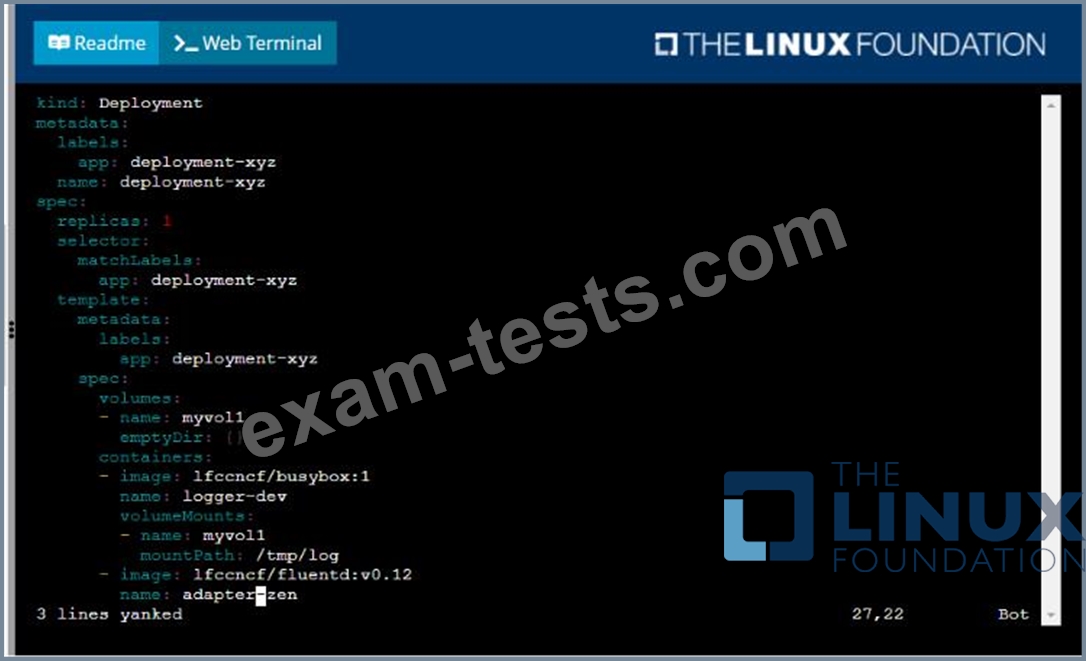
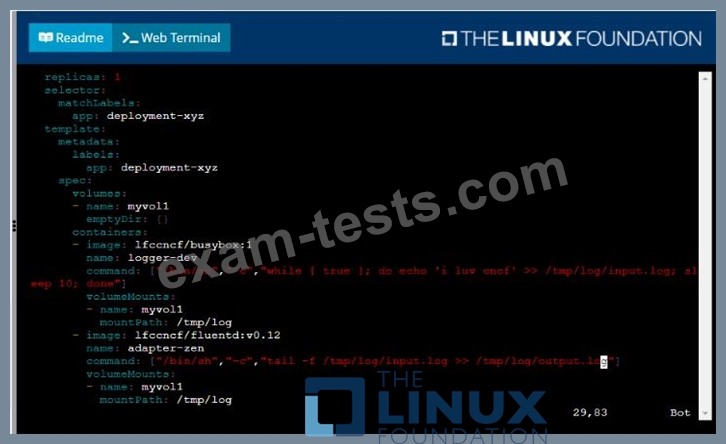
Given a container that writes a log file in format A and a container that converts log files from format A to format B, create a deployment that runs both containers such that the log files from the first container are converted by the second container, emitting logs in format B.
Task:
* Create a deployment named deployment-xyz in the default namespace, that:
* Includes a primary
lfccncf/busybox:1 container, named logger-dev
* includes a sidecar Ifccncf/fluentd:v0.12 container, named adapter-zen
* Mounts a shared volume /tmp/log on both containers, which does not persist when the pod is deleted
* Instructs the logger-dev
container to run the command
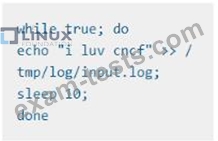
which should output logs to /tmp/log/input.log in plain text format, with example values:

* The adapter-zen sidecar container should read /tmp/log/input.log and output the data to /tmp/log/output.* in Fluentd JSON format. Note that no knowledge of Fluentd is required to complete this task: all you will need to achieve this is to create the ConfigMap from the spec file provided at /opt/KDMC00102/fluentd-configma p.yaml , and mount that ConfigMap to /fluentd/etc in the adapter-zen sidecar container
Given a container that writes a log file in format A and a container that converts log files from format A to format B, create a deployment that runs both containers such that the log files from the first container are converted by the second container, emitting logs in format B.
Task:
* Create a deployment named deployment-xyz in the default namespace, that:
* Includes a primary
lfccncf/busybox:1 container, named logger-dev
* includes a sidecar Ifccncf/fluentd:v0.12 container, named adapter-zen
* Mounts a shared volume /tmp/log on both containers, which does not persist when the pod is deleted
* Instructs the logger-dev
container to run the command
which should output logs to /tmp/log/input.log in plain text format, with example values:
* The adapter-zen sidecar container should read /tmp/log/input.log and output the data to /tmp/log/output.* in Fluentd JSON format. Note that no knowledge of Fluentd is required to complete this task: all you will need to achieve this is to create the ConfigMap from the spec file provided at /opt/KDMC00102/fluentd-configma p.yaml , and mount that ConfigMap to /fluentd/etc in the adapter-zen sidecar container




Question 112
You have a microservice application that relies on a Redis cacne for data retrieval. Design a multi-container Pod that incorporates a Redis sidecar container to provide local caching within the Pod. Ensure that the main application container can access the Redis sidecar container within the same Pod Namespace Without needing to communicate with an external Redis cluster.

Question 113

Task
You have rolled out a new pod to your infrastructure and now you need to allow it to communicate with the web and storage pods but nothing else. Given the running pod kdsn00201 -newpod edit it to use a network policy that will allow it to send and receive traffic only to and from the web and storage pods.


Question 114
You have a Deployment for a web application that uses a separate Redis cache pod for session management. You want to ensure that each web application pod can access a dedicated Redis instance for session management and avoid contention. Explain how you can use a PersistentVolumeClaim and StatetulSet to achieve this.


Question 115
You are tasked With deploying a new web application on Kubernetes. The application is designed to be highly available and requires persistent storage for user dat a. The application needs to be able to handle incoming requests even during rolling updates. How would you design the deployment using StatetulSets, ensuring that the application remains available and data is preserved even when updating the deployment?


