

Question 116
Context

Task
A Deployment named backend-deployment in namespace staging runs a web application on port 8081.

Task
A Deployment named backend-deployment in namespace staging runs a web application on port 8081.


Question 117
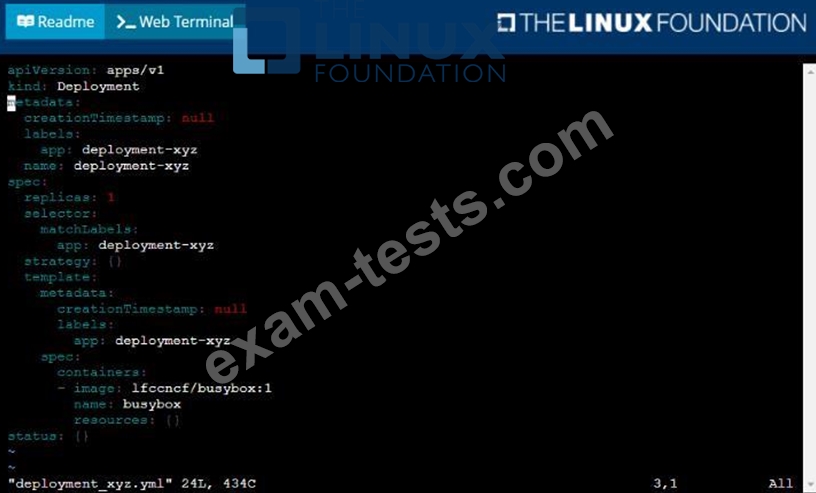
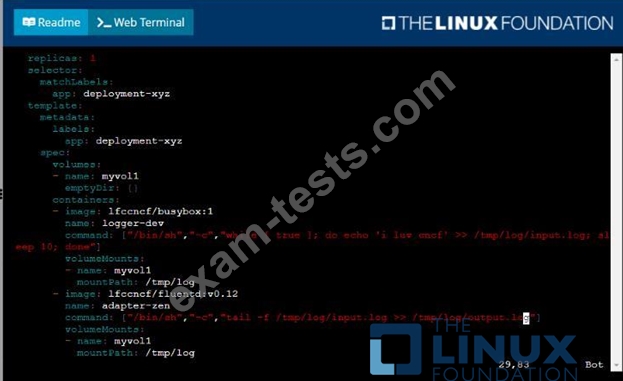
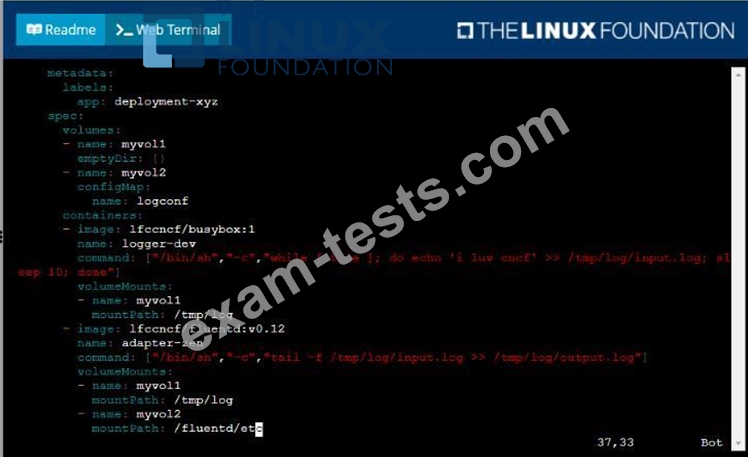
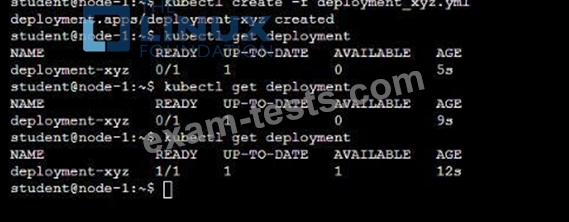
Given a container that writes a log file in format A and a container that converts log files from format A to format B, create a deployment that runs both containers such that the log files from the first container are converted by the second container, emitting logs in format B.
Task:
* Create a deployment named deployment-xyz in the default namespace, that:
*Includes a primary
lfccncf/busybox:1 container, named logger-dev
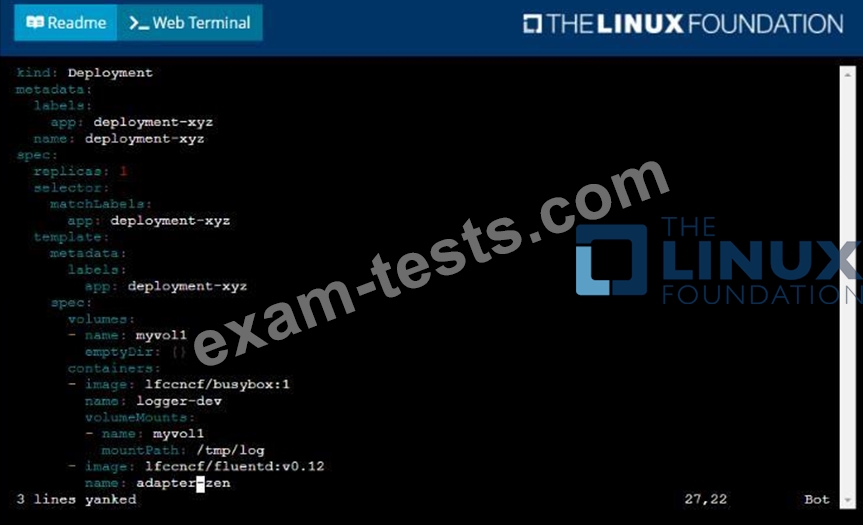
*includes a sidecar Ifccncf/fluentd:v0.12 container, named adapter-zen
*Mounts a shared volume /tmp/log on both containers, which does not persist when the pod is deleted
*Instructs the logger-dev
container to run the command

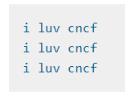
which should output logs to /tmp/log/input.log in plain text format, with example values:
* The adapter-zen sidecar container should read /tmp/log/input.log and output the data to /tmp/log/output.* in Fluentd JSON format. Note that no knowledge of Fluentd is required to complete this task: all you will need to achieve this is to create the ConfigMap from the spec file provided at /opt/KDMC00102/fluentd-configma p.yaml , and mount that ConfigMap to /fluentd/etc in the adapter-zen sidecar container See the solution below.

Question 118
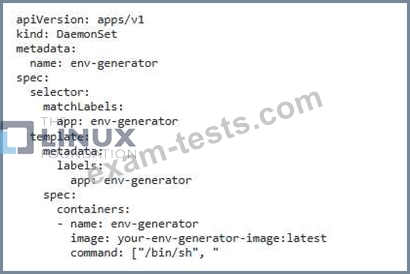
You nave a Deployment tnat runs an application that requires specific environment variables to be set. These variables snould be different for each Pod in the Deployment- How would you use a Daemonset to generate unique environment variables for each Pod based on its hostname?
Question 119
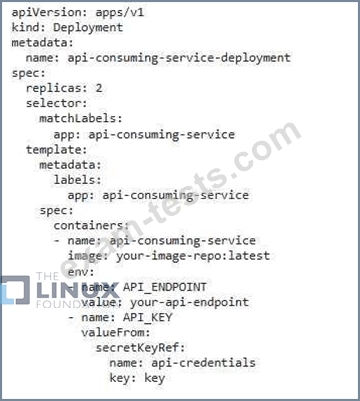
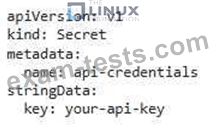
You are building a microservice that relies on a third-party API for its functionality_ To ensure the reliability and performance of your microservice, you need to implement a robust strategy tor handling API calls. Design a deployment strategy that addresses potential issues with the third-pany API and ensures the stability of your microservice.
Question 120
You have a Kubernetes cluster with a namespace called 'dev' and a deployment named 'app-deployment' in that namespace. You need to create a new Role that allows users in the 'developers' group to only scale the Sapp-deployment' deployment. They should not be able to access any other resources in the 'dev' namespace. Implement the RBAC configuration for this scenario.


Premium Bundle
Newest CKAD Exam PDF Dumps shared by BraindumpsPass.com for Helping Passing CKAD Exam! BraindumpsPass.com now offer the updated CKAD exam dumps, the BraindumpsPass.com CKAD exam questions have been updated and answers have been corrected get the latest BraindumpsPass.com CKAD pdf dumps with Exam Engine here: