

Question 11
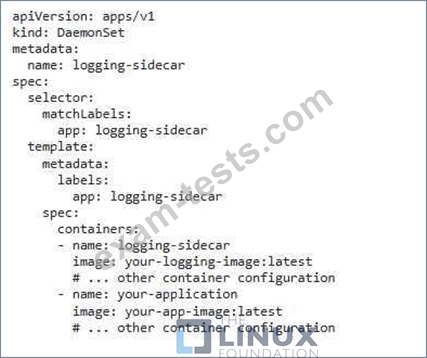
You have a web application tnat requires a dedicated sidecar container to manage logging and monitoring. The sidecar container should be deployed alongside every pod of the application. You need to ensure that the sidecar container is always available alongside the application pods, even if the main application container ex;mences failures. Which Kubernetes resource is most suitable for this scenario and wny?
Question 12
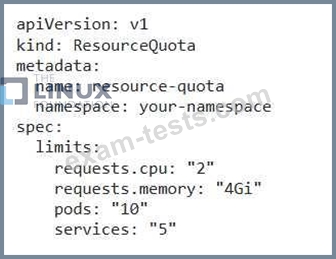
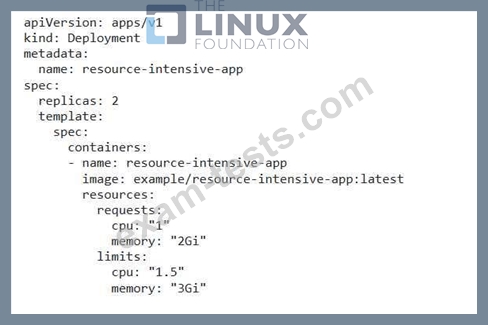
You are running a Kubernetes cluster with a limited number of nodes, and you want to deploy a new application that requires a lot of resources. You are concerned about potential resource contention and performance issues with other existing applications. How would you use resource quotas to manage resource usage and prevent potential issues?
Question 13
Refer to Exhibit.

Task:
1- Update the Propertunel scaling configuration of the Deployment web1 in the ckad00015 namespace setting maxSurge to 2 and maxUnavailable to 59
2- Update the web1 Deployment to use version tag 1.13.7 for the Ifconf/nginx container image.
3- Perform a rollback of the web1 Deployment to its previous version


Question 14
You are managing a Kubernetes cluster running a highly-available application that uses a custom resource called 'Orders. The 'orders resource is created and managed by a custom controller that ensures the order processing workflow runs flawlessly. However, the 'order' resource's validation rules have changed, requiring a new schema to be applied. How can you ensure that the existing 'Order' resources conform to the new schema without disrupting the application's functionality?


Question 15
You have a Deployment named 'my-app' that runs 3 replicas of a Python application. You need to implement a bluetgreen deployment strategy where only a portion of the traffic is directed to the new version of the application initially. After successful validation, you want to gradually shift traffic to the new version until all traffic is directed to it. You'll use a new image tagged for the new version.


