

Question 31
Context

Context
As a Kubernetes application developer you will often find yourself needing to update a running application.
Task
Please complete the following:
* Update the app deployment in the kdpd00202 namespace with a maxSurge of 5% and a maxUnavailable of 2%
* Perform a rolling update of the web1 deployment, changing the Ifccncf/ngmx image version to 1.13
* Roll back the app deployment to the previous version


Question 32
You are asked to prepare a canary deployment for testing a new application release.
You must connect to the correct host . Failure to do so may result in a zero score.
[candidate@base] $ ssh ckad00023
Modify the Deployments so that:
a maximum number of 10 Pods run in the moose namespace.
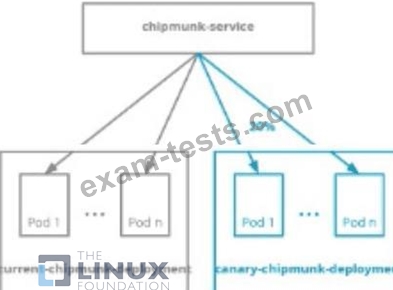
20% of the chipmunk-service 's traffic goes to the canary-chipmunk-deployment Pod (s).
The Service is exposed on NodePort 30000. To test its load- balancing, run
[candidate@ckad00023]
$ curl http://localhost:30000/
or open this URL in the remote desktop's browser.
You must connect to the correct host . Failure to do so may result in a zero score.
[candidate@base] $ ssh ckad00023
Modify the Deployments so that:
a maximum number of 10 Pods run in the moose namespace.
20% of the chipmunk-service 's traffic goes to the canary-chipmunk-deployment Pod (s).
The Service is exposed on NodePort 30000. To test its load- balancing, run
[candidate@ckad00023]
$ curl http://localhost:30000/
or open this URL in the remote desktop's browser.
Question 33
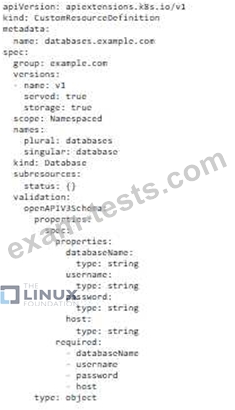
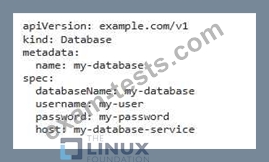
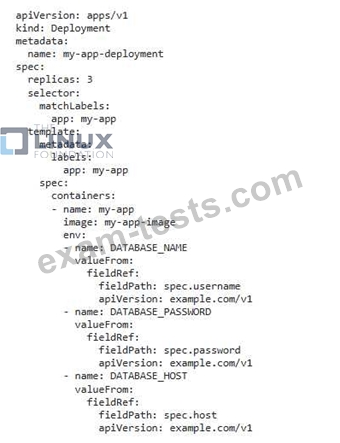
You have a Deployment named 'my-app-deployment' that runs 3 replicas of a Spring Boot application. This application needs to access a PostgreSQL database hosted on your Kubernetes cluster. You need to create a Custom Resource Definition (CRD) to define a new resource called 'Database' to represent the PostgreSQL database instances within your cluster. This CRD should include fields for specifying the database name, username, password, and the host where the database is deployed. Further, you need to configure the 'my- app-deployment' to use the 'Database' resource to connect to the PostgreSQL instance dynamically.
Question 34
You are managing a Kubernetes cluster with multiple teams working on different projects. Each team needs its own isolated environment within the cluster to deploy tneir applications and manage their resources witnout interfering With others. Describe how you would use Kubernetes namespaces to achieve this, and provide an example of how you might configure a namespace for a team working on a new e-commerce application.


Question 35
Exhibit:
Given a container that writes a log file in format A and a container that converts log files from format A to format B, create a deployment that runs both containers such that the log files from the first container are converted by the second container, emitting logs in format B.
Task:
* Create a deployment named deployment-xyz in the default namespace, that:
* Includes a primary
lfccncf/busybox:1 container, named logger-dev
* includes a sidecar Ifccncf/fluentd:v0.12 container, named adapter-zen
* Mounts a shared volume /tmp/log on both containers, which does not persist when the pod is deleted
* Instructs the logger-dev
container to run the command
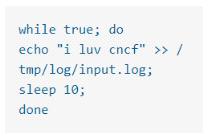
which should output logs to /tmp/log/input.log in plain text format, with example values:
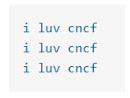
* The adapter-zen sidecar container should read /tmp/log/input.log and output the data to /tmp/log/output.* in Fluentd JSON format. Note that no knowledge of Fluentd is required to complete this task: all you will need to achieve this is to create the ConfigMap from the spec file provided at /opt/KDMC00102/fluentd-configma p.yaml , and mount that ConfigMap to /fluentd/etc in the adapter-zen sidecar container
Given a container that writes a log file in format A and a container that converts log files from format A to format B, create a deployment that runs both containers such that the log files from the first container are converted by the second container, emitting logs in format B.
Task:
* Create a deployment named deployment-xyz in the default namespace, that:
* Includes a primary
lfccncf/busybox:1 container, named logger-dev
* includes a sidecar Ifccncf/fluentd:v0.12 container, named adapter-zen
* Mounts a shared volume /tmp/log on both containers, which does not persist when the pod is deleted
* Instructs the logger-dev
container to run the command
which should output logs to /tmp/log/input.log in plain text format, with example values:
* The adapter-zen sidecar container should read /tmp/log/input.log and output the data to /tmp/log/output.* in Fluentd JSON format. Note that no knowledge of Fluentd is required to complete this task: all you will need to achieve this is to create the ConfigMap from the spec file provided at /opt/KDMC00102/fluentd-configma p.yaml , and mount that ConfigMap to /fluentd/etc in the adapter-zen sidecar container