

Question 41
A company's annual dividend has grown steadily at an annual rate of 3% for many years. It has a cost of equity of 11%. The share price is presently $64.38.
The company is about to announce its latest dividend, which is expected to be $5.00 per share.
The Board of Directors is considering an attractive investment opportunity that would have to be funded by reducing the dividend to $4.50 per share. The board expects the project to enable future dividends to grow by
5% every year and the cost of equity to remain unchanged.
Calculate the change in share price, assuming that the directors announce their intention to proceed with this investment opportunity.
Give your answer to 2 decimal places.
$ ?
The company is about to announce its latest dividend, which is expected to be $5.00 per share.
The Board of Directors is considering an attractive investment opportunity that would have to be funded by reducing the dividend to $4.50 per share. The board expects the project to enable future dividends to grow by
5% every year and the cost of equity to remain unchanged.
Calculate the change in share price, assuming that the directors announce their intention to proceed with this investment opportunity.
Give your answer to 2 decimal places.
$ ?
Question 42
A company wishes to raise new finance using a rights issue. The following data applies:
* There are 10 million shares in issue with a market value of $4 each
* The terms of the rights will be 1 new share for 4 existing shares held
* After the rights issue, the theoretical ex-rights price (TERP) will be $3.80 Assuming all shareholders take up their rights, how much new finance will be raised ?
Give your answer to one decimal place.
* There are 10 million shares in issue with a market value of $4 each
* The terms of the rights will be 1 new share for 4 existing shares held
* After the rights issue, the theoretical ex-rights price (TERP) will be $3.80 Assuming all shareholders take up their rights, how much new finance will be raised ?
Give your answer to one decimal place.
Question 43
An entity prepares financial statements to 30 June.
During the year ended 30 June 20X2 the following events occurred:
1 July 20X1
* The entitiy borrowed $100 million at a variable rate of interest.
* In order to protect itself against the variability of its interest cashflows, the entity entered into a pay-fixed-receive-variable interest swap with annual settlements. The fair value of the swap on this date was zero.
30 June 20X2
* The entity received a net settlement of $2 million under the swap. After this net settlement, the fair value of the swap was $5 million - a financial asset.
The entity decides to use hedge accounting for this arrangement and has designated it as a cash flow hedge. The swap is a perfect hedge of the variability of the cash interest payments.
Which of the following describes the treatment of the settlement and the change in the fair value of the swap in the statement of profit or loss and other comprehensive income for the year ended 30 June 20X2?
During the year ended 30 June 20X2 the following events occurred:
1 July 20X1
* The entitiy borrowed $100 million at a variable rate of interest.
* In order to protect itself against the variability of its interest cashflows, the entity entered into a pay-fixed-receive-variable interest swap with annual settlements. The fair value of the swap on this date was zero.
30 June 20X2
* The entity received a net settlement of $2 million under the swap. After this net settlement, the fair value of the swap was $5 million - a financial asset.
The entity decides to use hedge accounting for this arrangement and has designated it as a cash flow hedge. The swap is a perfect hedge of the variability of the cash interest payments.
Which of the following describes the treatment of the settlement and the change in the fair value of the swap in the statement of profit or loss and other comprehensive income for the year ended 30 June 20X2?
Question 44
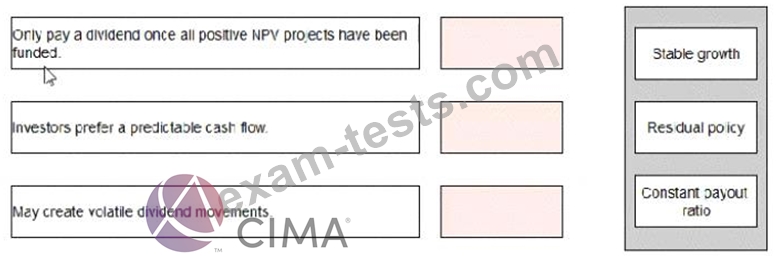
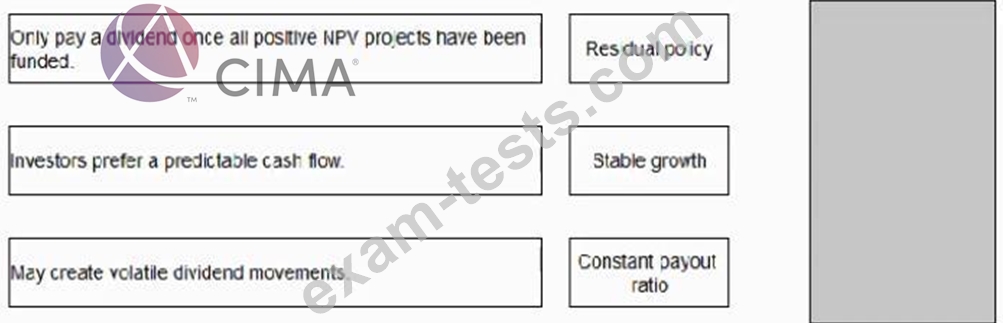
Select the most appropriate divided for each of the following statements:

Question 45
Company ABC is planning to bid for company DDD, an unlisted company in an unrelated industry sector to ABC.
The directors of ABC are considering a number of different valuation methods for DDD before making a bid.
Which of the following is the MOST appropriate method for ABC to use to value DDD?
The directors of ABC are considering a number of different valuation methods for DDD before making a bid.
Which of the following is the MOST appropriate method for ABC to use to value DDD?